
Severe upadacitinib-induced anemia in a multi-refractory Crohn’s disease patient – a case report
Authors:
A. Gojdičová
 ; I. Šturdík; J. Tóth
; S. Majna; J. Skubáková; M. Graňák-Pytliaková -; T. Hlavatý
; I. Šturdík; J. Tóth
; S. Majna; J. Skubáková; M. Graňák-Pytliaková -; T. Hlavatý
Authors place of work:
Gastroenterology Centre Bezručova, Bratislava
Published in the journal:
Gastroent Hepatol 2026; 80(4): 321-325
Category:
IBD: kazuistika
doi:
https://doi.org/10.48095/ccgh2026321
Summary
Background: Janus kinase (JAK) inhibitors represent an effective oral therapeutic option for moderate-to-severe inflammatory bowel disease (IBD) refractory to conventional and biologic agents. Hematological adverse events have been reported, but severe myelosuppression is uncommon and its clinical management – particularly the decision to continue therapy in patients who derive substantial benefit – remains a challenge. Case description: We report a 45-year-old female with colonic Crohn’s disease, multi-refractory to sequential treatment. Upadacitinib was initiated at the standard induction dose (45 mg q.d.), resulting in rapid clinical, biochemical and patient-reported remission within one month. Approximately four months into therapy, she developed grade 3 normocytic anemia with a hemoglobin level of 80 g/L. Despite this severity, the patient refused permanent discontinuation of upadacitinib because of profound symptomatic and quality-of-life improvement. After iterative dose adjustment, hemoglobin gradually recovered into the normal range. Clinical remission, mucosal healing and normalization of inflammatory markers were maintained. Conclusion: This case illustrates that severe upadacitinib-induced myelosuppression may be reversible by dose attenuation rather than permanent withdrawal, and highlights the central role of shared decision-making in IBD patients with limited remaining therapeutic alternatives. Close hematological monitoring is essential during JAK inhibitor therapy, especially in patients with multiple prior immunomodulator exposures.
Keywords:
upadacitinib – JAK inhibitor – Crohn’s disease – inflammatory bowel disease – myelosuppression – anemia – shared decision making – case report
Introduction
The therapeutic landscape of inflammatory bowel disease (IBD) has been transformed over the past two decades by anti-tumor necrosis factor (anti-TNFa) agents, anti-integrin molecules and anti--interleukin (IL) -12/23, and anti-IL-23 antibodies. Despite the expansion of biologic options, a substantial proportion of patients still experience primary non-response or secondary loss of response – reported in up to 30–40% across biologic classes [1,2]. For this group, oral small-molecule therapies targeting the Janus kinase (JAK) – signal transducer and activator of transcription (STAT) pathway have emerged as an important addition to the treatment protocol.
Upadacitinib (UPA) is a selective JAK1 inhibitor licensed for the treatment of moderate-to-severe ulcerative colitis and Crohn’s disease (CD) in patients who have failed or are intolerant to conventional or biologic therapy [3,4]. Its rapid onset of action and demonstrated efficacy on clinical, endoscopic, and histological end-points has been confirmed in the U-EXCEL, U-EXCEED, and U-ENDURE phase III trials [4,5].
Hematological adverse events including neutropenia, anemia, lymphopenia and – less frequently – thrombocytopenia have been reported with all currently available JAK inhibitors. Most events are mild-to-moderate (CTCAE grade 1–2), reversible upon dose interruption or reduction, and do not preclude long-term treatment continuation [6–9]. Grade ≥ 3 cytopenia is rare (< 1%) and clinical guidance on the optimal management strategy in patients with severe myelosuppression yet pronounced symptomatic benefit is limited.
We present the case of a young patient with multi-refractory colonic CD who developed grade 3 normocytic anemia during upadacitinib therapy. Despite the laboratory severity, the patient strongly advocated for continuation of treatment, and an individualized dose--attenuation strategy allowed maintenance of clinical remission with progressive hematological recovery.
Case description
Patient and disease history
A 45-year-old female (born 1979) was diagnosed in January 2018 with colonic Crohn’s disease. Initial presentation included diarrhea with blood and mucus admixture; colonoscopy demonstrated segmental colitis with multiple pseudopolyps from the hepatic flexure to the aboral sigmoid colon. Comorbidities included a history of suicidal attempt during corticosteroid therapy and azathioprine-induced leukopenia at 25 mg daily. Risk factors comprised of active smoking (12 cigarettes/day, unsuccessful cessation attempts) and occasional weekend alcohol consumption.
Sequential biologic therapy and treatment failures
Adalimumab was initiated in September 2018 with initial clinical remission lasting until January 2022, when secondary loss of response prompted a switch to ustekinumab. After a primary non-response to intensified ustekinumab (q. 8 weeks), vedolizumab was introduced in March 2022. In July 2022, a transsphincteric perianal fistula opened and endoscopy in November 2022 documented high mucosal inflammatory activity despite vedolizumab intensification to every 4 weeks.
In December 2022, the patient was switched to intravenous infliximab (5 mg/kg), achieving remission by February 2023 and was subsequently transitioned to subcutaneous infliximab 120 mg q. 2 weeks. Secondary loss of response was documented in September 2023 (undetectable anti-drug antibodies but sub-therapeutic trough levels) and the regimen was intensified to intravenous infliximab 10 mg/kg every 4 weeks with transient response.
In November 2024, after at least five lines of biologic therapy, profound articular and gastrointestinal symptoms severely impaired the patient’s mobility and quality of life. Upadacitinib was initiated at the standard induction dose (45 mg orally once daily).
Clinical response to upadacitinib
Within one month of upadacitinib initiation, the patient reported the most pronounced improvement since diagnosis: complete resolution of arthralgia and myalgia, formed stools without blood or mucus, absence of abdominal pain, weight gain, restoration of energy, and resolution of depressive symptoms. Inflammatory markers (CRP, fecal calprotectin) normalized. Concomitantly, however, surveillance hematology revealed progressive decline of hemoglobin.
Development of severe anemia and management
The hemoglobin trajectory throughout the patient’s biologic and small-molecule course is summarized in Graph 1. Before upadacitinib initiation, mean hemoglobin ranged between 122 and 145 g/L. After approximately four months on upadacitinib 45 mg, hemoglobin declined progressively to 80 g/L (grade 3 anemia, CTCAE v5.0). Iron, vitamin B12 deficiency, and hemolysis were excluded.
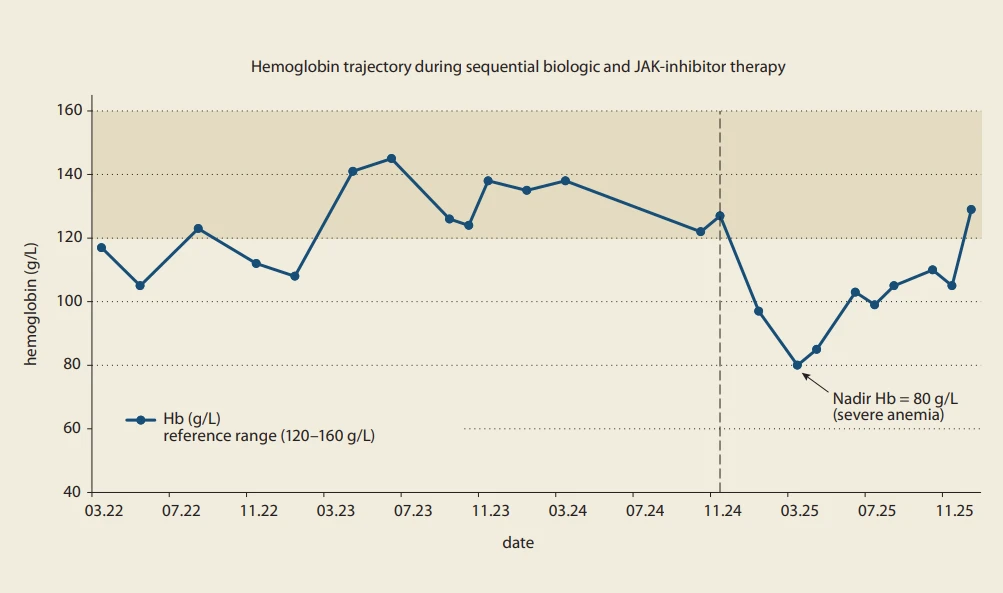
Upadacitinib dose was first reduced to 30 mg, and then temporarily discontinued; because of marked symptomatic deterioration during the washout period, the patient firmly requested resumption of treatment. An iterative re-introduction protocol was agreed: 15 mg every third day, followed by 15 mg every other day, then 15 mg daily, alternating 15/30 mg, and finally stable maintenance at 30 mg daily. Hemoglobin recovered progressively and reached 128 g/L at last follow-up. Clinical, biochemical, and endoscopic remission were maintained throughout (Graph 1).
Current status
At the last clinical encounter, the patient was asymptomatic with formed stools, sustained clinical and biochemical remission, mucosal healing on follow-up colonoscopy, and complete normalization of hemoglobin to 128 g/L. She has stopped smoking and alcohol consumption, resumed regular physical activity, and reports substantial improvement in social and psychological well-being.
Discussion
This case illustrates several clinically relevant aspects of JAK-inhibitor management in multi-refractory IBD:
i) the magnitude and rapidity of clinical response that upadacitinib can deliver in patients who have exhausted multiple biologic classes;
ii) the spectrum and reversibility of hematological adverse events; and
iii) the central role of patient autonomy and shared decision-making when therapeutic alternatives are limited.
Mechanistically, JAK1 inhibition by upadacitinib blocks cytokine signalling pathways mediated by IL-6, granulocyte–macrophage colony-stimulating factor (GM-CSF), and interferons – cytokines that contribute to the proliferation and maturation of hematopoietic progenitors. Unlike less selective JAK1/2 inhibitors used in myeloproliferative neoplasms, selective JAK1 blockade does not produce complete hematopoietic suppression [6,10]. Compensatory bone marrow adaptation – with increased precursor output and re-equilibration between differentiation and apoptosis – typically restores hematological homeostasis within 3–6 months of continued therapy.
Pooled data from the SELECT clinical trial program (SELECT-NEXT, SELECT--COMPARE, SELECT-MONOTHERAPY) and the U-EXCEL/U-EXCEED/U-ENDURE trials in IBD confirm a consistent hematological safety pattern [4,5,7]. Mild decreases in absolute neutrophil count (ANC 1.0–1.5 × 10⁹/L) were observed in 5–10% of patients, while clinically significant cytopenia of grade ≥ 3 occurred in < 1% of cases. Anemia of any grade was reported in 1–2% of patients, with severe anemia being exceptional. Most importantly, long-term extension data up to 5 years showed no cumulative hematotoxic effect [8].
Real-world evidence further supports the favorable hematological safety profile of upadacitinib. Analyses from the CorEvitas (United States), BIOBADASER (Spain), and DANBIO (Denmark) registries consistently report low rates of hematological adverse events; the majority of patients with initial declines in neutrophil count or hemoglobin achieved stabilization within 3–6 months without permanent discontinuation [11–13]. In patients with previous cytopenia (e. g., methotrexate - or thiopurine-related), more frequent monitoring is recommended, although no excess risk of irreversible bone marrow suppression has been documented.
In our patient, the magnitude of hemoglobin decline (DHb ≈ 47 g/L; nadir 80 g/L) exceeded what is typically reported in registration trials and real-world literature. Several contributing factors may have augmented the hematological response: prior azathioprine-induced leukopenia suggesting a degree of constitutional hematopoietic vulnerability and possibly higher individual upadacitinib exposure during the induction phase. Nonetheless, dose attenuation was sufficient to achieve hematological recovery while preserving clinical and endoscopic remission.
The decision to continue – rather than permanently discontinue – upadacitinib in this patient deserves comment. With at least five prior biologic exposures, including all major mechanisms of action available in Slovakia at the time, the therapeutic horizon was severely constrained. Withdrawal of upadacitinib would have meant either return to a sub-optimally effective biologic or consider surgical management. The patient explicitly weighed the trade-off between hematological risk and quality-of-life benefit, and – in the context of transparent counselling about potential adverse events – chose continuation. This experience aligns with current European consensus on the prominence of patient-reported outcomes and shared decision-making in IBD care [14,15].
Several practical lessons may be drawn for clinical practice. First, baseline and serial complete blood count monitoring during the first 6 months of JAK inhibitor therapy is essential, and patients with previous immunomodulator-related cytopenia warrant heightened vigilance. Second, severe myelosuppression may not mandate definitive discontinuation: dose attenuation, temporary interruption with re-introduction at a lower dose, and parallel correction of contributing factors (iron deficiency, vitamin B12, occult bleeding) can preserve treatment continuity. Third, in patients with limited therapeutic alternatives and substantial symptomatic benefit, the risk-benefit balance should be re-discussed jointly with the patient at every adjustment.
Conclusion
Severe anemia is an uncommon but clinically relevant adverse event of upadacitinib therapy in IBD. In this case of a multi-refractory Crohn’s disease patient with grade 3 normocytic anemia, an individualized, patient-driven dose-attenuation strategy enabled continuation of treatment, normalization of hemoglobin, and sustained clinical remission. The case underscores the importance of close hematological surveillance, structured dose-modification protocols, and shared decision-making when balancing severe adverse events against meaningful clinical benefit in patients with few remaining therapeutic options.
Submitted/Doručené: 21. 5. 2026
Accepted/Prijaté: 22. 6. 2026
Corresponding author
Anna Gojdičová, MD, PhD
Gastroenterology Centre Bezručova
Bezručova St. 2531/5
811 09 Bratislava
gojdicova@polibez.sk
Zdroje
1. Roda G, Jharap B, Neeraj N et al. Loss of response to anti-tnfs: definition, epidemiology, and management. Clin Transl Gastroenterol 2016; 7 (1): e135. doi: 10.1038/ctg.2015.63.
2. Ben-Horin S, Kopylov U, Chowers Y. Optimizing anti-tnf treatments in inflammatory bowel disease. Autoimmun Rev 2014; 13 (1): 24–30. doi: 10.1016/j.autrev.2013.06.002.
3. Sandborn WJ, Ghosh S, Panes J et al. Efficacy of upadacitinib in a randomized trial of patients with active ulcerative colitis. Gastroenterology 2020; 158 (8): 2139.e14–2149.e14. doi: 10.1053/j.gastro.2020.02.030.
4. Loftus EV, Panés J, Lacerda AP et al. Upadacitinib induction and maintenance therapy for crohn‘s disease. N Engl J Med 2023; 388 (21): 1966–1980. doi: 10.1056/NEJMoa2212728.
5. Danese S, Vermeire S, Zhou W et al. Upadacitinib as induction and maintenance therapy for moderately to severely active ulcerative colitis: results from three phase 3, multicentre, double-blind, randomised trials. Lancet 2022; 399 (10341): 2113–2128. doi: 10.1016/ S0140-6736 (22) 00581-5.
6. Panaccione R, Panés J, Peyrin-Biroulet L et al. Long-term safety of upadacitinib in patients with inflammatory bowel disease: integrated analysis of phase 2/3 studies. Clin Gastroenterol Hepatol. In press 2026. doi: 10.1016/j.cgh.2026.02.018.
7. Burmester GR, Cohen SB, Winthrop KL et al. Safety profile of upadacitinib over 15 000 patient-years across rheumatoid arthritis, psoriatic arthritis, ankylosing spondylitis and atopic dermatitis. RMD Open 2023; 9 (1): e002735. doi: 10.1136/rmdopen-2022-002735.
8. Fleischmann R, Swierkot J, Penn SK et al. Long-term safety and efficacy of upadacitinib versus adalimumab in patients with rheumatoid arthritis: 5-year data from the phase 3, randomised SELECT-COMPARE study. RMD Open 2024; 10 (2): e004007. doi: 10.1136/rmdopen-2023-004007.
9. Winthrop KL, Citera G, Gold D et al. Hematologic outcomes with upadacitinib: integrated analysis of phase 3 clinical trials. Ann Rheum Dis 2023; 82 (Suppl 1): A123.
10. Schwartz DM, Kanno Y, Villarino A et al. JAK Inhibition as a therapeutic strategy for immune and inflammatory diseases. Nat Rev Drug Discov 2017; 17 (1): 78. doi: 10.1038/nrd.2017.267.
11. Baker JF, Zueger P, Ali M et al. Real-World Use and Effectiveness Outcomes in Patients with Rheumatoid Arthritis Treated with Upadacitinib: An Analysis from the CorEvitas Registry. Rheumatol Ther 2024; 11 (2): 363–380. doi: 10.1007/s40744-024-00639-4.
12. Hernández-Cruz B, Otero-Varela L, Freire-González J et al. Janus kinase inhibitors and tumour necrosis factor inhibitors show a favourable safety profile and similar persistence in rheumatoid arthritis, psoriatic arthritis and spondyloarthritis: real-world data from the BIOBADASER registry. Ann Rheum Dis 2024; 83 (9): 1189–1199. doi: 10.1136/ard-2023-225271.
13. Faquetti ML, Vallejo-Yagüe E, Cordtz R et al. JAK-inhibitors and risk on serious viral infection, venous thromboembolism and cardiac events in patients with rheumatoid arthritis: A protocol for a prevalent new-user cohort study using the Danish nationwide DANBIO register. PLoS One 2023; 18 (7): e0288757. doi: 10.1371/journal.pone.0288757.
14. Raine T, Bonovas S, Burisch J et al. ECCO Guidelines on therapeutics in ulcerative colitis: medical treatment. J Crohns Colitis 2022; 16 (1): 2–17. doi: 10.1093/ecco-jcc/jjab178.
15. Lamb CA, Kennedy NA, Raine T et al. British society of gastroenterology consensus guidelines on the management of inflammatory bowel disease in adults. Gut 2019; 68 (Suppl 3): s1–s106. doi: 10.1136/gutjnl-2019-318484.
Štítky
Dětská gastroenterologie Gastroenterologie a hepatologie Chirurgie všeobecnáČlánek vyšel v časopise
Gastroenterologie a hepatologie
2026 Číslo 4
- VIDEO: Antibiotická léčba infekcí vyvolaných MDR bakteriemi – záznam semináře
- Kazuistika: Divertikulitida vs. Crohnova nemoc
- Idiopatické střevní záněty jsou spojeny se zvýšenou standardizovanou mortalitou
- Těhotenství a idiopatické střevní záněty – terapie zlepšuje stav a je bezpečná
- Vliv těhotenství na klinickou aktivitu Crohnovy nemoci
Nejčtenější v tomto čísle
- Výběr správného probiotika: od specifičnosti kmenů k racionálnímu klinickému využití
- Klinická a experimentální gastroenterologie
- Ťažká anémia vyvolaná upadacitinibom u pacienta s multirefraktérnou Crohnovou chorobou – kazuistika
- Farmakologická léčba obezity u kandidátů transplantace jater: první zkušenosti