
Global trends, regional disparities, and causes of maternal mortality – a systematic review
Authors:
T. C. Sabatine 1
 ; T. A. Durães 1
; D. M. Nagahashi 1
; Edward Araujo Júnior 1,2
; Antônio Braga 3-5
; D. A. C. Gomes 1
Authors place of work:
Discipline of Woman Health, Municipal University of São Caetano do Sul (USCS), São Caetano do Sul – SP, Brazil
1; Department of Obstetrics, Paulista School of Medicine, Federal University of São Paulo (EPM-UNIFESP), São Paulo – SP, Brazil
2; Department of Gynecology and Obstetrics, School of Medicine, Maternity School. Federal University of Rio de Janeiro (UFRJ), Rio de Janeiro – RJ, Brazil
3; Department of General and Specialized Surgery, School of Medicine and Surgery, Federal University of the State of Rio de Janeiro (UNIRIO), Rio de Janeiro – RJ, Brazil
4; Postgraduate Program in Applied Health Sciences, University of Vassouras (Univassouras), Vassouras – RJ, Brazil
5
Published in the journal:
Ceska Gynekol 2026; 91(5): 432-438
Category:
Přehledová práce
doi:
https://doi.org/10.48095/cccg2026432
Summary
Objective: To synthesize current evidence on global maternal mortality trends, focusing on regional disparities, leading causes of maternal death, and methodological challenges in estimating maternal mortality across different health system contexts. Methods: A systematic review was conducted following PRISMA guidelines. Searches were performed in PubMed/MEDLINE and SciELO using terms related to maternal mortality, health systems, and social determinants. Observational studies, systematic reviews, meta-analyses, and institutional reports with explicit methodology were included. Studies focusing only on morbidity, lacking clear methodology, or those not available in English or Portuguese were excluded. Data on maternal mortality ratios, trends, causes of death, and structural determinants were extracted and synthesized narratively due to methodological heterogeneity. Results: A total of 513 records were identified; after removing 173 duplicates, 340 were screened. Following title and abstract review, 299 records were excluded. Forty-one full-text articles were assessed, and 30 were excluded. Eleven studies were included in the qualitative synthesis (three observational studies, three systematic reviews/meta-analyses, and five institutional reports). Maternal mortality declined substantially between 1990 and 2015, but progress slowed thereafter. Approximately 287,000 maternal deaths occurred in 2020. Major regional disparities persist, with the highest burden in Sub-Saharan Africa. Hemorrhage, hypertensive disorders, and sepsis remain the leading direct causes, while indirect causes – especially cardiovascular disease – are increasingly relevant. Conclusion: Although maternal mortality has declined since 1990, progress has slowed and major regional inequalities persist. Indirect causes are becoming more prominent, and methodological differences complicate global estimates. Further reductions will require stronger healthcare systems, improved surveillance, and policies addressing social determinants of maternal health.
Keywords:
maternal mortality – global – healthcare systems – regional disparities
Introduction
Maternal mortality remains a major global health challenge despite substantial reductions over recent decades. Since 1990, expanded access to reproductive and obstetric care has contributed to declining maternal mortality ratios (MMR) worldwide [1,2]. However, progress has slowed in recent years, and many countries are unlikely to meet the Sustainable Development Goal (SDG) target of reducing the global MMR to fewer than 70 deaths per 100,000 live births by 2030. This burden is concentrated in low - and middle-income countries (LMICs), where more than 99% of maternal deaths occur and mortality ratios remain far above global targets [3–5].
The distribution of maternal mortality is highly uneven. Sub-Saharan Africa accounts for the majority of maternal deaths, with obstetric hemorrhage, hypertensive disorders of pregnancy, sepsis, and abortion-related complications as the leading causes. Indirect causes, including HIV/AIDS, also contribute significantly in this region. In contrast, countries with high sociodemographic index (SDI) levels report much lower MMRs, although progress has slowed and indirect causes represent a growing proportion of deaths [1,4,6–8].
These disparities reflect differences in health system capacity and broader social determinants. Limited access to antenatal care, skilled birth attendance, and emergency obstetric services remains a key barrier in many LMICs. Socioeconomic inequalities, adolescent fertility, and health system disruptions – such as conflict, epidemics, and disasters – further hinder progress in reducing maternal mortality [4,5,9,10].
This study aims to synthesize current evidence on global maternal mortality trends, focusing on regional disparities, leading causes of death, and methodological challenges in estimating maternal mortality across different health system contexts.
Methods
Search strategy
This study is a systematic review of the literature. The conduct and reporting of the study were guided by the PRISMA (Preferred Reporting Items for Systematic Reviews and Meta-Analyses) recommendations [11].
The literature search was conducted in PubMed/MEDLINE and Scientific Electronic Library Online (SciELO) databases. Controlled descriptors (MeSH and DeCS) and free terms were used, combined with the Boolean operators “AND” and “OR.” The search terms included “maternal mortality”, “maternal death”, “health systems”, and “social determinants of health”.
Observational studies, systematic reviews and meta-analyses, institutional reports with explicit methodology, and publications addressing temporal trends, causes of maternal death, or structural determinants were included. Studies were excluded if they focused exclusively on maternal morbidity without mortality analysis, consisted of case reports or small case series, lacked a clearly described methodology, or were not available in English or Portuguese.
The article selection process occurred in three stages: title screening, abstract screening, and full-text evaluation. Articles were assessed based on thematic relevance, methodological quality, and alignment with the objectives of the review.
Data extraction and synthesis
Information was extracted regarding the MMR, temporal trends, geographic distribution, main direct and indirect causes, statistical modeling strategies used, and associated structural factors (healthcare access, inequality, public policies, maternity leave, postpartum coverage). Data synthesis was conducted narratively and comparatively, given the methodological heterogeneity of the studies and institutional sources.
Ethical considerations
The present investigation is a systematic literature review of published data, so no patient informed consent was required.
Results
Included studies
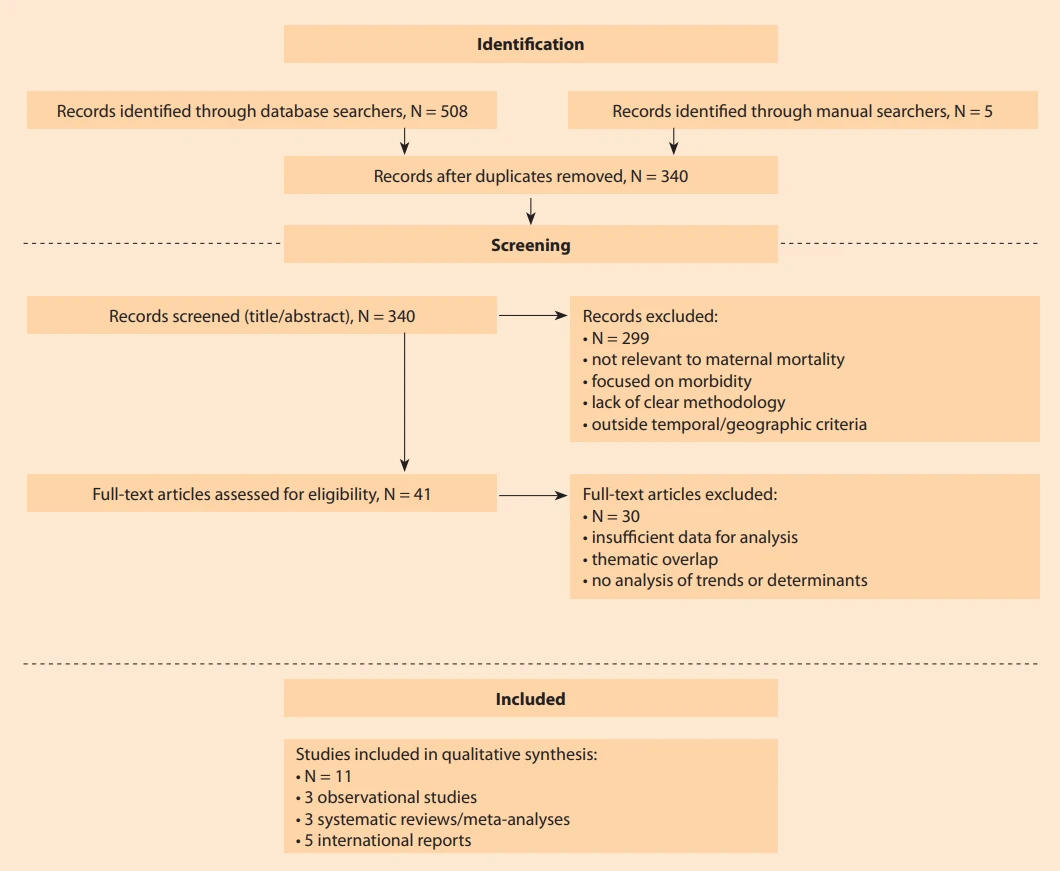
A total of 508 records were identified through electronic database searches. Additionally, five records were identified through manual searches of references and institutional documents (including international technical reports), resulting in a total of 513 records. After removing 173 duplicates, 340 records remained for screening. Titles and abstracts were assessed for eligibility, and 299 records were excluded for not addressing maternal mortality, focusing exclusively on morbidity, lacking clear methodology, or not meeting the defined temporal or geographic criteria. Forty-one articles were retrieved for full-text review. Thirty studies were excluded due to insufficient data for comparative analysis, thematic overlap without additional contribution, or absence of analysis of temporal trends or structural determinants. Ultimately, 11 studies were included in the qualitative synthesis – three observational studies, three systematic reviews or meta-analyses, and five international institutional reports (Fig. 1).
Global trends in maternal mortality
Maternal mortality declined substantially between 1990 and 2015, followed by a slower reduction in subsequent years. According to estimates from the World Health Organization (WHO), the global MMR decreased by approximately 34% between 2000 and 2020, from about 339 to 223 deaths per 100,000 live births. Despite this decline, the absolute number of maternal deaths remained high, reaching approximately 287,000 deaths in 2020 [12,13]. Estimates from the Global Burden of Disease Study also indicate a global downward trend in maternal mortality since 1990, although with a reduced pace of decline after 2015 [9].
Regional distribution
Maternal mortality remains unevenly distributed across regions. Sub-Saharan Africa accounts for approximately two-thirds of global maternal deaths, with maternal mortality ratios exceeding 500 deaths per 100,000 live births in some settings. In contrast, countries in Western Europe, Australia, and Japan report maternal mortality ratios below 10 deaths per 100,000 live births [12,14]. In 2020, developing countries reported an MMR of approximately 430 deaths per 100,000 live births, whereas developed countries reported approximately 12 deaths per 100,000 live births [12].
Within high-income countries, the United States recorded 18.8 maternal deaths per 100,000 live births between 2015 and 2019. This value is higher than that observed in Israel (2.75 per 100,000 live births) and above the European average of approximately 7 per 100,000 live births [12].
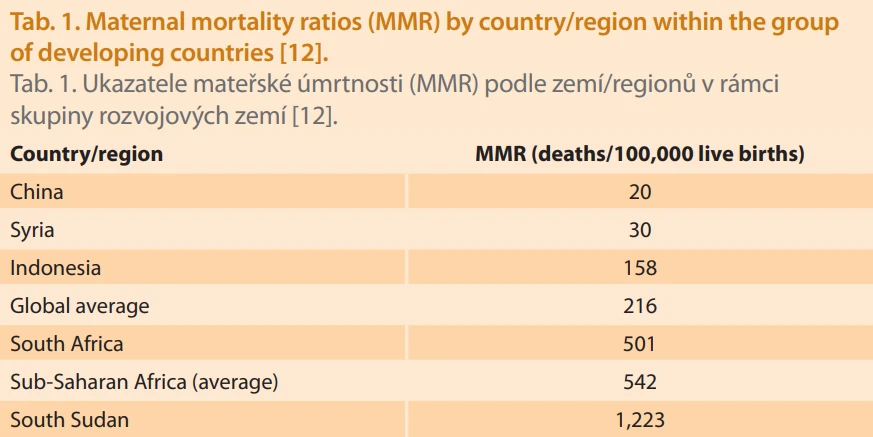
In developing countries, substantial variability is also observed. The MMR ranged from 30 deaths per 100,000 live births in Syria to 1,223 deaths per 100,000 live births in South Sudan in 2020 [13]. China reported an MMR of 20 in 2019, while South Africa reported 501 and Indonesia 158 in the same year (Tab. 1) [12].
Causes of maternal mortality
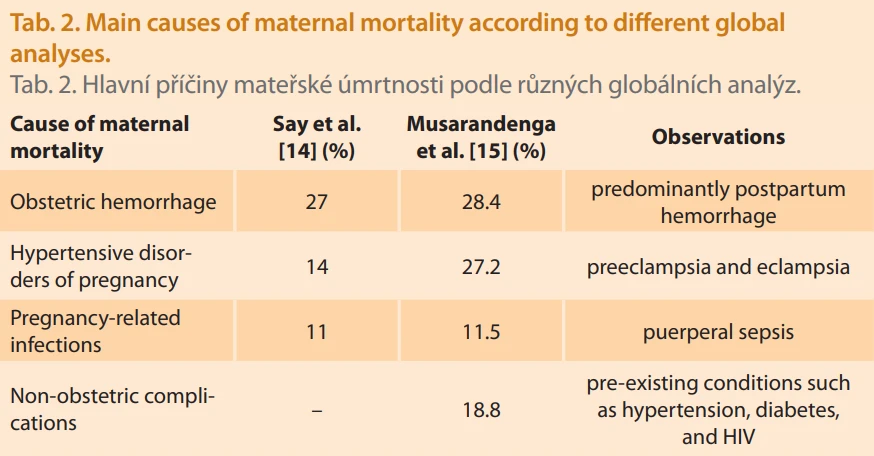
Global etiological analyses indicate that direct obstetric causes account for the majority of maternal deaths. Obstetric hemorrhage is the leading cause worldwide, responsible for approximately 27% of maternal deaths, followed by hypertensive disorders of pregnancy (14%) and sepsis (11%) [14].
In developing countries, obstetric hemorrhage accounts for approximately 28.4% of maternal deaths, hypertensive disorders of pregnancy for 27.2%, non-obstetric complications such as pre-existing chronic diseases and HIV for 18.8%, and pregnancy-related infections including puerperal sepsis for 11.5% [15].
In the United States, 52% of maternal deaths occur between the immediate postpartum period and six weeks after birth. The leading causes include cardiovascular diseases (15.3%), infections (13.3%), hemorrhage (11.1%), and hypertensive disorders (7.8%) (Tab. 2) [16].
Methodological characteristics of maternal mortality estimates
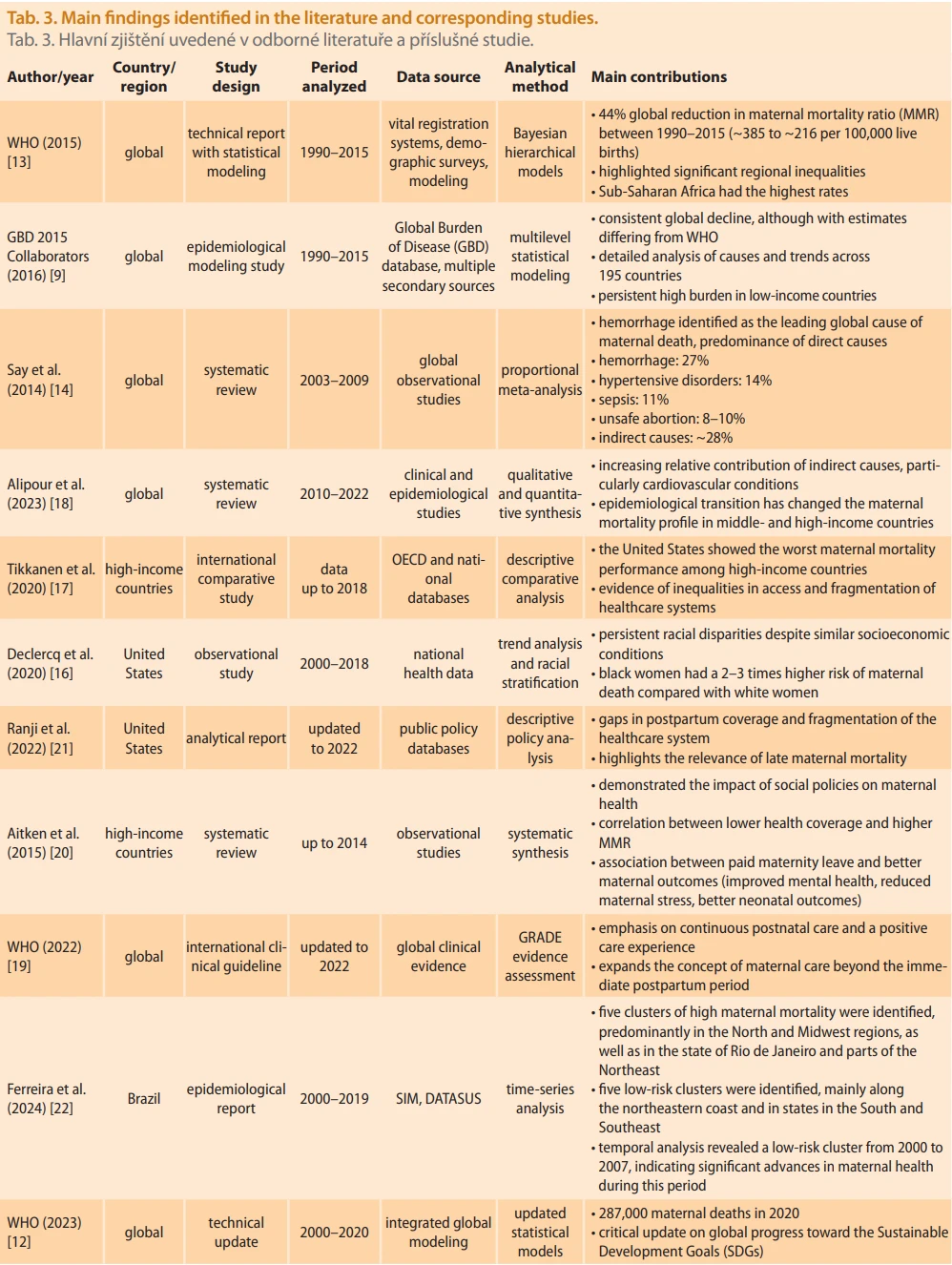
Differences in maternal mortality estimates have been reported between the World Health Organization and the Global Burden of Disease Study. Although both sources report declining global trends since 1990, differences in absolute values and annual rates of decline are observed [9,13]. The introduction of the ICD-MM classification system has provided a standardized framework for classifying maternal deaths and distinguishing between direct and indirect causes [13]. Tab. 3 summarizes the main findings identified in the literature and corresponding studies.
Discussion
This review synthesizes evidence from observational studies, systematic reviews, and international reports describing global trends, regional disparities, and causes of maternal mortality. The findings indicate a substantial global reduction in maternal mortality since 1990, although the pace of decline has slowed in recent years (Tab. 3).
One notable finding is the persistence of a high absolute number of maternal deaths despite declining mortality ratios. Population growth in many low - and middle-income countries contributes to maintaining a substantial burden of maternal deaths worldwide [14].
The decline observed between 1990 and 2015 has been associated with expanded access to skilled birth attendance, increased prenatal care coverage, and improvements in epidemiological surveillance systems. However, recent estimates suggest that several countries have reached a plateau in maternal mortality reduction, particularly in low - and middle-income settings. The COVID-19 pandemic has further disrupted maternal health services, affecting both service availability and healthcare utilization.
Marked regional disparities remain one of the most striking aspects of maternal mortality. The concentration of deaths in Sub-Saharan Africa contrasts sharply with the very low mortality ratios observed in many high-income countries. These differences reflect persistent inequalities in access to emergency obstetric care, availability of trained professionals, and overall health system capacity.
Even among high-income countries, considerable heterogeneity exists. The United States presents a maternal mortality ratio substantially higher than that observed in other developed countries and has shown an increasing trend in recent decades [17]. Studies have also documented significant racial disparities in maternal mortality, with Black women facing a two - to threefold higher risk of death compared with White women, even after adjustment for socioeconomic factors [16].
Another relevant finding concerns the growing contribution of indirect causes of maternal death, particularly cardiovascular disease, thromboembolism, and complications related to chronic conditions. This pattern is consistent with the ongoing epidemiological transition, increasing maternal age, and the rising prevalence of chronic diseases among women of reproductive age [18].
Methodological differences between global estimation systems also deserve attention. Discrepancies between WHO and Global Burden of Disease estimates arise primarily from different statistical modeling approaches, strategies for correcting underreporting, redistribution of ill-defined causes, and criteria used to include late maternal deaths. These differences are particularly relevant in countries with incomplete civil registration systems, where modeled estimates play a major role.
Structural determinants and public policies also appear to influence maternal mortality outcomes. Universal health coverage, access to emergency obstetric care, and effective integration across levels of care have been consistently associated with lower maternal mortality rates [19]. Additionally, social protection policies such as paid maternity leave have been linked to improved maternal health outcomes, particularly during the postnatal period [20].
Importantly, a considerable proportion of maternal deaths occurs beyond the immediate postpartum period, between 42 days and one year after delivery. Failures in continuity of care, fragmentation of healthcare systems, and limitations in postpartum coverage, especially within insurance-based systems, may contribute to these outcomes [21].
In Brazil, in a temporal trend analysis of maternal mortality between 2000 and 2019, it was observed that between 2000 and 2007 there was a notable decrease of the relative risk of maternal mortality, suggesting a period of protection and significant improvements in maternal health during this interval. However, some significant challenges persist for the reduction of maternal mortality in Brazil such as the regional inequalities and the impairments in the access to health services of quality and in the qualification of health professionals in poorer and remote regions [22].
Recent recommendations emphasize the need for a comprehensive postnatal care model that ensures continuous follow-up of both mother and newborn for up to 12 months after childbirth. Achieving sustained reductions in maternal mortality will likely require not only evidence-based clinical interventions but also broader social and health system policies aimed at reducing structural inequalities and ensuring continuity of care [19].
Conclusion
The integrated analysis of the included studies demonstrates that, although there was a significant reduction in maternal mortality between 1990 and 2015, global progress slowed considerably in the subsequent period. Estimates regarding the overall downward trend reveal methodological divergences that affect the magnitude of the estimates and the monitoring of international targets. Profound regional inequalities persist, with a disproportionate concentration of deaths in Sub-Saharan Africa, as well as marked disparities in high-income countries. The etiological profile has also undergone a relevant transition, with a proportional increase in indirect causes, particularly cardiovascular diseases, reflecting demographic and epidemiological changes. The findings indicate that strategies based exclusively on expanding healthcare coverage are insufficient to sustain additional significant reductions. Continuity of care during the postpartum period, integration between obstetric care and the management of chronic diseases, strengthening of surveillance systems, and the implementation of policies are essential components to accelerate the decline in maternal mortality. Given the observed slowdown and the recent impact of global health crises, achieving the Sustainable Development Goals target by 2030 will require not only the intensification of clinical interventions, but also structural transformation of health systems and consistent action to address the social determinants that sustain inequalities in maternal health.
Zdroje
1. Wei Y, Luo H, Liu X et al. Global, regional, and national levels of maternal mortality, 1990-2021: a systematic analysis for the Global Burden of Disease Study 2021. BMC Pregnancy Childbirth 2025; 25 (1): 1359. doi: 10.1186/s12884-025-08456-5.
2. Amouzou A, Barros AJ, Requejo J et al. The 2025 report of the Lancet Countdown to 2030 for women’s, children’s, and adolescents’ health: tracking progress on health and nutrition. Lancet 2025; 405 (10488): 1505–1554. doi: 10.1016/S0140-6736 (25) 00151-5.
3. Ward ZJ, Atun R, King G et al. Simulation--based estimates and projections of global, regional and country-level maternal mortality by cause, 1990–2050. Nat Med 2023; 29 (5): 1253–1261. doi: 10.1038/s41591-023-02310-x.
4. Black RE, Levin C, Walker N et al. Reproductive, maternal, newborn, and child health: key messages from Disease Control Priorities 3rd Edition. Lancet 2016; 388 (10061): 2811–2824. doi: 10.1016/S0140-6736 (16) 00738-8.
5. Kurjak A, Stanojević M, Dudenhausen J. Why maternal mortality in the world remains tragedy in low-income countries and shame for high-income ones: will sustainable development goals (SDG) help? J Perinat Med 2022; 51 (2): 170–181. doi: 10.1515/jpm-2022-0061.
6. Wang M, Zhou L, Tang W et al. Global burden of maternal disorders and mortality among female individuals aged 15–49 years, 1990–2021. Obstet Gynecol 2025; 146 (2): 255–266. doi: 10.1097/AOG.0000000000005980.
7. Huang J, Man Y, Shi Z et al. Global, regional, and national burden of maternal disorders, 1990–2021: a systematic analysis from the global burden of disease study 2021. BMC Public Health 2025; 25 (1): 2576. doi: 10.1186/s12889-025-23814-w.
8. Cresswell JA, Alexander M, Chong MY et al. Global and regional causes of maternal deaths 2009–20: a WHO systematic analysis. Lancet Glob Health 2025; 13 (4): e626–e634. doi: 10.1016/S2214-109X (24) 00560-6.
9. GBD 2015 Maternal Mortality Collaborators. Global, regional, and national levels of maternal mortality, 1990–2015: a systematic analysis for the Global Burden of Disease Study 2015. Lancet 2016; 388 (10053): 1775–1812. doi: 10.1016/S0140-6736 (16) 31470-2.
10. Lawrence ER, Klein TJ, Beyuo TK. Maternal mortality in low and middle-income countries. Obstet Gynecol Clin North Am 2022; 49 (4): 713–733. doi: 10.1016/j.ogc.2022.07.001.
11. Liberati A, Altman DG, Tetzlaff J et al. The PRISMA statement for reporting systematic reviews and meta-analyses of studies that evaluate health care interventions: explanation and elaboration. PLoS Med 2009; 6 (7): e1000100. doi: 10.1371/journal.pmed.1000100.
12. World Health Organization. Trends in maternal mortality 2000 to 2020: estimates by WHO, UNICEF, UNFPA, World Bank Group and UNDESA/Population Division. Geneva: World Health Organization 2023. [online]. Available from: https: //www.who.int/publications/i/item/9789240068759.
13. World Health Organization. Trends in maternal mortality: 1990 to 2015: estimates by WHO, UNICEF, UNFPA, World Bank Group and the United Nations Population Division. Geneva: World Health Organization 2015. [online]. Available from: https: //www.unfpa.org/publications/trends-maternal-mortality-1990-2015.
14. Say L, Chou D, Gemmill A et al. Global causes of maternal death: a WHO systematic analysis. Lancet Glob Health 2014; 2 (6): e323–e333. doi: 10.1016/S2214-109X (14) 70227-X.
15. Musarandega R, Nyakura M, Machekano R et al. Causes of maternal mortality in Sub-Saharan Africa: a systematic review of studies published from 2015 to 2020. J Glob Health 2021; 11 : 04048. doi: 10.7189/jogh.11.04048.
16. Declercq E, Zephyrin L. Maternal mortality in the United States: a primer. New York: The Commonwealth Fund 2020. [online]. Available from: https: //www.commonwealthfund.org/sites/default/files/2020-12/Declercq_maternal_mortality_primer_db.pdf.
17. Tikkanen R, Gunja MZ, FitzGerald M et al. Maternal mortality and maternity care in the United States compared to 10 other developed countries. New York: The Commonwealth Fund 2020. [online]. Available from: https: //www.commonwealthfund.org/publications/issue-briefs/2020/nov/maternal-mortality-maternity-care-us-compared-10-countries.
18. Alipour J, Payandeh A, Karimi A. Prevalence of maternal mortality causes based on ICD-MM: a systematic review and meta-analysis. BMC Pregnancy Childbirth 2023; 23 (1): 821. doi: 10.1186/s12884-023-06142-y.
19. World Health Organization. WHO recommendations on maternal and newborn care for a positive postnatal experience. Geneva: World Health Organization 2022. [online]. Available from: https: //www.who.int/publications/i/item/9789240045989.
20. Aitken Z, Garrett CC, Hewitt B et al. The maternal health outcomes of paid maternity leave: a systematic review. Soc Sci Med 2015; 130 : 32–41. doi: 10.1016/j.socscimed.2015.02.001.
21. Ranji U, Gomez I, Salganicoff A. Medicaid coverage of pregnancy-related services: findings from a 2021 state survey. San Francisco: Kaiser Family Foundation (KFF) 2022. [online]. Available from: https: //www.kff.org/report-section/medicaid-coverage-of-pregnancy-related-services-findings-from-a-2021-state-survey-report/.
22. Ferreira RC, Guedes SC, Moreira RS. Maternal mortality in Brazil: spatio-temporal analysis between 2000 and 2019. Rev Bras Saúde Mater Infant 2024; 24: e20230231. doi. 10.1590/1806-9304202400000231-en.
Štítky
Dětská gynekologie Gynekologie a porodnictví Reprodukční medicínaČlánek vyšel v časopise
Česká gynekologie
2026 Číslo 5
- I „pouhé“ doporučení znamená velkou pomoc. Nasměrujte své pacienty pod křídla Dobrých andělů
- Neuromodulace v terapii hyperaktivního močového měchýře – výsledky klinických studií a možnost náboru do studie
- Inosin pranobex v léčbě chřipky a dalších respiračních infekcí virové etiologie
- Dlouhodobá ketodieta může poškozovat naše orgány
- Stresová inkontinence moči se týká žen i mužů. Jak vypadají aktuální možnosti léčby?
Nejčtenější v tomto čísle
- Methylation test versus dual staining in the triage of HR-HPV positive women – pilot data from cervical cancer screening
- Transverse B-Lynch suture – specific modality of a uterine compression suture
- Hysteroscopic septum resection and reproductive outcomes – a retrospective cohort study
- Female ejaculation and squirting – definition, classification and differential diagnosis