
Hysteroscopic septum resection and reproductive outcomes – a retrospective cohort study
Authors:
Z. S. Özgül 1
 ; A. Ç. Madakbaş 2
; P. Yıldız 3
; G. Topçu⁴
; M. T. Alay⁵
; S. S. Karakuş⁶; R. Karakuş⁶
Authors place of work:
Department of Obstetrics and Gynecology, Umraniye Training and Research Hospital, Istanbul, Turkey
1; Department of Obstetrics and Gynecology, Faculty of Medicine, Düzce University, Düzce, Turkey
2
Published in the journal:
Ceska Gynekol 2026; 91(5): 390-394
Category:
Původní práce
doi:
https://doi.org/10.48095/cccg2026390
Summary
Objective: Uterine septum is one of the most common congenital uterine anomalies associated with infertility, recurrent pregnancy loss, and adverse reproductive outcomes. This study aimed to evaluate reproductive outcomes after hysteroscopic septum resection and to identify factors associated with live birth. Materials and methods: In this retrospective cohort study, 218 women who underwent hysteroscopic septum resection at a tertiary referral center in Istanbul between January 1, 2015 and August 31, 2020 were included. Among them, 160 had a history of infertility and 58 had a history of recurrent pregnancy loss. Demographic characteristics, preoperative and postoperative live birth outcomes, and pregnancy complications were obtained from hospital electronic records, the national e-Nabız system, and follow-up telephone interviews. Results: Among the overall cohort, the live birth rate increased from 17.4% before septum resection to 53.7% after the procedure (P < 0.001). In the infertility subgroup, the live birth rate increased from 10.6% to 46.9% (P < 0.001), whereas in the recurrent pregnancy loss subgroup it increased from 36.2% to 72.4% (P < 0.001). Patients who underwent repeat septum resection had a higher live birth rate than those who underwent a single procedure (74.0 vs. 44.0%, P < 0.001). Pregnancy complications were observed in 23.9% of pregnancies. Conclusion: Hysteroscopic septum resection may be associated with improved live birth outcomes in women with infertility or recurrent pregnancy loss. However, these findings should be interpreted cautiously given the retrospective design, and prospective studies are needed to define the benefit of surgical intervention.
Keywords:
hysteroscopy – reproductive outcomes – Mullerian anomaly – live birth – uterine septum
Introduction
Uterine septum is one of the most common congenital uterine anomalies and has been associated with adverse reproductive outcomes such as spontaneous abortion, preterm birth, malpresentation, and a decrease in live birth rates [1,2]. Although the underlying mechanism of this association has not been fully elucidated, reduced vascularization and impaired implantation in the septal tissue are the most commonly proposed explanations [3,4]. Due to its minimally invasive nature and low perioperative morbidity, hysteroscopic septum resection is a widely used surgical treatment option [5].
A diagnosis of uterine septum can be made using methods including ultrasound, hysterosalpingography, and magnetic resonance imaging. However, there is heterogeneity among studies due to differences in diagnostic criteria and classification systems. While it is generally accepted in the current literature that a uterine septum is associated with adverse obstetric outcomes, the independent effect of hysteroscopic septum resection, particularly on live birth and pregnancy loss, remains controversial. Although some studies have reported improvements in pregnancy outcomes following surgery, no definitive consensus has been reached on this matter [6].
The aim of this study is to evaluate the demographic and clinical characteristics of patients who underwent hysteroscopic septum resection at our clinic between 2015 and 2020, to analyze pregnancy and live birth outcomes, and to investigate factors that may be associated with procedural success.
Materials and methodology
Study design and participants
This retrospective cohort study was conducted between January 2015 and August 2020 at the Department of Obstetrics and Gynecology of a tertiary care hospital in Istanbul. A total of 323 patients who underwent hysteroscopic septum resection due to a uterine septum were evaluated. A total of 218 patients who met the predefined inclusion criteria were included in the study, while 105 patients were excluded. The reasons for exclusion were the presence of additional uterine anomalies (N = 36), intraoperative complications (N = 2), loss of desire for fertility after the procedure (N = 12), and insufficient data (N = 55). Data were obtained from hospital electronic records, the national E-Nabız system, and follow-up telephone interviews.
Data collection and surgical procedure
Patients’ age, height, weight, body mass index (BMI), obstetric history, presence of chronic diseases, history of previous uterine surgery, septum level, and number of resections performed were recorded. All patients underwent hysteroscopy in the early follicular phase. Prior to the procedure, 200 mcg of sublingual misoprostol was administered. The surgery was performed under general anesthesia in the dorsolithotomy position. Following cervical dilation, the septum was resected using a 5 mm, 30° hysteroscope and a plasmakinetic resectoscope until both tubal ostia were visible in the same plane. Intrauterine pressure was maintained between 80–100 mmHg, and the procedure was terminated when the fluid deficit reached 1,000 mL. All patients were monitored and followed up in the ward post-procedure.
Statistical analysis
Statistical analyses were performed using SPSS 25.0 software. Categorical variables were presented as counts and percentages, while continuous variables were presented as mean ± standard deviation or median (Min.–Max.), as appropriate. For comparisons of continuous variables, the independent samples T-test or the Mann-Whitney U-test was used; for categorical variables, the Chi-square test, McNemar’s test, and Fisher’s exact test were used. Cumulative pregnancy rates following septum resection were evaluated using Kaplan--Meier analysis. A P-value of < 0.05 was considered statistically significant.
Ethics approval and consent to participate
This retrospective study was approved by the Clinical Research Ethics Committee of Zeynep Kamil Women and Children’s Health Training and Research Hospital (Approval Number: 95, Date: April 21, 2021). The study was conducted by the principles of the Declaration of Helsinki.
Results
A total of 323 patients who underwent hysteroscopic septum resection due to a uterine septum between January 2015 and August 2020 were retrospectively evaluated; 218 patients who met the inclusion criteria were analyzed. Of these patients, 160 had a history of infertility, and 58 had a history of recurrent pregnancy loss.
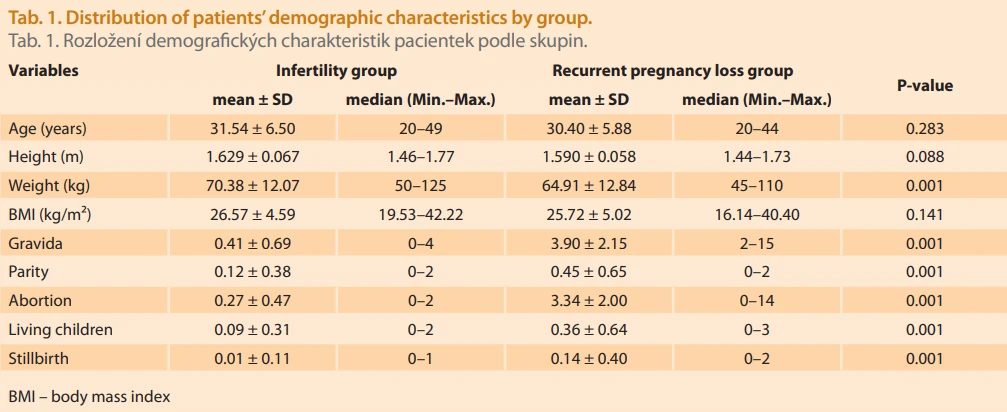
The demographic and obstetric characteristics of the participants are presented in Tab. 1. The mean age in the entire cohort was 31.7 ± 6.34 years, and the mean BMI was 26.34 ± 4.70 kg/m². No significant differences were found between the infertility and recurrent pregnancy loss groups in terms of age, height, and BMI. However, prior to resection, the number of pregnancies, births, abortions, live births, and stillbirths in the recurrent pregnancy loss group was significantly higher than in the infertility group (P < 0.001 for all comparisons).
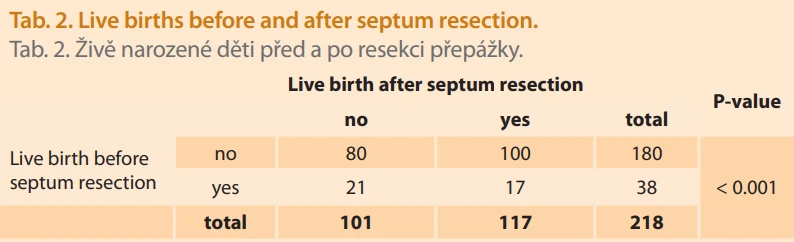
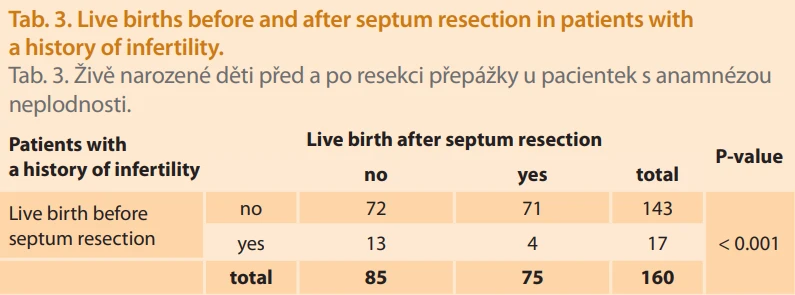
The live birth rate after septum resection increased significantly in the entire patient group compared to pre-procedure levels (P < 0.001, Tab. 2). Similarly, a significant increase in live birth rates was observed after resection in both the infertility group and the recurrent pregnancy loss group (P < 0.001 for both groups, Tab. 3).
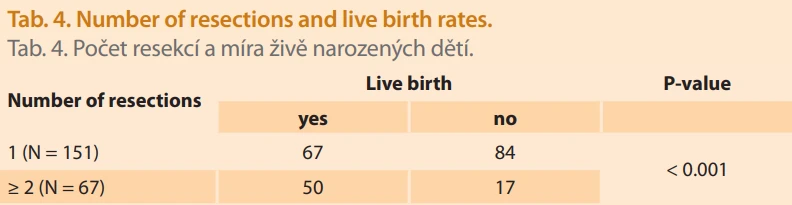
The live birth rate in patients who underwent repeated resections was significantly higher than in those who underwent a single-session resection (P < 0.001, Tab. 4).
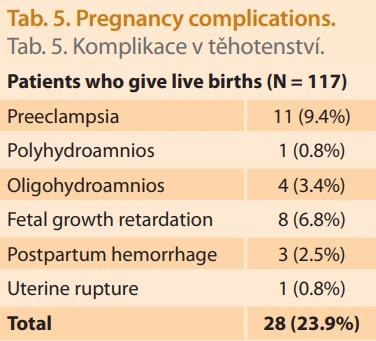
Pregnancy complications are summarized in Tab. 5. The most common complication in pregnancies following septum resection was preeclampsia; overall, at least one pregnancy complication was detected in 23.9% of patients. In addition, polyhydramnios, oligohydramnios, fetal growth restriction, postpartum hemorrhage, and uterine rupture were observed at lower rates.
Discussion
Uterine septum is one of the most common Müllerian anomalies and is associated with adverse reproductive outcomes such as pregnancy loss, preterm birth, malpresentation, and cesarean delivery [1,7]. However, the extent to which hysteroscopic septum resection improves reproductive outcomes remains controversial [8]. Although early observational studies generally reported favorable outcomes in favor of surgery, most of these studies had an uncontrolled before-after design and were therefore susceptible to selection bias [9,10]. Current guidelines and systematic reviews therefore interpret the benefits of surgery with greater caution [11].
In our study, an increase in the live birth rate was observed following septum resection. Although this finding appears consistent with previous retrospective series, it should be evaluated in light of current high-level evidence [12]. The 2024 ASRM guidelines state that septal incision may be considered, particularly in patients with recurrent pregnancy loss, and that in cases of infertility, the decision should be made through individualized counseling and shared decision-making. In contrast, a 2021 randomized controlled trial and a 2024 systematic review/meta-analysis failed to demonstrate a clear superiority of septum resection over expectant management in terms of live birth or overall reproductive outcomes. Therefore, the increase in live births observed in our series may have been influenced by factors such as patient selection, the retrospective design, and the absence of a control group [13,14].
Our study did not reveal a significant reduction in spontaneous abortion rates. This finding may be related to the multifactorial nature of pregnancy loss and the heterogeneity of patient group [15,16]. Indeed, current evidence does not show complete consensus on this matter [17]. While ASRM 2024 acknowledges that surgery may be beneficial in patients with recurrent pregnancy loss, Cochrane 2025 reports that existing randomized data show little or no difference in terms of live birth and ongoing pregnancy, and that non-randomized data have very low certainty [11,14]. Therefore, the lack of change in our abortion rates is not entirely inconsistent with the current literature.
While the improvement observed in the infertility subgroup is noteworthy, it is not appropriate to interpret this as direct evidence that septum resection increases fertility. Current guidelines emphasize that the relationship between a septate uterus and infertility is unclear and that evidence supporting the claim that surgery increases live births in infertile patients is limited [18]. Therefore, the decision to proceed with surgery in cases of infertility should be evaluated in conjunction with underlying causes of infertility, plans for assisted reproductive technology, history of pregnancy loss, and patient preference.
The finding that no significant difference was observed between the complete and incomplete septum subgroups in terms of live birth rate and time to conception is also consistent with the current literature. ASRM 2024 recommends that the size or shape characteristics of the septum alone should not be used to determine poor reproductive outcomes or to identify patients who would benefit from surgery [1,19]. This finding suggests that the impact of septal morphology on clinical outcomes may be limited.
Our study did not identify a significantly increased risk of obstetric complications, and the rate of malpresentation was found to be consistent with the literature. Malpresentation appears to be one of the areas where septum resection may offer potential benefits [19]. However, our high cesarean section rate may be related not only to anatomical or obstetric reasons but also to a lower threshold for cesarean section decisions – from both the patient’s and the physician’s perspectives – in patients with a history of infertility or pregnancy loss. A randomized study reported that surgery did not improve overall reproductive outcomes and that the potential for surgery-related harm should not be entirely disregarded [20].
In conclusion, our study suggests that there may be some positive reproductive outcomes following septum resection, particularly in a carefully selected patient group. However, current evidence indicates that this benefit cannot be consistently demonstrated in all patients, particularly with regard to live birth. Therefore, the decision to perform a septum resection should be individualized by evaluating recurrent pregnancy loss, infertility profile, obstetric history, and patient preference together. Future prospective and controlled studies conducted using standardized diagnostic criteria will more clearly identify which patient group truly benefits from surgery.
Strengths and limitations
The strengths of this study include a relatively large single-center cohort, a broadly uniform surgical approach, and a follow-up period long enough to evaluate live birth rather than only intermediate reproductive outcomes. However, several limitations should be acknowledged. First, the retrospective design may have introduced selection and information bias. Second, data on assisted reproductive technologies, male factor infertility, and endometrial factors were incomplete, which may have confounded the reproductive outcomes. Third, because the procedures were performed by different surgeons, variations in resection depth and surgical technique may have affected the results. Finally, since only the first postoperative pregnancy was included in the analysis, the cumulative reproductive potential may have been underestimated.
Conclusion
In conclusion, our findings suggest that hysteroscopic septum resection may be associated with improved live birth rates, longer gestational age, and higher birthweight in selected patients. However, these findings should be interpreted with caution given the retrospective design and the ongoing controversy in the literature regarding the independent effect of septum resection on reproductive outcomes. Although hysteroscopic resection is a minimally invasive procedure with low perioperative morbidity, its benefit may not be uniform across all patient groups. Further prospective, well-designed randomized controlled studies comparing surgical treatment with expectant management are needed to better define which patients are most likely to benefit from intervention
References
1. Practice Committee of the American Society for Reproductive Medicine. Evidence-based diagnosis and treatment for uterine septum: a guideline. Fertil Steril 2024; 122 (2): 251–265. doi: 10.1016/j.fertnstert.2024.02.033.
2. Grimbizis GF, Gordts S, Di Spiezio Sardo A et al. The ESHRE/ESGE consensus on the classification of female genital tract congenital anomalies. Hum Reprod 2013; 28 (8): 2032–2044. doi: 10.1093/humrep/det098.
3. Chan YY, Jayaprakasan K, Zamora J et al. The prevalence of congenital uterine anomalies in unselected and high-risk populations: a systematic review. Hum Reprod Update 2011; 17 (6): 761–771. doi: 10.1093/humupd/dmr028.
4. Pfeifer SM, Attaran M, Goldstein J et al. ASRM Müllerian anomalies classification 2021. Fertil Steril 2021; 116 (5): 1238–1252. doi: 10.1016/j.fertnstert.2021.09.025.
5. Chan YY, Jayaprakasan K, Tan A et al. Reproductive outcomes in women with congenital uterine anomalies: a systematic review. Ultrasound Obstet Gynecol 2011; 38 (4): 371–382. doi: 10.1002/uog.10056.
6. Parodi L, Hoxhaj I, Dinoi G et al. Complete uterine septum, double cervix and vaginal septum (U2b C2 V1): hysteroscopic management and fertility outcomes-a systematic review. J Clin Med 2022; 12 (1): 189. doi: 10.3390/jcm12010189.
7. Rikken JF, Verhorstert KW, Emanuel MH et al. Septum resection in women with a septate uterus: a cohort study. Hum Reprod 2020; 35 (7): 1578–1588. doi: 10.1093/humrep/dez284.
8. Woelfer B, Salim R, Banerjee S et al. Reproductive outcomes in women with congenital uterine anomalies detected by three-dimensional ultrasound screening. Obstet Gynecol 2001; 98 (6): 1099–1103. doi: 10.1016/s0029-7844 (01) 01599-x.
9. Paradisi R, Barzanti R, Natali F et al. Hysteroscopic metroplasty: reproductive outcome in relation to septum size. Arch Gynecol Obstet 2014; 289 (3): 671–676. doi: 10.10047/ s00404-013-3003-9.
10. Fedele L, Bianchi S, Marchini M et al. Residual uterine septum of less than 1 cm after hysteroscopic metroplasty does not impair reproductive outcome. Hum Reprod 1996; 11 (4): 727–729. doi: 10.1093/oxfordjournals.humrep.a019242.
11. Rikken JF, Kowalik CR, Emanuel MH et al. Septum resection for women of reproductive age with a septate uterus. Cochrane Database Syst Rev 2017; 1 (1): CD008576. doi: 10.1002/1465 1858.CD008576.pub4.
12. Saygili-Yilmaz ES, Erman-Akar M, Yilmaz Z. A retrospective study on the reproductive outcome of the septate uterus corrected by hysteroscopic metroplasty. Int J Gynaecol Obstet 2002; 78 (1): 59–60. doi: 10.1016/s0020-7292 (02) 00096-6.
13. Liu C, Liao Z, Gong X et al. Does septum resection improve reproductive outcomes for women with a septate uterus? A systematic review and meta-analysis. Front Endocrinol (Lausanne) 2024; 15 : 1361358. doi: 10.3389/fendo.2024.1361358.
14. Rikken JF, Kowalik CR, Emanuel MH et al. Septum resection versus expectant management in women with a septate uterus: an international multicentre open-label randomized controlled trial. Hum Reprod 2021; 36 (5): 1260–1267. doi: 10.1093/humrep/deab037.
15. Esmaeilzadeh S, Delavar MA, Andarieh MG. Reproductive outcome following hysteroscopic treatment of uterine septum. Mater Sociomed 2014; 26 (6): 366–371. doi: 10.5455/msm.2014.26.366-371.
16. Saygili-Yilmaz E, Yildiz S, Erman-Akar M et al. Reproductive outcome of septate uterus after hysteroscopic metroplasty. Arch Gynecol Obstet 2003; 268 (4): 289–292. doi: 10.1007/s00404-002-0378-4.
17. Bender Atik R, Christiansen OB, Elson J et al. ESHRE guideline: recurrent pregnancy loss: an update in 2022. Hum Reprod Open 2023; 2023 (1): hoad002. doi: 10.1093/hropen/hoad002.
18. Jiang Y, Wang L, Wang B et al. Reproductive outcomes of natural pregnancy after hysteroscopic septum resection in patients with a septate uterus: a systematic review and meta--analysis. Am J Obstet Gynecol MFM 2023; 5 (1): 100762. doi: 10.1016/j.ajogmf.2022.100762.
19. Saridogan E, Salman M, Direk LS et al. Reproductive performance following hysteroscopic surgery for uterine septum: results from a single-surgeon dataset. J Clin Med 2021; 10 (1): 130. doi: 10.3390/jcm10010130.
20. Kormányos Z, Molnár BG, Pál A. Removal of a residual portion of a uterine septum in women of advanced reproductive age: obstetric outcome. Hum Reprod 2006; 21 (4): 1047–1051. doi: 10.1093/humrep/dei438.
Contributions to authorship
ZSÖ, AÇM – concept.
ZSÖ, AÇM, PY – design.
ZSÖ, GT, MTA, SSK, RK – data collection and/or processing.
AÇM, PY, ZSÖ – analysis and/or interpretation.
ZSÖ, AÇM – literature search.
ZSÖ, AÇM – writing.
PY, GT, MTA, SSK, RK – critical review.
Zdroje
1. Practice Committee of the American Society for Reproductive Medicine. Evidence-based diagnosis and treatment for uterine septum: a guideline. Fertil Steril 2024; 122 (2): 251–265. doi: 10.1016/j.fertnstert.2024.02.033.
2. Grimbizis GF, Gordts S, Di Spiezio Sardo A et al. The ESHRE/ESGE consensus on the classification of female genital tract congenital anomalies. Hum Reprod 2013; 28 (8): 2032–2044. doi: 10.1093/humrep/det098.
3. Chan YY, Jayaprakasan K, Zamora J et al. The prevalence of congenital uterine anomalies in unselected and high-risk populations: a systematic review. Hum Reprod Update 2011; 17 (6): 761–771. doi: 10.1093/humupd/dmr028.
4. Pfeifer SM, Attaran M, Goldstein J et al. ASRM Müllerian anomalies classification 2021. Fertil Steril 2021; 116 (5): 1238–1252. doi: 10.1016/j.fertnstert.2021.09.025.
5. Chan YY, Jayaprakasan K, Tan A et al. Reproductive outcomes in women with congenital uterine anomalies: a systematic review. Ultrasound Obstet Gynecol 2011; 38 (4): 371–382. doi: 10.1002/uog.10056.
6. Parodi L, Hoxhaj I, Dinoi G et al. Complete uterine septum, double cervix and vaginal septum (U2b C2 V1): hysteroscopic management and fertility outcomes-a systematic review. J Clin Med 2022; 12 (1): 189. doi: 10.3390/jcm12010189.
7. Rikken JF, Verhorstert KW, Emanuel MH et al. Septum resection in women with a septate uterus: a cohort study. Hum Reprod 2020; 35 (7): 1578–1588. doi: 10.1093/humrep/dez284.
8. Woelfer B, Salim R, Banerjee S et al. Reproductive outcomes in women with congenital uterine anomalies detected by three-dimensional ultrasound screening. Obstet Gynecol 2001; 98 (6): 1099–1103. doi: 10.1016/s0029-7844 (01) 01599-x.
9. Paradisi R, Barzanti R, Natali F et al. Hysteroscopic metroplasty: reproductive outcome in relation to septum size. Arch Gynecol Obstet 2014; 289 (3): 671–676. doi: 10.10047/ s00404-013-3003-9.
10. Fedele L, Bianchi S, Marchini M et al. Residual uterine septum of less than 1 cm after hysteroscopic metroplasty does not impair reproductive outcome. Hum Reprod 1996; 11 (4): 727–729. doi: 10.1093/oxfordjournals.humrep.a019242.
11. Rikken JF, Kowalik CR, Emanuel MH et al. Septum resection for women of reproductive age with a septate uterus. Cochrane Database Syst Rev 2017; 1 (1): CD008576. doi: 10.1002/1465 1858.CD008576.pub4.
12. Saygili-Yilmaz ES, Erman-Akar M, Yilmaz Z. A retrospective study on the reproductive outcome of the septate uterus corrected by hysteroscopic metroplasty. Int J Gynaecol Obstet 2002; 78 (1): 59–60. doi: 10.1016/s0020-7292 (02) 00096-6.
13. Liu C, Liao Z, Gong X et al. Does septum resection improve reproductive outcomes for women with a septate uterus? A systematic review and meta-analysis. Front Endocrinol (Lausanne) 2024; 15 : 1361358. doi: 10.3389/fendo.2024.1361358.
14. Rikken JF, Kowalik CR, Emanuel MH et al. Septum resection versus expectant management in women with a septate uterus: an international multicentre open-label randomized controlled trial. Hum Reprod 2021; 36 (5): 1260–1267. doi: 10.1093/humrep/deab037.
15. Esmaeilzadeh S, Delavar MA, Andarieh MG. Reproductive outcome following hysteroscopic treatment of uterine septum. Mater Sociomed 2014; 26 (6): 366–371. doi: 10.5455/msm.2014.26.366-371.
16. Saygili-Yilmaz E, Yildiz S, Erman-Akar M et al. Reproductive outcome of septate uterus after hysteroscopic metroplasty. Arch Gynecol Obstet 2003; 268 (4): 289–292. doi: 10.1007/s00404-002-0378-4.
17. Bender Atik R, Christiansen OB, Elson J et al. ESHRE guideline: recurrent pregnancy loss: an update in 2022. Hum Reprod Open 2023; 2023 (1): hoad002. doi: 10.1093/hropen/hoad002.
18. Jiang Y, Wang L, Wang B et al. Reproductive outcomes of natural pregnancy after hysteroscopic septum resection in patients with a septate uterus: a systematic review and meta--analysis. Am J Obstet Gynecol MFM 2023; 5 (1): 100762. doi: 10.1016/j.ajogmf.2022.100762.
19. Saridogan E, Salman M, Direk LS et al. Reproductive performance following hysteroscopic surgery for uterine septum: results from a single-surgeon dataset. J Clin Med 2021; 10 (1): 130. doi: 10.3390/jcm10010130.
20. Kormányos Z, Molnár BG, Pál A. Removal of a residual portion of a uterine septum in women of advanced reproductive age: obstetric outcome. Hum Reprod 2006; 21 (4): 1047–1051. doi: 10.1093/humrep/dei438.
Štítky
Dětská gynekologie Gynekologie a porodnictví Reprodukční medicínaČlánek vyšel v časopise
Česká gynekologie
2026 Číslo 5
- I „pouhé“ doporučení znamená velkou pomoc. Nasměrujte své pacienty pod křídla Dobrých andělů
- Neuromodulace v terapii hyperaktivního močového měchýře – výsledky klinických studií a možnost náboru do studie
- Inosin pranobex v léčbě chřipky a dalších respiračních infekcí virové etiologie
- Dlouhodobá ketodieta může poškozovat naše orgány
- Stresová inkontinence moči se týká žen i mužů. Jak vypadají aktuální možnosti léčby?
Nejčtenější v tomto čísle
- Metylační test versus duální barvení v triáži HR-HPV pozitivních žen – pilotní data ze screeningu karcinomu děložního hrdla
- Transverzální B-Lynchův steh – specifická modalita kompresního stehu dělohy
- Hysteroskopická resekce septa a reprodukční výsledky – retrospektivní kohortová studie
- Ženská ejakulace a squirting – definice, klasifikace a diferenciální diagnostika