
Hypothermia in the home setiing – case report
Authors:
Lucia Moravčíková 1; Ján Bajaj 1; Ubomír Straka 1,2
Authors place of work:
Department of Forensic Medicine and Pathological Anatomy of Health Care Surveillance Authority in Martin
1; Department of Forensic Medicine and Medicolegal Expertise of Jessenius Medical Faculty of Commenius University in Martin
2
Published in the journal:
Soud Lék., 71, 2026, No. 2, p. 12-15
Category:
Původní práce
Summary
In the present case report, the authors describe the deaths of two individuals—an 85-year-old female and her 56-year-old son – both discovered within a shared household, exhibiting advanced postmortem changes. The fatalities occurred in a confined apartment environment. The decedents had been residing under conditions of extreme environmental neglect, characterized by prolonged accumulation of domestic waste and an almost complete absence of interaction with the external community. Postmortem examinations revealed morphological indicators consistent with hypothermia, including pale postmortem lividity, frostbite lesions, and Visnevsky’s spots within the gastric mucosa. The terminal causes of death in both cases were determined to be combined cardiovascular and respiratory failure secondary to hypothermia. Relevant comorbidities were identified: in the female, predominantly chronic cardiac and hepatic pathology; in the male, marked malnutrition. In both individuals, ethanol was detected in postmortem blood specimens at concentrations consistent with endogenous production during the late stages of decomposition. In both cases, different degrees of development of hypothermia-related Visnevsky spots were observed, which the authors explain by different reserve capacities of the organism.
Keywords:
Hypothermia – Death of two individuals – socially disadvantaged environment
Hypothermia is a systemic condition where the core body temperature drops below the level required for normal metabolic functioning (35°C) (1,2). People who are immobile, have blood loss, suffer from malnutrition, or are affected by the toxic effects of alcohol and psychoactive substances (especially those with a sedative effect, such as sedatives and hypnotics) are more susceptible to hypothermia (1,3).
In the initial stages, the body responds with muscle shivering to generate new heat and increased urine production. Subsequently, subjective feelings of warmth may occur, followed by loss of consciousness. Serious heart rhythm disturbances can develop, progressing to ventricular fibrillation and ultimately cardiac arrest. A critical body temperature is considered to be between 26-27°C (2,3,4).
For the diagnosis of hypothermia, Visnevský spots (Visnevsky’s spots) are important, referring to vital exposure to low temperatures, which were introduced into forensic practice as early as the end of the 19th century. (1,5)
Sometimes in hypothermia, paradoxical behavior may occur, such as undressing, where the affected person removes clothing that may be away from the body (2,3). The process of human hypothermia is divided into four phases; during the 2nd and 3rd phases (core temperature 33-30°C and 30-27°C), consciousness is affected, mostly as apathy and confusion, later resulting in pleasant sensory experiences usually associated with a subjective feeling of warmth (2,3).
Stereotypical phenomena like the „hiding effect“ can also be observed, where the hypothermic person seeks shelter, shows stereotyped movements (such as curling into a protective body position with limb flexion and covering oneself with clothing or objects), or displays involuntary, purposeless movements (6).
The immediate cause of death in hypothermia is usually cardiac failure due to impaired contractility (contraction) of the heart muscle, related directly to the cold’s effect – ventricular fibrillation, a severe arrhythmia. Death is also facilitated by metabolic disruption.
CASE REPORT
In this case, it involved an 85-year-old woman (A. J.), with no known medical history, who had been living for a long time with her 56-year-old son (M. J.) in the apartment where the bodies were found (Fig. 1,2). Reportedly, she had not left the apartment for years; her son, who was also supposed to be retired, handled all errands, frequently visited gaming rooms and local pubs. In the days leading up to the discovery of their bodies, neighbors noticed that no one had been leaving the apartment for a long time, so they contacted the police. The apartment door was locked from the inside; the apartment was opened by members of the Police Force of the Slovak Republic together with members of the Fire and Rescue Corps.
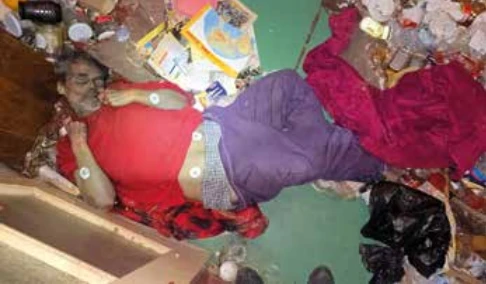
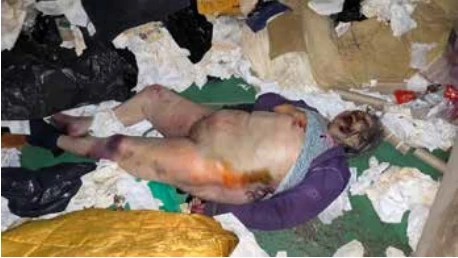
The interior of the apartment was in a severely neglected state, with an extreme amount of accumulated items and trash, because they were so-called „hoarders“. The trash consisted of clothing, newspapers, food remnants, components of electronics, and municipal waste. Empty containers and blisters from medications such as warfarin, detralex, and riboflavin were also found in the apartment.
The bodies were found in different rooms, and were in the late stages of postmortem changes, but without apparent traumatic injuries. Given the unclear circumstances of death, autopsies were ordered in accordance with the Criminal Procedure Code.
AUTOPSY
Cause of Death – A. J.
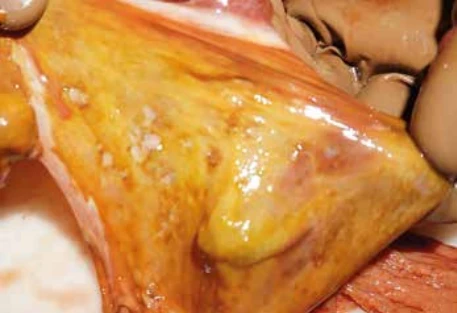
The immediate cause of death in A. J. was failure of the cardiovascular and respiratory systems due to hypothermia, occurring in the context of pathological changes with associated complications. The complications included frostnip to first‑degree frostbite involving both elbows, the dorsal aspects of the hands, and the knees; pale post‑mortem lividity; Visnevski spots (gastric mucosal hemorrhages) in the stomach (Fig. 3); cerebral edema; pulmonary edema; subpleural petechial hemorrhages; unclotted blood in the vessels; and advanced putrefactive changes of the skin.
The most significant pathological findings were obesity (body height 156 cm, body weight 89 kg), generalized atherosclerosis of moderate to severe degree, triple‑vessel coronary artery disease, left ventricular hypertrophy (heart weight 410 g), myocardial fibrosis (focal scarring of the myocardium), aneurysm of the ascending aorta, and hepatic cirrhosis.
Histological examination confirmed the vitality of the above‑described changes, the presence of characteristic gastric mucosal hemorrhages, and somatic organ diseases that directly contributed to death.
Cause of Death – M. J.
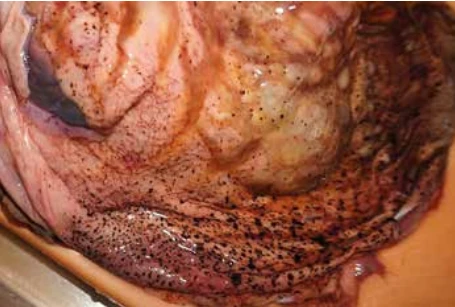
The immediate cause of death in M. J. was failure of the cardiovascular and respiratory systems due to hypothermia with associated complications, including frostnip, pale post‑mortem lividity, pulmonary and cerebral edema, Visnevsky spots in the stomach (Fig. 4), subpleural petechial hemorrhages, and putrefactive changes of the skin and internal organs. Additional findings included undernutrition (body height 164 cm, body weight 54 kg) and trophic changes of the right lower leg.
Histological examination confirmed the vitality of the above‑described changes, the presence of characteristic gastric mucosal hemorrhages, mild perivascular and interfascicular fibrosis of the myocardium, and chronic bronchitis with chronic pulmonary emphysema.
Toxicology findings:
Blood ethanol concentration in A. J. was 0.27 g/kg (‰). In M. J., the blood ethanol concentration was 0.50 g/kg (‰) and urine ethanol concentration was 0.22 g/kg (‰). Toxicological screening for psychoactive substances was negative in both individuals.
It was determined with certainty that the measured ethanol concentrations in both decedents were partially the result of post‑mortem ethanol production during the interval between death and autopsy. In M. J., borderline blood ethanol levels – corresponding to a state ranging from post‑ingestion to light intoxication – at the time of death could not be excluded.
Toxicological analyses, including immunochromatography followed by gas chromatography‑mass spectrometry (GC‑MS) confirmation, were negative for drugs and psychoactive substances in both case.
DISCUSSION
In this case, within the time frame from the autopsy to the submission of expert reports, the officers of the Police Force of the Slovak Republic were unable to gather any relevant investigated circumstances that would have fundamentally contributed to the knowledge already obtained at the scene, or that would contradict the autopsy findings.
Since the temperature in the apartment was practically the same and the body of the male displayed more advanced signs of decomposition than that of the female, it is most likely that the death of M. J. occurred somewhat earlier than the death of A. J., (determining the moment of death based on body analysis is difficult task (7)), who probably attempted to move from her room to the living room and then to the small hallway with the entrance door. However, due to the nature of the environment and her associated pathological conditions, she was unable to do so, and subsequently, she also died.
The occurrence and intensity of Visnevsky spots in deaths caused by hypothermia are significantly influenced by age and the individual‘s overall health condition (8). In younger people, the relatively good elasticity of blood vessels and the higher functional capacity of thermoregulatory and autonomic mechanisms (reactivity of vessels and gastric mucosa) are usually preserved (9). This may explain why in M. J.’s case, they were more pronounced. In older individuals, involutional and pathological changes (atherosclerotic damage to blood vessels, reduced vascular reactivity, atrophic gastritis) are significantly involved in the pathogenesis. These factors reduce the intensity of acute vasomotor and mucosal reactions. Therefore, Visnevsky spots in this age group are indistinct, diffuse, or may even be absent
From a forensic point of view, it is therefore essential to interpret the finding of Visnevsky spots in the gastric mucosa always in the context of the individual’s age and overall health condition. In younger individuals, they may represent a distinct and characteristic sign of hypothermia, while in older individuals, their occurrence is less reliable and may lead to underestimation of this finding when determining the cause of death.
In connection with Greek mythology, the death of two people (in a familial relationship – for example husband and wife) at the same place (in one place of residence) is called the „Baucis and Philemon phenomenon” – meaning the simultaneous death of two people from pathological (health impairment) causes (10). In this case, pathological causes contributed to death, especially in the deceased woman, but were not the primary cause.
CONCLUSION
As a result of the effect of ambient natural cold on the organism, the body‘s ability to retain heat (maintain body temperature) and vital functions become exhausted, followed by central asphyxiation and depletion of glycogen stores, resulting in the onset of serious cardiac rhythm disturbances, leading to failure of the cardiovascular and respiratory systems, and ultimately death. In the case of A. J., comorbidities significantly contributed to death; in the case of M. J., especially malnutrition.
Cases of death due to hypothermia in forensic medicine are observed not only outdoors, which might be expected especially among homeless individuals, but are also relatively often encountered in deaths occurring inside buildings – apartments, houses, or utility buildings. These fatalities predominantly occur in individuals with comorbidities (or immobilizing comorbidities), adverse social conditions, or in those consuming alcohol and sedative psychoactive substances.
CONFLICT OF INTEREST
The authors declare that there is no conflict of interest regarding the publication of this paper.
Zdroje
1. Šidlo, M. Súdne lekárstvo. 1. vydanie, Univerzita Komenského v Bratislave, Lekárska fakulta, Ústav súdneho lekárstva, 2020. Elektronická publikácia
2. Vorel, F. Soudní lékařství. Praha, Grada Publishing; 1999.
3. Štefan, J., Hladík, J. Soudní lékařství a jeho moderní trendy. In: Štefan, J. a kol., eds. Soudní lékařství a jeho moderní trendy, Praha, Grada Publishing; 2012.
4. Hirt, M. Soudní lékařství. I. díl. In: Hirt, M. a kol., eds. Soudní lékařství. I. díl. Praha, Grada Publishing; 2015.
5. Hejna P. Soudnělékařská diagnostika celkového prochlazení organismu. In: Soudní lékařství – výukové materiály. 1. LF UK Praha; 2019. Dostupné z: https://www.lf1.cuni.cz/file/84928/jr-doc-hejnateze.pdf
6. Rothschild, M. A., & Schneider, V. Terminal burrowing behaviour — a phenomenon of lethal hypothermia. International Journal of Legal Medicine 1995; 107(5): 250–256.
7. Bachynskyi V., Vanchulyak O., Pavlyukovich O., Sarkisova Y. Forensic medical possibilities of determining the post-mortem interval. Folia societatis medicinae legalis Slovacae 2024; 14(1): 11-13.
8. Sacco, M. A., Abenavoli, L., Juan, C., & Aquila, I. Biological mechanisms behind Wischnewsky spots finding on gastric mucosa: autopsy cases and literature review. International Journal of Environmental Research and Public Health 2022; 19(12): 7365.
9. Cowan, J. A., Kenshalo, D. R. Jr., & others. Age-related thermoregulatory differences during core cooling in humans. Journal of Applied Physiology 1999; 87(2): 634–642.
10. Sottmann, L., & Schmeling, A. Philemon and Baucis death: a literature review. International Journal of Legal Medicine 2024; 138(3): 1011–1021.
Štítky
Patologie Soudní lékařství ToxikologieČlánek vyšel v časopise
Soudní lékařství
2026 Číslo 2
Nejčtenější v tomto čísle
- Smrteľné úrazy detí pri rekreačnom lyžovaní: popis dvoch prípadov a medziodborové súvislosti
- Hypotermie v domácím prostředí - kazuistika