
Impact of the war in Ukraine on HIV-1 subtype distribution and antiretroviral resistance in Slovakia, 2022
Authors:
M. Hábeková 1
 ; L. Jánošíková 1,2; A. Kovářová 1; M. Takáčová 1
; R. Massmann 3; D. Valkovičová Staneková 1,4
; L. Jánošíková 1,2; A. Kovářová 1; M. Takáčová 1
; R. Massmann 3; D. Valkovičová Staneková 1,4
Authors place of work:
NRC for HIV/AIDS Prevention, Slovak Medical University, Bratislava, Slovakia
1; Department of Microbiology and Virology, Faculty of Natural Sciences, Comenius University, Slovakia
2; HIV/AIDS Centre, Clinic of Infectious Diseases Akademika Ladislava Dérera, University Hospital Bratislava, Slovakia
3; St. Elizabeth University of Health & Social work, Bratislava, Slovakia
4
Published in the journal:
Epidemiol. Mikrobiol. Imunol. 75, 2026, č. 3, s. 107-112
Category:
Původní práce
doi:
https://doi.org/10.61568/emi/11-6760/20260624/143935
Summary
The study analyses the prevalence of HIV-1 subtypes and antiretroviral resistance among newly registered HIV-positive individuals in Slovakia in 2022, with a particular focus on the impact of migration caused by the war in Ukraine. A total of 198 cases were confirmed or reconfirmed HIV-positive of whom 109 (55.1%) citizens were from Ukraine, 80 (40.4%) were from Slovakia, and 9 (4.5%) were from other countries. HIV subtyping and resistance testing were performed in 99 patients (50.0% of all newly registered cases). Among 99 analysed patients, HIV-1 subtype B was detected in 51 (51.5%) and non-B subtypes in 48 (48.5%), with subtype A6 being the most frequent non-B variant (38.4%). Non-B variants were more common in Ukrainians (28/31; 90.3%) than in Slovaks (17/66; 25.8%). The Ukrainian subgroup was not fully representative, as most cases were reconfirmations of previously diagnosed and treated patients. Minor resistance-associated mutations were observed in 9 (9.1%) of patients, while one additional previously treated Ukrainian patient harboured the major resistance mutation M184I. The findings demonstrate changes in the molecular profile of newly registered HIV cases in Slovakia in 2022, mainly associated with migration from Ukraine. Genetic diversity of circulating HIV-1 strains has increased mainly by introduction of subtype A6 and other non-B variants. This fact emphasises the need for continuous molecular surveillance and tailored therapeutic approaches for HIV infection in Central Europe.
Keywords:
Slovakia – Ukraine – migration – molecular epidemiology – HIV-1 subtypes – antiretroviral resistance – subtype A6
INTRODUCTION
Among the various HIV-1 subtypes circulating in Central and Eastern Europe, phylogenetic analysis based on partial HIV-1 pol gene sequences in Slovakia revealed a high prevalence of subtype B (93.0% and 81.6%), predominantly associated with men who have sex with men (MSM) during the periods 2004–2008 and 2009–2012, respectively [1, 2]. Migration from Ukraine and Eastern Europe to the post-Soviet region has caused an increase of the incidence of non-B subtypes, particularly subtype A6 [3]. Molecular surveillance in Central and Eastern European countries, including the Czech Republic and Bulgaria, showed an increase in the incidence of A6 and recombinant forms [4, 5].
Since the beginning of the war in Ukraine in 2022, many people, including HIV-positive individuals, have moved to Slovakia. Many Ukrainian patients included in this study had been previously diagnosed and were already receiving antiretroviral therapy (ART) before arriving in Slovakia; in most cases, their HIV infection was reconfirmed rather than newly diagnosed. They were most likely infected in Ukraine before arriving in Slovakia, and their reported mode of transmission refers to exposure outside Slovakia [6].
This study investigates the impact of this recent migration on the diversity of HIV-1 subtypes, the demographic composition of the HIV-infected population, routes of HIV transmission, and the occurrence of ART resistance-associated mutations in Slovakia in 2022.
MATERIALS AND METHODS
Study design and population
A total of 198 newly registered HIV-positive patients were in Slovakia in 2022 and were confirmed at the National Reference Centre for HIV/AIDS at the Slovak Medical University (NRC). Among them, 109 (55.1%) were from Ukraine, 80 (40.4%) from Slovakia, and 9 (4.5%) from other countries.
Virological analysis was performed in 99 patients (50.0% of study cohort) with sufficient biological material available.
This cohort was used for determination of antiretroviral drug resistance and HIV subtype classification. The analyses were performed on anonymised coded samples to ensure patient confidentiality.
Genetic subtyping, drug resistance testing and phylogenetic analysis
Partial sequencing of the pol gene was performed to determine HIV-1 subtypes and assess antiretroviral drug resistance [7, 8]. Viral RNA was extracted from plasma samples, and in selected cases with suppressed viraemia, proviral DNA was isolated from EDTA whole blood. Nested RT-PCR amplification was carried out according to the ANRS consensus protocol for genotypic resistance testing [9], followed by Sanger sequencing. Sequence editing and quality control were performed using BioEdit [10], and sequences were aligned with reference strains from the Los Alamos HIV Sequence Database [11].
Drug resistance interpretation was conducted using the Stanford HIV Drug Resistance Database (HIVdb) algorithm [12]. Subtype classification was confirmed by phylogenetic analysis using the Neighbour-Joining method [13] implemented in MEGA X software [14] (Figure 1).
![Figure 1. The phylogenetic tree illustrating non-B HIV subtypes distribution among analyzed patients. (Phylogenetic analysis was performed for subtype confirmation rather than for transmission cluster analysis.) The bootstrap consensus tree was constructed using the Neighbor-Joining method [13] inferred from 100 replicates. Branches corresponding to partitions reproduced in less than 40% bootstrap replicates are collapsed. The evolutionary distances were computed using the Kimura 2-parameter method. The rate variation among sites was modelled using a gamma distribution. The phylogenetic analyses were conducted in MEGA X [14].](https://pl-master.mdcdn.cz/media/image/b8c3e618ca67eca481d5cfc321e4c22b.png?version=1791368268)
RESULTS
The analysed cohort of 99 patients included 74 (74.7%) men and 25 (25.3%) women. In the cohort 66 (66.7%) were from Slovakia, 31 (31.3%) from Ukraine and 2 (2.0%) from other countries. The lower proportion of analysed Ukrainian patients was mainly due to suppressed viral load in patients already receiving ART before arrival in Slovakia, which limited RNA-based sequencing.
Among Ukrainian patients, women predominated (20/31; 64.5%), while 11 (35.5%) were men. Of the two patients from other countries, one was male and one female.
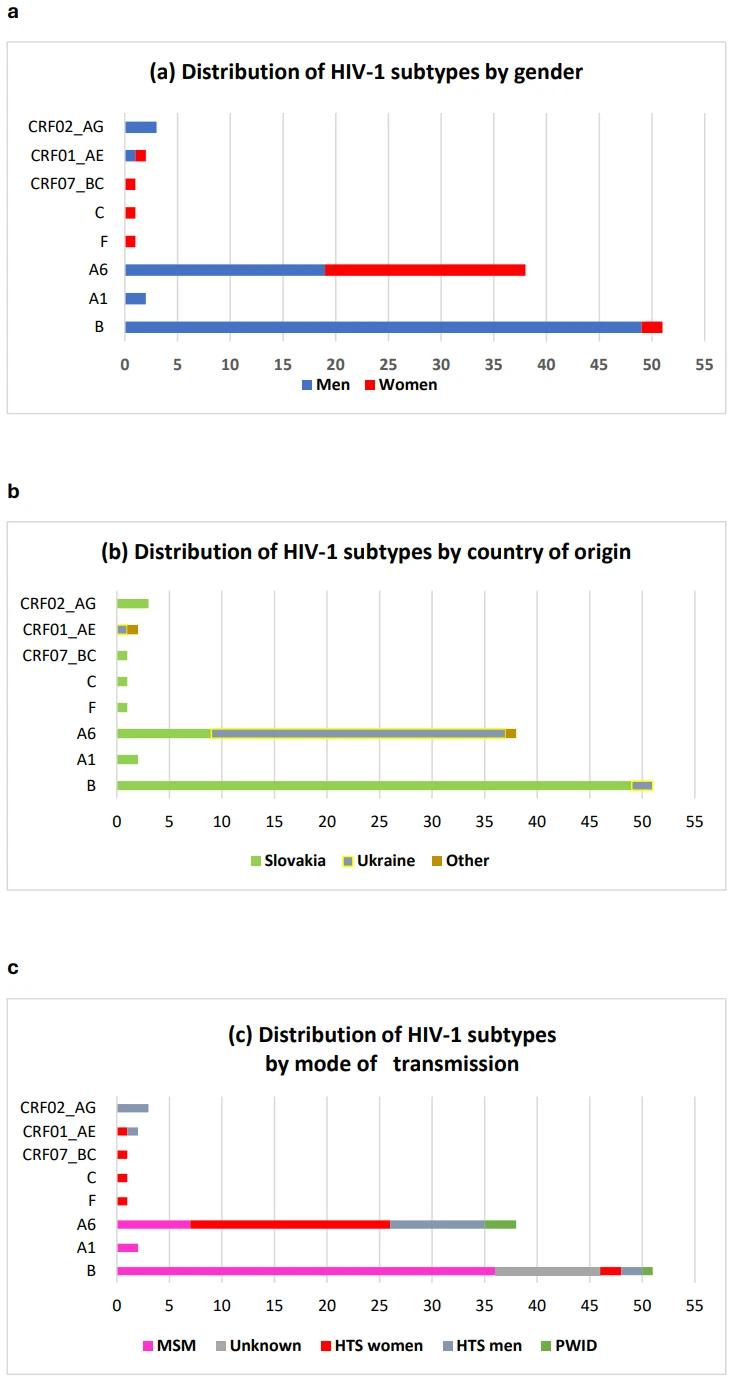
Subtype analysis in 99 patients identified subtype B in 51 (51.5%) and subtype A6 in 38 (38.4%) cases. Other subtypes and recombinant forms were rare: A1 in 2 (2.0%), F in 1 (1.0%), C in 1 (1.0%), CRF07_BC in 1 (1.0%), CRF01_AE in 2 (2.0%) and CRF02_AG in 3 (3.0%) cases.
Subtype B was more common in men (49/74; 66.2%), while subtype A6 was more common in women (20/25; 80.0%). Subtype A6 was detected in 18 men (24.3%), and subtype B was detected in 2 women (8.0 %).
According to country of origin, 66 (66.7%) patients were from Slovakia, 31 (31.3%) from Ukraine and 2 (2.0%) from other countries. Among Slovak patients, subtype B was dominant (49/66; 74.2%), and subtype A6 was detected in 9 (13.6%) cases. Among Ukrainian patients, subtype A6 was clearly dominant (28/31; 90.3%), while subtype B was found in 2 (6.5%) cases. One Ukrainian patient was infected with CRF01_AE. The two patients from other countries were infected with subtypes A6 and CRF01_AE.
Regarding route of transmission, MSM transmission was reported in 45 (45.5%) patients, heterosexual transmission in 40 (40.4%) and injecting drug use in 4 (4.0%); in 10 (10.1%) cases the transmission route was unknown. Heterosexual transmission included 25 of 25 women and 15 of 74 men. Subtype B was strongly associated with MSM transmission (36/45; 80.0%). Among heterosexual cases, subtype A6 was most frequent (28/40; 70.0%). Among people who inject drugs (PWID), subtype A6 was detected in 3 of 4 (75.0%) cases. All cases with unknown transmission were subtype B (10/10; 100%) – Figure 2.
Drug resistance
HIV resistance testing performed in samples from 99 patients revealed a generally low prevalence of resistance-associated mutations. Most patients (89/99; 89.9%) showed full susceptibility to all analysed drug classes. Minor or accessory mutations associated with low or potential low-level resistance were identified in 9 (9.1%) patients.
One major resistance mutation, M184I, was detected in a previously treated patient. This mutation is known to confer high-level resistance to lamivudine (3TC) and emtricitabine (FTC).
The most frequently observed accessory or polymorphic mutations included A62V, M46L, D232N and E157Q, which are commonly reported as naturally occurring or treatment-associated minor variants.
DISCUSSION
Epidemiological shift and migration impact
The molecular epidemiology of HIV-1 infections diagnosed in Slovakia in 2022 reflects the impact of migration following the war in Ukraine. However, findings of our study should be interpreted with caution, as most Ukrainian patients had been previously diagnosed and treated before arrival and were only reconfirmed in Slovakia.
HIV-1 subtype B accounts for about 11% of infections globally [15] and has historically represented approximately 70% of newly registered cases in Slovakia [1, 16, 17]. In this study, subtype B remained dominant (51.5%) and was strongly associated with MSM transmission (36/45; 80.0%), whereas subtype A6 predominated among Ukrainian patients (28/31; 90.3%), reflecting the known epidemiology of Eastern Europe rather than ongoing local transmission in Slovakia [18–20].
Demographic differences were observed between Slovak and Ukrainian patients. In the analysed molecular cohort, Slovak patients were predominantly men (62/66; 93.9%), reflecting MSM transmission, whereas women predominated among Ukrainian patients (20/31; 64.5%) with mainly heterosexual transmission. These differences likely reflect the demographic structure of the refugee population and the epidemiology of HIV infection in Ukraine [19, 20], as also reported for Ukrainian HIV-positive refugees in Slovakia [6, 21].
Similar migration-associated changes in subtype distribution have been reported in other European countries, including the Czech Republic, Bulgaria, Poland and Germany [4, 5, 22, 23]. In Slovakia, subtype B still predominates among domestic infections, whereas the increase in subtype A6 is mainly linked to imported cases.
Drug resistance patterns
The resistance profile observed in this study is consistent with recent findings from Slovakia and neighbouring countries [16, 17]. The overall prevalence of resistance-associated mutations was 9.1%, in the studied population.
Most patients (89/99; 89.9%) were fully susceptible to all major antiretroviral drug classes. Minor or accessory mutations identified in this cohort included A62V, M46L and E157Q, which are commonly reported in subtype A variants circulating also in Eastern Europe and the post-Soviet region [24, 25].
One major resistance mutation, M184I, was detected in a previously treated patient. This mutation confers high-level resistance to lamivudine (3TC) and emtricitabine (FTC) and is usually associated with prior treatment exposure. Apart from this single case, suggesting that major resistance-associated mutations were uncommon in the analysed cohort. Continued effectiveness of ART in Slovakia and suggesting only a minimal risk of widespread transmission of resistant strains [26].
Subtype diversity and its implications for public health policy
The presence of multiple non-B subtypes, including A6 and several recombinant forms, indicates increasing genetic diversity of HIV-1 in Slovakia. Similar diversification has been reported in Bulgaria and Hungary [5, 27], highlighting the impact of population migration. Although subtype B remains dominant among MSM, the occurrence of non-B variants in heterosexual transmission suggests evolving epidemiological dynamics and supports the need for continuous molecular surveillance [18].
The conflict in Ukraine has created large numbers of refugees from its inhabitants, caused significant population movements, which has had implications for epidemiology and molecular diversity of HIV1 in receiving countries. These data show that geopolitical events can influence the spread of infectious diseases. It is therefore essential to allocate funds with the aim to improve HIV resistance testing and targeted prevention initiatives for both MSM and heterosexuals. These strategies are critical for continuing effective ART and thus to monitor the spread of resistant or recombinant strains in Central Europe.
CONCLUSION
The findings of this study, such as the increased proportion of non-B HIV-1 subtypes, especially A6, the change in the demographic composition of the HIV-infected population, and the associated shift in the mode of HIV transmission suggest that migration related to the war in Ukraine influenced the structure of the HIV epidemic in Slovakia. Despite the observed changes in subtype distribution, major resistance-associated mutations were uncommon in the analysed cohort. Nevertheless, continuous surveillance and monitoring of resistance and the effectiveness of ART in Slovakia remains an important task in HIV prevention regardless of the origin of HIV-infected patients.
Funding
This study was conducted as part of the National Reference Centre for HIV/AIDS activities at the Slovak Medical University in Bratislava. No external financial support was received.
Conflict of interest statement
The authors declare no conflict of interest.
Zdroje
1. Hábeková M, Takáčová M, Lysý J. Genetic subtypes of HIV type 1 circulating in Slovakia. AIDS Res Hum Retroviruses, 2010; 26(10):1103–1107.
2. Chabadová Z, Hábeková M, Truska P, et al. Distribution of HIV-1 subtypes circulating in Slovakia (2009–2012). Acta Virol.; 2014, 58 : 317–324.
3. Čereš A, Staneková D, Hábeková M, et al. HIV genetic diversity and occurrence of the HLA-B*57 : 01 allele in newly diagnosed HIV-positive patients in Slovakia in 2015–2016. Clin Microbiol Rep., 2018;18(SA):39.
4. Malý M, Němeček V, Zákoucká H. Annual report on the incidence and spread of HIV/AIDS in the Czech Republic in 2022. Epidemiol Mikrobiol Imunol., 2023;72(9): 335–351.
5. Alexiev I, Campbell EM, Knyazev S, et al. Molecular epidemiology of the HIV-1 subtype B sub-epidemic in Bulgaria. Viruses, 2020;12 : 441. doi: https://doi.org/10.3390/ v12040441.
6. Massmann R, Müller D, Adravecz L, et al. Demographic, epidemiological and clinical characteristics of Ukrainian war refugees with HIV infection in the Slovak Republic. Travel Med Infect Dis., 2024;62 : 102764.
7. German Advisory Committee Blood (Arbeitskreis Blut). Human immunodeficiency virus (HIV) – background paper. Transfus Med Hemother., 2016;43 : 203–222. doi: https://doi. org/10.1159/000445852.
8. Li G, De Clercq E. HIV genome-wide protein associations: a review of 30 years of research. Microbiol Mol Biol Rev., 2016;80(3):679–731. doi https://doi.org/10.1128/MMBR.00065-15
9. ANRS (Agence nationale de recherches sur le sida et les hépatites virales). ANRS consensus procedures for HIV-1 genotypic resistance testing (version 2020). Paris: ANRS; 2020. Available at: https://www.hivfrenchresistance.org.
10. Hall TA. BioEdit: a user-friendly biological sequence alignment editor and analysis program for Windows 95/98/NT. Nucleic Acids Symp Ser., 1999;41 : 95–98.
11. Los Alamos National Laboratory. HIV Sequence Database. Available at: https://www.hiv.lanl.gov/.
12. Liu TF, Shafer RW. Web resources for HIV type 1 genotypic-resistance test interpretation. Clin Infect Dis., 2006;42(11):1608 – 1618. doi: https://doi.org/10.1086/503914¨.
13. Saitou N, Nei M. The neighbor-joining method: a new method for reconstructing phylogenetic trees. Mol Biol Evol., 1987;4 : 406–425.
14. Kumar S, Stecher G, Li M, Knyaz C, Tamura K. MEGA X: molecular evolutionary genetics analysis across computing platforms. Mol Biol Evol,. 2018;35(6):1547–1549. Doi: https://doi.org/10.1093/ molbev/msy096.
15. Junqueira DM, Almeida SE. HIV-1 subtype B: traces of a pandemic. Virology, 2016;495 : 173–184. Doi: https://doi.org/10.1016/j. virol.2016.05.003.
16. Staneková D, Čereš A, Hábeková M, et al. Resistance to ART in HIV-positive patients newly diagnosed in Slovakia 2015–2016. Vnitr Lek., 2017;63(Suppl 4):18.
17. Kovářová A, Valkovičová Staneková D, Hábeková M, Takáčová M. HIV-1 subtype distribution and resistance to ART in HIV-infected persons in Slovakia (2019–2021). Epidemiol Mikrobiol Imunol., 2023;72(2):76–85.
18. European Centre for Disease Prevention and Control, WHO Regional Office for Europe. HIV/AIDS surveillance in Europe 2023 – 2022 data. Stockholm/Copenhagen: ECDC; 2023.
19. Díez-Fuertes F, Cabello M, Thomson MM. Bayesian phylogeographic analyses clarify the origin of the HIV-1 subtype A variant circulating in former Soviet Union countries. Infect Genet Evol., 2015;33 : 197–205. Doi: https://doi.org/10.1016/j. meegid.2015.05.003.
20. Aibekova L, Foley B, Hortelano G, et al. Molecular epidemiology of HIV-1 subtype A in former Soviet Union countries. PLoS One, 2018;13:e0191891. doi: https://doi.org/ 10.1371/journal. pone.0191891.
21. Serwin K, Chaillon A, Scheibe K, et al. Circulation of human immunodeficiency virus 1 A6 variant in the eastern border of the European Union – dynamics of virus transmissions between Poland and Ukraine. Clin Infect Dis., 2023;76(10):1716–1724. Doi: https://doi.org/10.1093/cid/ciad058.
22. Parczewski M, Boesecke C, Khaykin P, et al. Provision of care for people with HIV migrating from Ukraine: preparing for a longterm response. AIDS, 2025;39(6):629–638. Doi: https://doi. org/10.1097/QAD.0000000000004147.
23. UNHCR. Refugees from Ukraine recorded in Europe. Available at: https://data.unhcr.org/en/situations/ukraine. [Accessed 15 January 2025].
24. Załęski A, Lembas A, Dyda T, et al. Changes in primary HIV-1 drug resistance due to war migration from Eastern Europe. J Immigr Minor Health., 2024;26(1):15–22. Doi: https://doi.org/10.1007/ s10903-023-01559-1.
25. Van de Klundert MAA, et al. Molecular epidemiology of HIV-1 in Eastern Europe and Russia. Viruses, 2022;14(10):2099. Doi: https://doi.org/10.3390/v14102099.
26. Bukovinová P, Jarčuška P. Standard procedure for ensuring comprehensive management of HIV infection. Bratislava: Ministry of Health of the Slovak Republic; 2020.
27. Zsichla L, Adravecz L, Müller D, et al. Molecular epidemiology of HIV-1 in Hungary: an evolving contact zone of colliding virus subtypes. Front Microbiol., 2025; 16 : 1732254. doi: https://doi. org/10.3389/fmicb.2025.173225.
Štítky
Hygiena a epidemiologie Infekční lékařství MikrobiologieČlánek vyšel v časopise
Epidemiologie, mikrobiologie, imunologie
- Perorální antivirotika jako vysoce efektivní nástroj prevence hospitalizací kvůli COVID-19 − otázky a odpovědi pro praxi
- Parazitičtí červi v terapii Crohnovy choroby a dalších zánětlivých autoimunitních onemocnění
- Vakcíny proti klíšťové encefalitidě
- Kdy je nejlepší očkovat
Nejčtenější v tomto čísle
- Impact of the war in Ukraine on HIV-1 subtype distribution and antiretroviral resistance in Slovakia, 2022
- Listeriosis in the elderly: epidemiology, pathogenesis, clinical presentation, and prevention
- Vaccinomics – The future of personalized vaccination?
- Diphtheria – assessment of immune status in newly enlisted professional soldiers in the Czech Republic
Zvyšte si kvalifikaci online z pohodlí domova
Mazová zátka a její řešení
nový kurzVšechny kurzy