
A systematic review of sensory outcomes in nipple reinnervation after implant-based breast reconstruction
Autoři:
A. R. del Río-Hernández 1,2; R. Esquiliano-Raya 2; X. González-López 2; C. Domínguez-Suárez 2; J. R. Gomez-Woodworth 2; J. E. Telich Tarriba 3,4
Působiště autorů:
Department of Plastic Surgery, University of Pittsburgh Medical Center, Pittsburgh, USA
1; Faculty of Health Sciences, Universidad Panamericana, Mexico City, Mexico
2; Hospital Angeles Pedregal, Mexico City, Mexico
3; Peripheral Nerve Surgery Clinic, Hospital General “Dr. Manuel Gea Gonzalez”, Mexico City, Mexico
4
Vyšlo v časopise:
ACTA CHIRURGIAE PLASTICAE, 68, 1-2, 2026, pp. 19-25
doi:
https://doi.org/10.48095/ccachp202619
Del Río-Hernández AR, Esquiliano-Raya R, González-López X et al. A systematic review of sensory outcomes in nipple reinnervation after implant-based breast reconstruction. Acta Chir Plast 2026; 68 (1–2): 19–25.
Introduction
Breast reconstruction has evolved from the simple creation of a breast mound to the restoration of a more natural and aesthetically pleasing breast, particularly when performed in conjunction with nipple-sparing mastectomy (NSM) [1].
Despite these advances, loss of sensation in the nipple–areola complex (NAC) remains a frequent complaint among breast cancer survivors. The NAC is a key aesthetic component of the breast as well as also a region rich in sensory receptors, making it essential for self-image and sexual health [2].
Loss of sensation primarily results from damage to the intercostal nerves during mastectomy. While spontaneous sensory recovery is possible, it occurs in fewer than half of the patients. Over 60% of patients report complete sensory loss 2 years after surgery, and nearly 90% experience little to no sensory input from the NAC [2,3]. The emotional and psychological impact of sensory loss may contribute to decreased sexual satisfaction, impaired interpersonal relationships, and diminished quality of life [4].
Sensory recovery has been extensively studied in autologous breast reconstruction. The transfer of well-vascularized tissue facilitates spontaneous neurotization of the skin island, and outcomes improve further when nerve coaptation is incorporated into the reconstruction [5,6].
Implant-based breast reconstruction (IBR) remains the preferred choice for many patients and surgeons due to its less invasive nature, shorter recovery time, and absence of donor site morbidity [7]. However, sensory recovery following IBR is variable and unpredictable [6]. Some centres have proposed reconnecting the severed intercostal nerves to the NAC to restore sensation, but evidence supporting these techniques remains limited.
This systematic review aims to provide a comprehensive evaluation of the current evidence on NAC reinnervation following IBR.
Evaluation of the topic
Methods
A systematic review was conducted in accordance with the Preferred reporting items for systematic reviews and meta-analyses (PRISMA) guidelines [8] and was registered in PROSPERO (ID: CRD42024629767). The primary objective was to assess the efficacy and feasibility of nipple neurotization for sensory restoration in patients undergoing IBR after mastectomy.
Studies were eligible for inclusion if they reported outcomes of nipple neurotization in patients undergoing IBR and included sensory recovery as an outcome. Nipple neurotization was defined as any surgical technique aiming to restore NAC sensation by reconnecting intercostal or other donor nerves to the NAC following mastectomy.
Eligible studies were published between 2000 and 2025. Relevant studies published outside this time frame were also considered if they provided meaningful clinical insights. No language restrictions were applied.
A search was conducted across PubMed, Web of Science, Embase, Cochrane Library, and Google Scholar databases. The following terms were used: “mastectomy”, “breast reconstruction”, “expander”, “mammaplasty”, “breast implant”, “neurotization”, “sensation”, “nerve transfer”, and “reinnervation”. Reference lists of included studies were manually screened to identify additional relevant publications.
Three reviewers independently screened all retrieved records. Initial screening involved removal of duplicates and evaluation of titles and abstracts to identify potentially eligible studies. Full--text articles of selected studies were then reviewed to determine final inclusion. Data extraction was performed independently by each reviewer to minimize selection bias. Any discrepancies were resolved through discussion, and when necessary, a fourth reviewer adjudicated to achieve consensus.
Data extraction was performed using a standardized form, capturing study characteristics and details of the patient population such as demographic data, neurotization procedure, including nerve graft type (autograft, allograft, or direct coaptation) and donor nerve (s) used. Primary outcomes included NAC sensory recovery, time to sensory return (in months postoperatively), and the modality of sensory testing (e. g. clinical evaluation, Semmes-Weinstein monofilament testing, two-point discrimination, or the pressure-specified sensory device (PSSD)). Risk of bias was assessed using the Joanna Briggs Institute critial appraisal checklist for case series [9].
When essential data were missing, corresponding authors were contacted for clarification. Studies with unresolved critical data gaps were excluded from specific analyses. Given the heterogeneity in methodology, outcome measures, and follow-up duration among included studies, a meta-analysis was not feasible. Therefore, results are presented in a descriptive format.
The initial search retrieved 332 studies. Eight studies met the inclusion criteria and were included in the final analysis (Fig. 1) [6,10–16]. A total of 131 patients (mean age 41.1 years) were included, corresponding to 181 reconstructed breasts (Tab. 1). Most patients underwent direct-to-implant reconstruction (176 breasts; 97.2%), whereas 4 breasts (2.2%) received tissue expanders, and 1 patient (0.5%) already had a pre-existing implant at the time of neurotization.

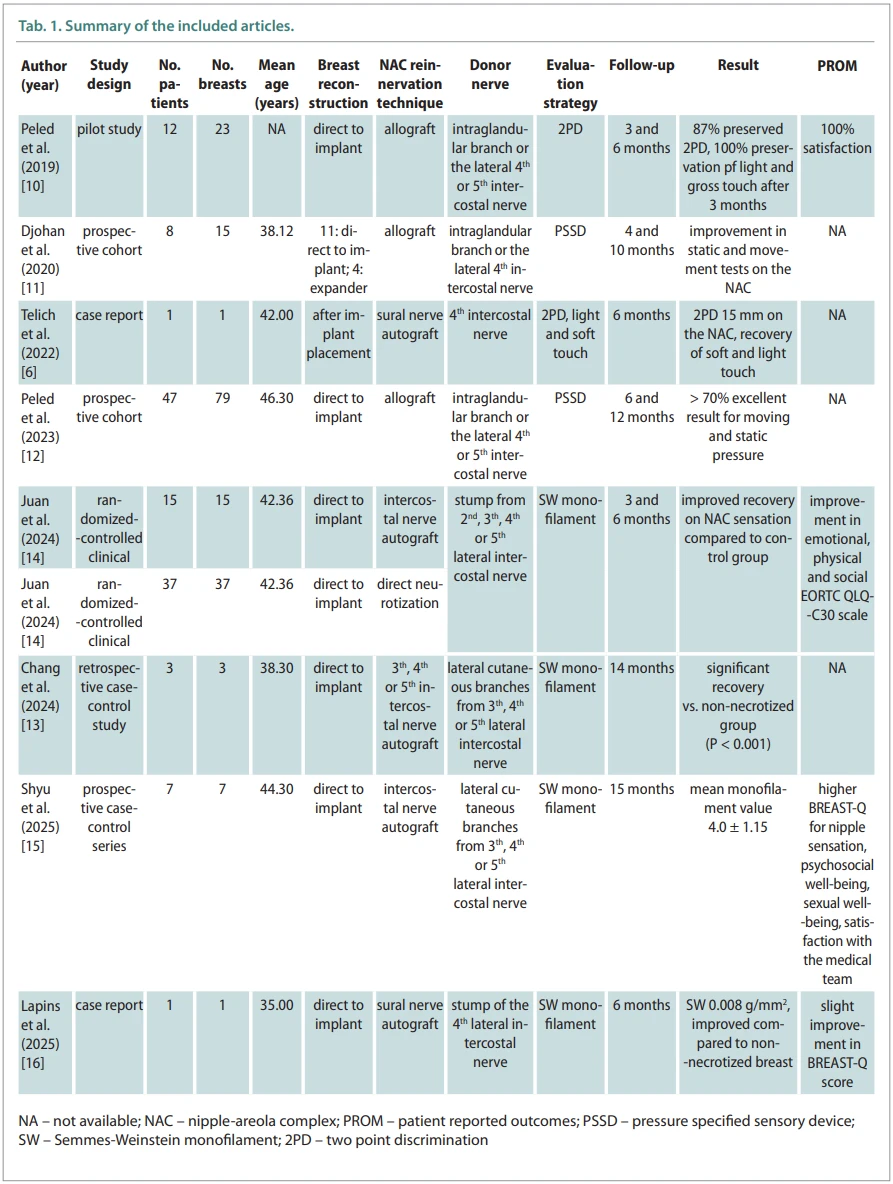
Among the reported nerve repair approaches, allografts were most frequently utilized (117 breasts; 64.6%), followed by direct neurotization (37 breasts; 20.4%) and autografts (27 breasts; 14.9%).
The fourth intercostal nerve was the most selected donor nerve. Peled et al. used the fourth or fifth intercostal nerves in 102 reconstructed breasts (56.3%) [10,12], while Juan et al. varied donor selection between the second and fourth intercostal nerves in 52 breasts (28.7%) [14]. Chang and Shyu employed branches from the third to fifth intercostal nerves in 10 breasts (5.5%) [13,15]; the rest of the authors used the fourth intercostal nerve exclusively in 17 breasts (9.4%) [6,11,16].
Surgical technique
Nipple neurotization was performed using three primary techniques, depending on the timing of reconstruction and the availability of donor nerves.
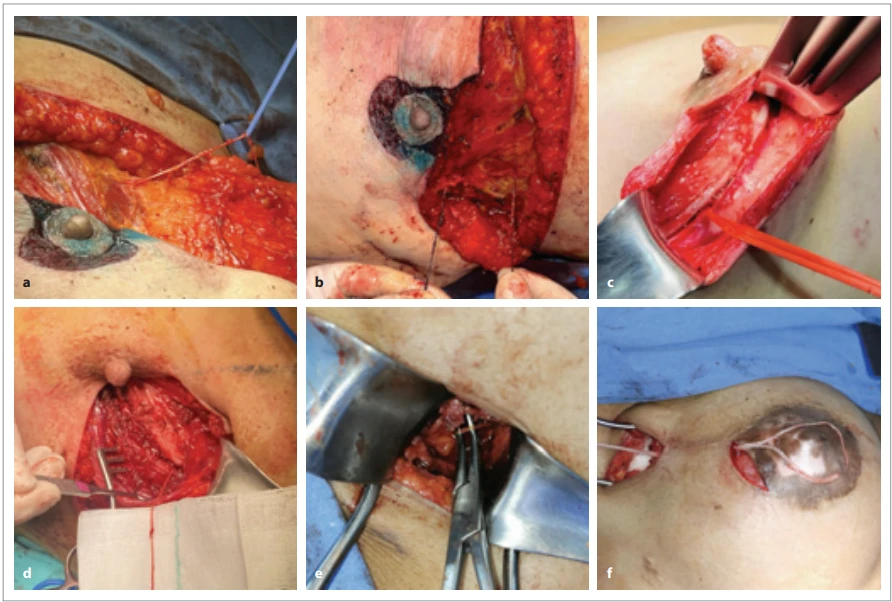
In most cases, reinnervation was performed at the time of mastectomy (immediate reconstruction). The anterior branches of the intercostal nerves were identified as they emerged laterally to the pectoralis major muscle, followed by intraglandular dissection to achieve sufficient donor nerve length [10–12].
When a suitable donor nerve was not identifiable, or in delayed reconstructions performed during expander-to-implant exchange, intercostal nerves were dissected directly within the intercostal spaces [13]. Autografts were used when nerve allografts were unavailable, with donor sources including intercostal and sural nerves.
A single late reconstruction case was described in which the intercostal nerve was harvested lateral to the breast implant and bridged to the areola using a sural nerve graft [6].
All nerve coaptations were performed under magnification, either with surgical loupes or an operating microscope. The distal graft was coapted to a recipient nerve stump within the areola or embedded within the nipple dermis (Fig. 2).
Postoperative recovery
Follow-up intervals for sensory evaluation varied among studies, ranging from 3 months to 15 months postoperatively. Return of NAC sensation was reported as early as 3 months, with progressive improvement over time.
A pilot study published by Peled et al. reported two-point discrimination recovery in 87% of breasts and preservation of light and gross touch in all cases 3 months after surgery [10]. In a subsequent study from the same group, quantitative assessment using the PSSD showed excellent one-point moving pressure thresholds in 69–73% and static pressure thresholds in 38–75% of breasts at 12 months [12].
Djohan et al. reported improvement in static and movement tests using the PSSD 4 months after surgery, with improvement in thresholds in the patients that were followed for 10 months. In 2 cases of bilateral reconstruction and unilateral neurotization the neurotized sides had better sensory outcomes at 4 and 10 months [11].
In a randomized clinical trial, Juan et al. found that neurotized breasts had significantly improved nipple and skin sensation at 3 and 6 months. Additionally, patients with neurotized breasts reported better emotional, physical, and social functioning, as well as lower pain scores on the EORTC QLQ-C30 questionnaire [14].
Chang et al. compared neurotized vs. non-neurotized breasts in patients undergoing autologous or implant-based reconstruction. The mean Semmes--Weinstein monofilament values were significantly better in the neurotized group (35.61 g) compared to controls (179.13 g; P < 0.001). Progressive sensory recovery was documented, with mean monofilament thresholds improving from 138.17 g (0–6 months) to 59.55 g (7–12 months), 14.54 g (13–18 months), and 0.37 g (19–24 months) post-mastectomy. Although only 3 patients in this series underwent IBR, their mean final threshold (5.72 g) remained superior to that of non-neurotized breasts (179.13 g) [13].
In a more recent prospective case-control study by the same group, the neurotized cohort achieved a mean monofilament threshold of 4.02 ± 1.15 g, however no measurements are reported for the non-neurotized group. Furthermore, in this series only seven patients out of 67 received IBR. Overall results showed significantly higher BREAST-Q scores for nipple sensation, psychosocial and sexual well--being, satisfaction with the medical team, and fewer postoperative breast symptoms. Subgroup analysis for IBR demonstrated a consistent trend toward better outcomes, though only the “itchiness” domain reached statistical significance [15].
Finally, two case reports provided additional clinical insight. The first, from Mexico, described a patient with a pre-existing breast implant in whom a long sural nerve graft was used to bridge the fourth intercostal nerve to the areola, resulting in recovery of light touch and two-point discrimination at 6 months postoperatively [6]. The second, from Latvia, reported a patient who underwent bilateral NSM, in whom the neurotized breast demonstrated superior monofilament test results and improved BREAST-Q scores compared to the non--neurotized side at 6 months [16].
Discussion
The NAC is a key anatomical landmark in breast aesthetics, and its sensory function plays a critical role for both protective and psychosocial well-being [17]. Loss of sensation in the mastectomy flaps and NAC can result in multiple complications, including increased risk of injury due to impaired protective sensation, dryness and scaling of the skin secondary to autonomic denervation, and psychological distress related to altered body image and sexual well-being [18,19].
The impact of sensory loss after mastectomy was first described by Courtiss in 1976 [20]. However, interest in restoring breast sensation only emerged following Blondeel’s 1999 reports on autologous flap neurotization, which demonstrated meaningful sensory recovery and improved patient-reported outcomes [21]. Despite these advances, widespread adoption was limited by technical challenges and increased operative times.
IBR has historically shown poorer sensory recovery compared with autologous techniques, primarily due to the lack of vascularized tissue supporting axonal regrowth [22]. Nevertheless, IBR remains the predominant reconstructive approach, representing nearly 80% of all breast reconstructions [23,24]. Consequently, alternative neurotization strategies, such as direct NAC neurotization and nerve graft interposition, have been proposed to enhance sensory outcomes in these patients.
This review analysed 8 studies including 181 breasts that underwent NAC reinnervation. Although techniques varied between authors, all aimed to re-establish a neural connection between the areolar dermis and an intercostal nerve, most commonly the fourth. All studies reported improved nipple sensation, with recovery beginning as early as 3 months after the surgery. Although results could not be pooled in a meta-analysis, outcomes were consistently favourable, and statistically significant improvement in nipple sensation was in the studies that compared neurotized breasts against controls [13,14].
Most patients in the reviewed studies underwent direct-to-implant reconstruction, raising the question of whether neurotization is equally effective in two-stage expander-based reconstructions, or if the nerve repair should be deferred until expander exchange. Furthermore, no group has directly compared autologous flap neurotization with nipple neurotization in alloplastic reconstruction. However, Chang’s group has extended the application of direct NAC neurotization to microsurgical flap reconstructions, suggesting potential benefit across reconstructive modalities [13].
A noteworthy finding of this review is the frequent use of nerve allografts in American studies. This eliminates donor-site morbidity but may be cost-prohibitive or unavailable in some settings. Boyd et al. reported that neurotization increases surgical costs by more than $7,000. Although the authors did not detail the specific contributors, the difference is likely related to the price of nerve allografts and the additional operative time required [25]. While these figures reflect the U.S. healthcare environment and may not directly apply to other systems, the expenses must be considered when discussing reimbursement with public health authorities or when counselling patients who pay out of pocket.
This review is limited by the small number of published studies, small sample sizes, heterogeneity in surgical techniques, and lack of standardized outcome or rehabilitation protocols. These factors reduce generalizability and may limit the broader applicability of nipple neurotization. Additionally, the requirement for specialized training in peripheral nerve surgery and longer operative times may deter some surgeons from adopting these procedures in their practice.
Another limitation concerns the numerous factors influencing NAC reinnervation, such as mastectomy flap thickness, dissection technique (cold vs. cautery), implant plane (prepectoral vs. subpectoral), and patient comorbidities. Although none of the reviewed studies comprehensively addressed these aspects, available evidence from controlled studies supports improved sensation and quality of life among patients undergoing neurotization.
Overall, the consistent positive outcomes across diverse clinical scenarios suggest that incorporating nipple neurotization during IBR can meaningfully improve patient satisfaction and sensory recovery, particularly for those who are not candidates for, or prefer to avoid, autologous reconstruction. Compared to a prior review by Sorenson et al. [26], our analysis included broader databases (including Google Scholar) and removed language restrictions, identifying two additional studies that contribute new insights. The inclusion of reports from high-resource centres in the United States and Taiwan, as well as developing regions such as Mexico and Latvia, highlights the growing global interest in this technique.
Future research should focus on standardized, objective methods for sensory evaluation. Although Semmes-Weinstein monofilament testing and two--point discrimination remain widely used in clinical practice, they remain highly operator-dependent and subject to inter-observer variability [27]. Emerging technologies, such as the Acroval PSSD (Axogen, Jacksonville, FL) [12,28–30], provide more reproducible and quantifiable assessments. In addition to objective measures, the integration of validated patient-reported outcome instruments, such as the BREAST-Q Sensation Module, will be critical in demonstrating the clinical utility of these interventions [31]. Based on current evidence, we recommend mapping each breast into five quadrants and evaluating sensation preoperatively and at 3, 6, and 12 months postoperatively (Fig. 2).
Finally, increasing awareness of nipple reinnervation among reconstructive surgeons and patients is essential. Broader recognition of its benefits will facilitate protocol development, encourage the creation of multi-centre registries, and strengthen evidence supporting its inclusion as a standard adjunct in
implant-based reconstruction.
Conclusion
This systematic review demonstrates that nipple neurotization using intercostal nerves is a safe and effective technique for restoring sensation in IBR.
Roles of the authors
Ricardo Esquiliano-Raya, Ximena González-López, Cinthya Domínguez-Suárez, Juan R. Gomez-Woodworth: literature search and data extraction; Alexa Rivera del Río-Hernández: project coordinator, data analysis, draft writing; Jose E. Telich Tarriba: idea development, project supervisor, data analysis, final text writing. All authors reviewed and edited the manuscript and approved its final version.
Disclosures
The authors have no conflicts of interest to disclose. The authors declare that this study has received no financial support. All procedures performed in this study were in accordance with the Helsinki declaration and its later amendments or comparable ethical standards.
Zdroje
1. Amro C., Sorenson TJ., Boyd CJ., et al. The evolution of implant-based breast reconstruction: innovations, trends, and future directions. J Clin Med. 2024, 13 (23): 7407.
2. Gahm J., Hansson P., Brandberg Y., et al. Breast sensibility after bilateral risk-reducing mastectomy and immediate breast reconstruction: a prospective study. J Plast Reconstr Aesthet Surg. 2013, 66 (11): 1521–1527.
3. Khan A., Zhang J., Sollazzo V., et al. Sensory change of the reconstructed breast envelope after skin-sparing mastectomy. Eur J Surg Oncol. 2016, 42 (7): 973–979.
4. Van de Grift TC., Mureau MAM., Negenborn VN., et al. Predictors of women’s sexual outcomes after implant-based breast reconstruction. Psychooncology. 2020, 29 (8): 1272–1279.
5. Sgarzani R., Negosanti L., Morselli PG., et al. Patient satisfaction and quality of life in DIEAP flap versus implant breast reconstruction. Surg Res Pract. 2015, 2015 : 405163.
6. Telich-Tarriba J., Garza-Arriaga D., Navarro-Barquin D., et al. Late sensory neurotization of the nipple-areola complex after implant-based breast reconstruction. Arch Breast Cancer. 2022, 9 (2): 247–249.
7. Saldanha IJ., Broyles JM., Adam GP., et al. Implant-based breast reconstruction after mastectomy for breast cancer: a systematic review and meta-analysis. Plast Reconstr Surg Glob Open. 2022, 10 (3): e4179.
8. Page MJ., McKenzie JE., Bossuyt PM., et al. The PRISMA 2020 statement: an updated guideline for reporting systematic reviews. BMJ. 2021, 372: n71.
9. Munn Z., Barker TH., Moola S., et al. Methodological quality of case series studies: an introduction to the JBI critical appraisal tool. JBI Evid Synth. 2020, 18 (10): 2127–2133.
10. Peled AW., Peled ZM. Nerve preservation and allografting for sensory innervation following immediate implant breast reconstruction. Plast Reconstr Surg Glob Open. 2019, 7 (7): e2332.
11. Djohan R., Scomacao I., Knackstedt R., et al. Neurotization of the nipple-areola complex during implant-based reconstruction: evaluation of early sensation recovery. Plast Reconstr Surg. 2020, 146 (2): 250–254.
12. Peled AW., von Eyben R., Peled ZM. Sensory outcomes after neurotization in nipple-sparing mastectomy and implant-based breast reconstruction. Plast Reconstr Surg Glob Open. 2023, 11 (12): e5437.
13. Chang TN., Lu JC., Sung CW., et al. Elongation of intercostal nerve cutaneous branches for breast and nipple neurotization during breast reconstruction after mastectomy for breast cancer: case-control study. Br J Surg. 2024, 111 (2): znae005.
14. Juan Z., Liang YP., Shen JL., et al. Efficacy and safety of intercostal nerve anastomosis in immediate subpectoral prosthetic breast reconstruction after nipple-areola-sparing mastectomy: a randomized, controlled, open-label clinical study. Front Oncol. 2024, 14 : 1261936.
15. Shyu S., Chang TN., Lu JC., et al. Breast neurotization along with breast reconstruction after nipple sparing mastectomy enhances quality of life and reduces denervation symptoms in patient-reported outcome: a prospective cohort study. Int J Surg. 2025, 111 (5): 3235–3247.
16. Lapiņš J., Polita BSD., Kalniņa L., et al. Novel nipple reinnervation technique using n. suralis graft. Medicina (Kaunas). 2024, 60 (9): 1533.
17. Spear SL., Davison SP. Aesthetic subunits of the breast. Plast Reconstr Surg. 2003, 112 (2): 440–447.
18. Hammond JB., Kandi LA., Armstrong VL., et al. Long-term breast and nipple sensation after nipple-sparing mastectomy with implant reconstruction: relevance to physical, psychosocial, and sexual well-being. J Plast Reconstr Aesthet Surg. 2022, 75 (9): 2914–2919.
19. Telich-Tarriba JE., Alvarez G., Cardenas-Mejia A. Sensory nerve transfers and direct neurotization: the new frontier in peripheral nerve surgery. Int Microsurg J. 2022, 6 (2): 2.
20. Courtiss EH., Goldwyn RM. Breast sensation before and after plastic surgery. Plast Reconstr Surg. 1976, 58 (1): 1–13.
21. Blondeel PN., Demuynck M., Mete D., et al. Sensory nerve repair in perforator flaps for autologous breast reconstruction: sensational or senseless? Br J Plast Surg. 1999, 52 (1): 37–44.
22. Shridharani SM., Magarakis M., Stapleton SM., et al. Breast sensation after breast reconstruction: a systematic review. J Reconstr Microsurg. 2010, 26 (5): 303–310.
23. Panchal H., Matros E. Current trends in postmastectomy breast reconstruction. Plast Reconstr Surg. 2017, 140 (5S): 7S–13S.
24. Rubenstein RN., Nelson JA., Azoury SC., et al. Disparity reduction in U.S. breast reconstruction: an analysis from 2005 to 2017 using 3 nationwide data sets. Plast Reconstr Surg. 2024, 154 (6): 1065e–1075e.
25. Boyd CJ., Hemal K., Sorenson TJ., et al. Assessing perioperative complications and cost of nipple-areolar complex neurotization in immediate implant-based breast reconstruction following nipple-sparing mastectomy: a matched-paired comparison. Ann Plast Surg. 2025, 94 (4S Suppl 2): S118–S120.
26. Sorenson TJ., Boyd CJ., Park JJ., et al. Nipple areolar complex (NAC) neurotization after nipple-sparing mastectomy (NSM) in implant-based breast reconstruction: a systematic review of the literature. Breast J. 2025, 2025 : 2362697.
27. Kasielska-Trojan A., Szulia A., Zawadzki T., et al. The assessment of nipple areola complex sensation with Semmes-Weinstein monofilaments: normative values and its covariates. Diagnostics (Basel). 2021, 11 (11): 2145.
28. Wang L., Marcos D., Cooper L., et al. Bridging the gap: a pilot study on the efficacy of nerve allografts in autologous breast reconstruction. J Reconstr Microsurg Open. 2024, 9 (2): e102–e108.
29. Bibbo C., Rodrigues-Colazzo E. Nerve transfer with entubulated nerve allograft transfers to treat recalcitrant lower extremity neuromas. J Foot Ankle Surg. 2017, 56 (1): 82–86.
30. Tassler PL., Dellon AL. Correlation of measurements of pressure perception using the pressure-specified sensory device with electrodiagnostic testing. J Occup Environ Med. 1995, 37 (7): 862–866.
31. Tsangaris E., Klassen AF., Kaur MN., et al. Development and psychometric validation of the BREAST-Q Sensation Module for women undergoing post-mastectomy breast reconstruction. Ann Surg Oncol. 2021, 28 (12): 7842–7853.
Štítky
Chirurgie plastická Ortopedie Popáleninová medicína TraumatologieČlánek vyšel v časopise
Acta chirurgiae plasticae
2026 Číslo 1-2
- Potenciál vinpocetinu v léčbě kardiovaskulárních onemocnění
- Aktuální evropská doporučení pro léčbu renální koliky v důsledku urolitiázy
- Hybridní kooperující komplexy v léčbě osteoartrózy
Nejčtenější v tomto čísle
- A systematic review of sensory outcomes in nipple reinnervation after implant-based breast reconstruction
- Principles of nasal framework reconstruction for complex nasal defects: review
- Self-esteem and quality of sexual life in women undergoing breast reconstruction due to mastectomy: a cross-sectional study in a non-European setting
- Cutting-edge biotechnological strategies to enhance autologous fat graft survival