
Self-esteem and quality of sexual life in women undergoing breast reconstruction due to mastectomy: a cross-sectional study in a non-European setting
Authors:
C. Mert 1; İ. Çavdar 2
Authors‘ workplace:
Department of Surgical Nursing, Institute of Graduate Studies, İstanbul University-Cerrahpaşa, Istanbul, Türkiye
1; Department of Nursing, Faculty of Health Sciences, İstanbul Atlas University, Istanbul, Türkiye
2
Published in:
ACTA CHIRURGIAE PLASTICAE, 68, 1-2, 2026, pp. 6-13
doi:
https://doi.org/10.48095/ccachp20266
Introduction
Mastectomy is often an essential part of breast cancer treatment, yet for many women it alters how they see and feel about their bodies and intimate lives [1]. Breast reconstruction does not change oncologic outcomes, but it is widely used to help restore psychosocial well--being and quality of life, including aspects of self-image, confidence, and sexual functioning [2–4].
Reconstructive procedures may be performed immediately after mastectomy or later as a delayed intervention [5]. The main approaches include autologous tissue transfer, implant--based methods with or without expansion, and supplemental fat grafting [6]. Immediate reconstruction can lessen the total number of surgeries, yet adjuvant radiotherapy and tumor features often lead surgical teams to prefer delayed reconstruction when free flaps are planned [5,6]. However, despite these surgical preferences, patient-reported studies have shown that overall satisfaction and quality-of-life scores tend to be higher among women who undergo reconstruction – particularly in immediate procedures – compared with those who delay reconstruction or do not undergo it at all [7]. When considering the reconstructive method itself, autologous techniques can offer a more natural appearance and texture, but they involve longer operations and may lead to donor-site morbidity [8,9]. Implant-based reconstruction, on the other hand, is less invasive and allows a shorter initial recovery but carries risks such as capsular contracture [10]. While postoperative infection is possible after any surgical procedure, infections in implant-based reconstruction carry a higher risk of implant loss. Autologous and implant--based procedures each have their own advantages and limitations, and the choice between them depends on several factors, including patient preferences, tumor characteristics, anatomical considerations, the planned surgical approach, and the surgeon’s experience and available resources [7–10].
Beyond physical restoration, numerous studies emphasize the psychological and sexual dimensions of recovery after breast restoration [11]. Improvements in body image, self-esteem, and sexual functioning have been reported in various patient groups [12,13]. These effects often relate to overall satisfaction with reconstructive outcomes, which may be higher among women undergoing autologous procedures [14–16].
However, much of the published data originate from high-income Western systems where immediate reconstruction is widely recommended and performed [17–20]. In many hospitals in Türkiye, delayed reconstruction remains more common because of differences in health-system organization, patient awareness, and sociocultural views of femininity and sexuality [21]. Furthermore, national nursing research trends indicate that psychosocial outcomes and body image issues among women after mastectomy remain underexplored in Türkiye, reflecting the limited focus of postgraduate theses on this subject [22]. Similar cultural and systemic patterns have also been reported in Middle Eastern contexts [23], where delayed reconstruction is often preferred for comparable reasons. Reports from Türkiye describe the ongoing use of delayed reconstruction in clinical practice, including series that document its application in tertiary care centers [24,25].
Based on these considerations, we designed a cross-sectional study to describe the levels of self-esteem and quality of sexual life and to examine the relationship between these two psychosocial outcomes among women who underwent breast reconstruction after mastectomy. Following the primary analysis, exploratory analyses were also conducted to compare outcomes between autologous and implant-based reconstructions, recognizing that these comparisons were not part of the original research plan and were undertaken to generate hypotheses for future research.
Materials and methods
Study design and setting
This descriptive, cross-sectional study was conducted in the Plastic, Reconstructive, and Aesthetic Surgery Clinic of a tertiary hospital in Istanbul, Türkiye. The study aimed to evaluate self-esteem and sexual quality of life among women who underwent breast reconstruction following mastectomy for breast cancer. Data were collected through face--to-face interviews between November 2018 and December 2019, using validated self-report instruments.
Participants and sample size
The study population consisted of 87 women who underwent mastectomy followed by breast reconstruction between January 2014 and January 2018 in the Plastic, Reconstructive, and Aesthetic Surgery Clinic of a tertiary hospital in Istanbul, Türkiye. Among these, 10 women did not meet the inclusion criteria and were excluded, while 6 eligible women declined to participate. The final sample therefore comprised 71 women, aged between 18 and 55 years, who met the inclusion criteria and voluntarily participated after being informed about the purpose and procedures of the study.
A power analysis was carried out prior to data collection using the G*Power 3.1 software. Previous studies examining psychosocial outcomes after breast reconstruction, such as Matthews et al. [12], have generally reported moderate associations between psychological variables (b values around 0.32–0.41). Based on these findings, the expected correlation for the present study was set at ρ = 0.33, with a two-tailed significance level of a = 0.05 and a desired power of 0.80. The calculation indicated that a minimum of 67 participants would be sufficient. With 71 women included, the achieved sample size provided adequate statistical power for detecting the planned effect. All statistical analyses were conducted using NCSS (Number Cruncher Statistical System) 2007 software.
Participants were included if they
- had completed all oncologic treatments and reconstructive procedures at least three months prior to data collection;
- were married or living with a partner;
- resided in Istanbul province.
Women with recurrent or metastatic disease, severe psychiatric disorders, or ongoing adjuvant therapy at the time of the study were excluded.
All reconstructions in this study were delayed procedures performed in a separate operation after mastectomy; no reconstruction, implant, or tissue expander was placed at the time of mastectomy.
Importantly, the study included all eligible women who had undergone breast reconstruction at the study center during the specified period, ensuring that the sample was representative of the available patient population.
Reconstruction characteristics
Of the 71 women in our participant group, 48 underwent autologous reconstruction, while 23 underwent reconstruction using implant-based methods. Autologous reconstructions in this study consisted of pedicled latissimus dorsi (LD) flap performed without the placement of an additional implant. In all LD cases, the flap was harvested with a skin paddle to provide adequate soft-tissue coverage and no implant was placed in combination with the LD flap or no fat grafting was applied to the skin paddle at the time of flap harvesting. In some patients, fat grafting or limited flap contouring revisions were carried out to improve volume or shape.
Implant-based reconstructions were performed as delayed procedures in a separate operation after mastectomy.
Data collection tools
Data were collected using three instruments:
Sociodemographic information form, was developed by the researchers based on a review of previous studies examining psychosocial and sexual outcomes after mastectomy and breast reconstruction [11–15]. The form included items on age, marital status, type of surgery performed, self-reported satisfaction with body image and sexual life, perceived relationship quality with partners before and after surgery. Marital relationship was not assessed using a validated pre - or postoperative scale, these data are based on two descriptive self-report items in the sociodemographic form. These relationship-related items were simple self-report questions (good / bad and positive / negative / no effect).
Rosenberg self-esteem scale (RSES),developed by Rosenberg [26] andadapted into Turkish by Çuhadaro-ğlu [27], was used to measure global self-esteem. The 10-item self-esteem subscale was administered using four response options and scored according to the Turkish 0–6 scoring procedure. Lower scores indicate higher self-esteem.
Sexual quality of life–female (SQOL-F) scale, developed by Symonds et al. [28] and adapted for Turkish women by Tuğut and Gölbaşı [29], was used to assess sexual well-being. The scale contains 18 items scored on a 6-point Likert scale, where higher scores reflect better sexual quality of life.
Statistical analysis
The database of the collected data was created in Statistical Package for the Social Sciences (SPSS), version 21.0 for Windows, and the NCSS 2007 (Kaysville, Utah, USA) software was used for statistical analysis. Besides descriptive statistical methods (mean, standard deviation, median, frequency, ratio, minimum, and maximum), Shapiro-Wilk’s test was run to analyse whether the data were normally distributed. The Kruskal-Wallis Test was run to compare three groups with non-normally distributed quantitative data, the Mann--Whitney U-Test was run to compare two groups, the Spearman’s correlation test was used to determine the correlation between quantitative data that was not normally distributed, and multiple linear regression analysis was done to determine the variables that affected the dependent variables. Before performing regression analyses, assumptions of normality and multicollinearity were checked and found to be satisfactory. The significance levels were considered at P < 0.01 and P < 0.05.
Results
Participant characteristics (Tab. 1)
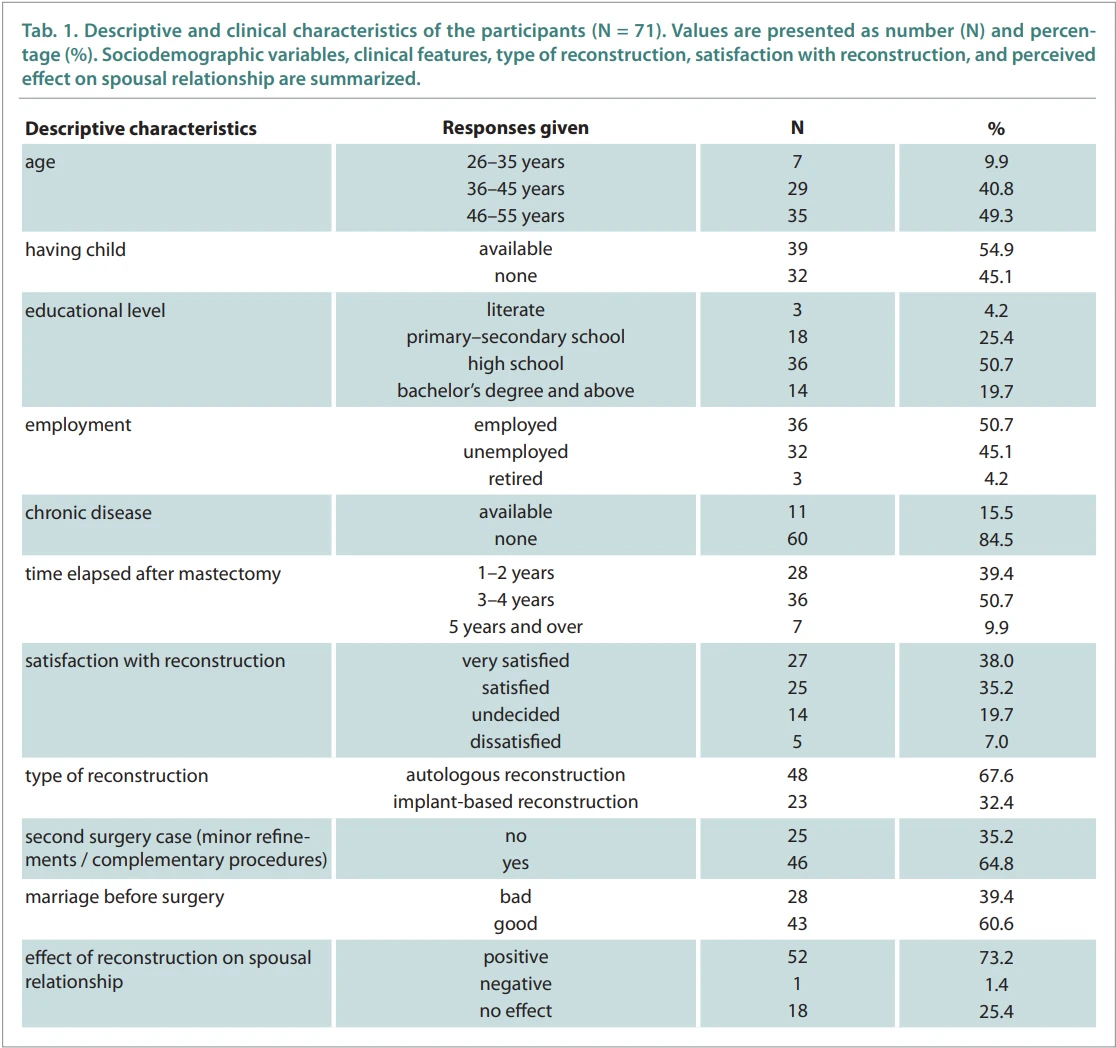
Participant characteristics are summarized in Tab. 1. The majority of participants were aged between 46 and 55 (N = 35), had completed high school education (N = 36), were employed (N = 36), and had children (N = 39), while only a small number of women reported a chronic disease (N = 11). All reconstructions in this study were delayed procedures. The interval between mastectomy and reconstruction was 3–4 years for most participiants (N = 36). Satisfaction with the surgical outcome was generally high; 27 participants reported being “very satisfied” and 25 reported being “satisfied”. Regarding the type of reconstruction, most participants underwent autologous reconstruction (N = 48), while the remaining participants received implant-based reconstruction (N = 23). A second surgical procedure was performed in 46 participants, primarily for minor refinements or complementary procedures rather than for a separate reconstructive intervention. Additionally, 43 participants described their marital relationships as good prior to surgery, while 52 women reported that breast reconstruction had a positive effect on their relationships with their partners.
Scale scores (Tab. 2)
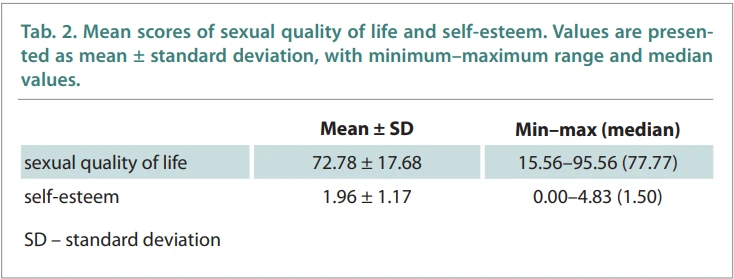
Mean SQOL-F was 72.78 ± 17.68 (range 15.56–95.56; median 77.77). Mean RSES was 1.96 ± 1.17 (range 0.00–4.83; median 1.50); in this scoring framework, lower RSES values reflect higher self-esteem.
Correlation between self-esteem and quality of sexual life (Tab. 3)
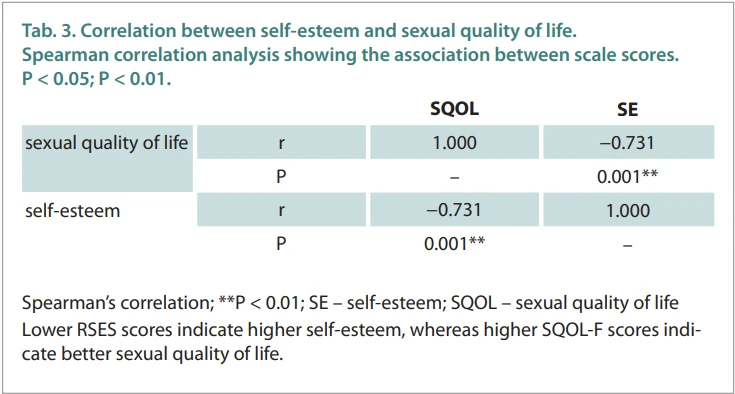
There was a strong correlation between self-esteem and sexual quality of life (Spearman r = –0.731; P < 0.001). Given the scoring direction of the scales – where lower scores on the Rosenberg self-esteem scale (RSES) reflect higher self-esteem – this negative value simply reflects that higher self-esteem was associated with better sexual quality of life.
Group comparisons (Tab. 4)
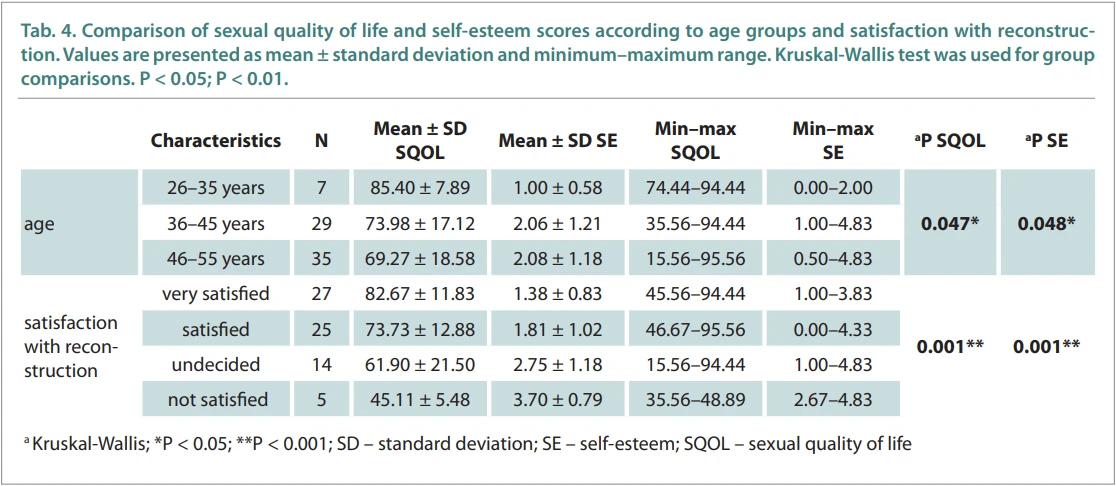
Women between 26 and 35 years showed better sexual quality of life and self-esteem scores compared with older participants (P = 0.047 and P = 0.048, respectively). Those who were very satisfied with their reconstruction also had noticeably better results on both scales than women who were dissatisfied (P < 0.001).
Multiple regression (Tab. 5)
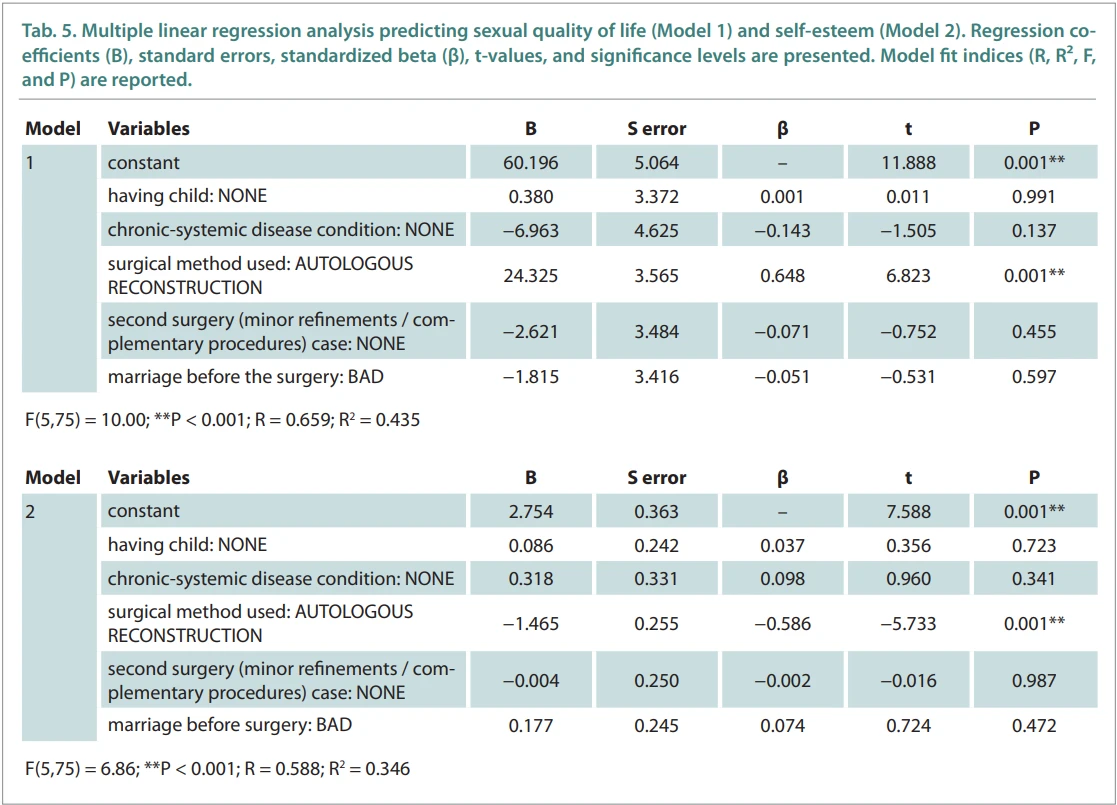
A strong and statistically significant association was observed between the independent variables and sexual quality of life (R = 0.659; P < 0.001). The model explained 43.5% of the variance in SQOL-Fscores (R2 = 0.435). Regression coefficients showed that autologous reconstruction, representing the surgical type variable, was a significant independent predictor of higher sexual quality of life scores (b = 24.33; P < 0.001). For self-esteem, a moderate but significant relationship was found (R = 0.588; P < 0.001), with the model explaining 34.6% of the variance in RSES scores (R2 = 0.346). Autologous reconstruction was again a significant predictor (b = −1.47; P < 0.001); given that higher RSES values indicate lower self-esteem, this negative coefficient (b = −1.47) reflects a positive association between autologous reconstruction and higher self-esteem.
Discussion
This study investigated the relationship between self-esteem and sexual quality of life among women who underwent breast reconstruction following mastectomy in Türkiye. The results demonstrated that women with autologous reconstruction reported significantly higher sexual quality of life and self-esteem compared with those who had implant-based reconstruction. Younger participants and those who expressed greater satisfaction with their reconstruction also had higher SQOL-F scores and lower RSES scores, indicating better sexual quality of life and higher self-esteem. These findings indicate that the psychological and sexual outcomes of breast reconstruction extend beyond the physical restoration of the breast itself [3,14,15,30].
Our results align with international literature suggesting that autologous procedures yield more favorable psychosocial outcomes than implant-based methods. Several studies have reported that women who underwent autologous tissue transfer experienced better satisfaction with body image, femininity, and sexual function compared with women who received implants [9,11,12,31]. These findings are consistent with recent randomized evidence showing superior quality-of-life outcomes after total autologous reconstruction using fat transfer compared with implant-based procedures [32]. Consistent with nursing-based evidence from Türkiye, autologous reconstruction has also been linked to a more natural contour, faster psychological recovery, and greater patient satisfaction [2]. In line with our findings, Toyserkani et al. [15] reported that autologous reconstruction contributes more effectively to emotional recovery, likely because it provides a more natural appearance and tactile sensation, reinforcing bodily integrity and confidence in intimate relationships.
These interpretations are further supported by systematic reviews demonstrating superior long-term psychosocial outcomes associated with autologous techniques [33–35].
Implant-based reconstruction, although less invasive and requiring shorter hospitalization, may not provide the same psychological reinforcement, especially when aesthetic expectations are unmet or complications such as capsular contracture occur [8,10]. The present study’s findings – showing a strong positive correlation between self-esteem and sexual quality of life – are consistent with evidence that self-esteem mediates the relationship between body image and intimacy [36]. The improvement in sexual quality of life among women with higher self-esteem reflects how reconstruction can help rebuild a sense of bodily wholeness, femininity, and confidence, which are integral components of psychosocial recovery after mastectomy [1,28].
In many public hospitals in Türkiye, immediate reconstruction is still not routinely performed. This situation largely stems from institutional limitations such as the shortage of microsurgery-trained plastic surgeons, restricted operating room capacity, and lower patient awareness of reconstructive options. Previous national reports confirm that delayed reconstruction remains common in tertiary centers [21,24,25]. These findings are consistent with broader international data suggesting that access to immediate reconstruction can be influenced by systemic organization, radiotherapy requirements, and resource allocation [5,6]. Together, these factors highlight how both structural and cultural dynamics shape the reconstructive journey of women with breast cancer in Türkiye.
The observed relationship between age and both self-esteem and sexual quality of life also echoes earlier findings that younger women tend to experience greater concern about body image and sexual intimacy after mastectomy [4,11]. Younger patients may have higher expectations for physical symmetry and attractiveness, making reconstructive outcomes particularly meaningful for their self-concept and partner relationships [33]. On the other hand, older women may prioritize health and survival over aesthetic outcomes, leading to lower psychosocial variability [12].
The exploratory comparisons between women who had autologous reconstruction and those who received implants need to be interpreted carefully. The groups were not the same size (48 vs. 23), and although the interval between mastectomy and reconstruction was documented, it was collected solely as descriptive information and was not suitable for inclusion in statistical modelling. Other factors known to influence psychosocial outcomes-such as radiotherapy exposure, oncologic treatment details, and individual anatomical characteristics-could not be included in the analyses because these data were not consistently available in medical records and were often not recalled with sufficient precision during patient interviews. Since these variables could not be accounted for, the subgroup findings should be considered hypothesis-generating rather than definitive. Studies with larger and more homogeneous samples will be needed to confirm these observations.
Limitations
This study is limited to women who underwent breast reconstruction in the plastic surgery clinic of the Training and Research Hospital where the study was conducted, so it cannot be generalised to all women who underwent breast reconstruction, but the results can be used to compare with the results of other studies. Since a certain time period was included in the study, the desired homogeneity in the age group could not be achieved, and the self-esteem and quality of sexual life of women who underwent breast reconstruction in pre-menopause and post-menopause periods may have been affected in different directions due to the predominance of the group with higher age. Although the study revealed significant findings regarding reconstruction types, the imbalance in group sizes (implant vs. autologous) may have limited the power of subgroup comparisons. As the comparison between reconstruction types was conducted as an exploratory analysis rather than a primary aim of the study, a balanced sample size was not ensured during the initial design. This imbalance potentially restricts the generalizability of the findings for the smaller implant group. Future studies are recommended to use a larger and more balanced sample size to confirm these findings.
Clinical implications
This study reveals that self-esteem and quality of sexual life are related to each other in women who have undergone breast reconstruction after mastectomy. The findings support the importance of holistic care approaches that address both psychosocial and sexual well-being in patients after mastectomy. In particular, body image disturbances and the resulting decline in self-esteem can significantly affect not only psychological outcomes but also the quality of their intimate relationships and sexual satisfaction. Therefore, post-mastectomy care should include structured support systems and counseling services aimed at improving body image and self-esteem.
Significantly, the study also found that women who underwent breast reconstruction using tissue transfer (autologous reconstruction) had a higher quality of sexual life than women who underwent implant-based reconstruction. This supports the importance of informing patients about the psychosocial and sexual health benefits of different reconstruction options and facilitating access to multidisciplinary teams, including plastic surgeons, nurses and sexual health counselors. Such an integrative approach has the potential to promote faster recovery, enhance psychological resilience, and improve overall quality of life in women affected with breast cancer.
Also, unlike many European countries where breast reconstruction is routinely offered immediately after mastectomy, the clinical and sociocultural context in Türkiye differs significantly. Women’s access to reconstruction after mastectomy varies according to patient awareness, cultural perceptions of femininity and sexuality, and economic and systemic health factors, but these factors influence whether women undergo reconstruction and what type of reconstruction they choose. These differences provide a unique perspective and support the importance of considering regional and sociocultural factors when evaluating outcomes such as self-esteem and sexual quality of life after mastectomy. Therefore, the findings of this study provide contextually valuable information for healthcare professionals working in non-European or resource--limited settings or in countries with similar sociocultural values to Türkiye.
Conclusion
In this study, women who underwent delayed breast reconstruction described generally positive psychosocial experiences, though their levels of self-esteem and quality of sexual life varied between reconstruction approaches. These observations indicate that psychosocial aspects of recovery deserve attention and should be part of the conservations held with women when planning reconstruction after mastectomy.
In this study, autologous reconstruction was associated with more favorable psychosocial outcomes compared with implant-based procedures.
Because the comparisons between autologous and implant-based procedures were exploratory, the findings mainly highlight the importance of offering counseling that reflects each woman’s expectations and circumstances-both physical and emotional. This is especially relevant in health care settings where reconstruction is not routinely available, underscoring the need for clear information and supportive guidance during decision-making.
Ethics approval
This study was approved by the Clinical Research Ethics Committee of Health Sciences University, Şişli Hamidiye Etfal Training and Research Hospital (approval No.: 2162; date: 6 November 2018) and conducted in accordance with the Declaration of Helsinki. Additionally; institutional permission was granted by the hospital’s chief physician.
Informed consent
Written informed consent was obtained from all individual participants included in the study.
Funding
The authors received no financial support or funding for the research, authorship, and/or publication of this article.
Conflict of interest statement
The authors declare no conflict of interest.
Roles of the authors
All listed authors contributed to this article. Cansu Mert designed the study, collected and analyzed the data, and drafted the manuscript. İkbal Çavdar supervised the research process, contributed to the interpretation of the findings, and critically revised the manuscript for intellectual content. Both authors reviewed and approved the final version of the manuscript.
Sources
1. Neto MS., de Aguiar Menezes MV., Moreira JR. Sexuality after breast reconstruction post mastectomy. Aesthetic Plast Surg. 2013, 37 (3): 643–647.
2. Gülşen M., Akansel N. Hastanın kendi dokusu kullanılarak oluşturulan meme rekonstrüksiyonları ve hemşirelik bakımı. JAREN. 2018, 4 (1): 45–51.
3. Álvarez-Pardo S., De Paz JA., Montserrat Romero-Pérez E., et al. Factors associated with body image and self-esteem in mastectomized breast cancer survivors. Int J Environ Res Public Health. 2023, 20 (6): 5154.
4. Roy N., Downes MH., Ibelli T., et al. The psychological impacts of post-mastectomy breast reconstruction: a systematic review. Ann Breast Surg. 2024, 8 : 19.
5. Dibbs R., Trost J., DeGregorio V., et al. Free tissue breast reconstruction. Semin Plast Surg. 2019, 33 (1): 59–66.
6. Alves AS., Tan V., Scampa M., et al. Complications of immediate versus delayed DIEP reconstruction: a meta-analysis of comparative studies. Cancers (Basel). 2022, 14 (17): 4272.
7. Siqueira HFF., Teixeira JLA., Lessa Filho RDS., et al. Patient satisfaction and quality of life in breast reconstruction: assessment of outcomes of immediate, delayed, and nonreconstruction. BMC Res Notes. 2020, 13 (1): 223.
8. Kidd T., McCabe G., Tait J., et al. Implant reconstruction after mastectomy: a review and summary of current literature. Cancer Treat Res Commun. 2024, 40 : 100821.
9. Christodoulou N., Secanho M., Kokosis G., et al. Capsular contracture in breast reconstruction: a systematic review and meta-analysis. J Plast Reconstr Aesthet Surg. 2024, 98 : 131–143.
10. Chao AH. Safe and efficient implant-based breast reconstruction. Plast Reconstr Surg Glob Open. 2020, 8 (9): e3134.
11. Howes BH., Watson DI., Xu C., et al. Quality of life following total mastectomy with and without reconstruction versus breast-conserving surgery for breast cancer: a case-controlled cohort study. J Plast Reconstr Aesthet Surg. 2016, 69 (9): 1184–1191.
12. Matthews H., Carroll N., Renshaw D., et al. Predictors of satisfaction and quality of life following post-mastectomy breast reconstruction. Psychooncology. 2017, 26 (11): 1860–1865.
13. Liu YT., Khan NH., Bordes MC., et al. Impact of autologous breast reconstruction on bra fit. Support Care Cancer. 2024, 32 (2): 105.
14. Sgarzani R., Negosanti L., Morselli PG., et al. Patient satisfaction and quality of life in DIEP flap versus implant breast reconstruction. Surg Res Pract. 2015, 2015 : 405163.
15. Toyserkani NM., Jørgensen MG., Tabatabaeifar S., et al. Autologous versus implant-based breast reconstruction: a systematic review and meta-analysis of Breast-Q patient-reported outcomes. J Plast Reconstr Aesthet Surg. 2020, 73 (2): 278–285.
16. Saraç Ö., Akdeniz Doğan ZD., Önal M., et al. Otolog doku ve implant ile meme rekonstrüksiyonunda hasta memnuniyetinin BREAST-Q sonuçları ile karşılaştırılması. In: 43. Ulusal Kurultayı. Antalya: Türk Plastik Rekonstrüktif ve Estetik Cerrahi Derneği 2021.
17. Albornoz CR., Bach PB., Mehrara BJ., et al. A paradigm shift in U.S. breast reconstruction: increasing implant rates. Plast Reconstr Surg. 2013, 131 (1): 15–23.
18. Jeevan R., Cromwell DA., Browne JP., et al. Findings of a national comparative audit of mastectomy and breast reconstruction surgery in England. J Plast Reconstr Aesthet Surg. 2014, 67 (10): 1333–1344.
19. National Institute for Health and Care Excellence. Early and locally advanced breast cancer: diagnosis and management (NG101). London: NICE, 2018.
20. Gilmour A., Cutress R., Gandhi A., et al. Oncoplastic breast surgery: a guide to good practice. Eur J Surg Oncol. 2021, 47 (9): 2272–2285.
21. Çakmak GK., Emiroğlu S., Sezer A., et al. Surgical trends in breast cancer in Turkey: an increase in breast-conserving surgery. JCO Glob Oncol. 2020, 6 : 285–292.
22. Kazanç Ş. Mastektomi olan hastalar ile yapılan lisansüstü tezlerin incelemesi: bir sistematik derleme. Ordu University J Nurs Stud. 2024, 7 (3): 866–878.
23. Aljaaly HA., Mortada H., Trabulsi NH. Patient perceptions and determinants of choice for breast reconstruction after mastectomy among Saudi patients. Plast Reconstr Surg Glob Open. 2021, 9 (9): e3750.
24. Baltu Y., Aydın O. Delayed breast reconstruction with latissimus dorsi myocutaneous flap and implant in patients undergoing total mastectomy. Acta Haematol Oncol Turc. 2018, 51 (2): 235–239.
25. Serel S., Sefa Özden N., Aydınlı Y., et al. Effects of delayed breast reconstruction on the thoracolumbar vertebrae in patients undergoing unilateral mastectomy: A retrospective cohort study. J Plast Reconstr Aesthet Surg. 2022, 75 (9): 3022–3029.
26. Rosenberg M. Society and the adolescent self-image. Princeton (USA): Princeton University Press, 1965.
27. Çuhadaroğlu F. Adölesanlarda benlik saygısı. Ankara: Hacettepe üniversitesi, Tıp Fakültesi, Psikiyatri Bőlümü, Ankara, 1986.
28. Symonds T., Boolell M., Quirk F. Development of a questionnaire on sexual quality of life in women. J Sex Marital Ther. 2005, 31 (5): 385–397.
29. Tuğut N., Gölbaşı Z. Cinsel Yaşam Kalitesi Ölçeği – Kadın Türkçe Versiyonunun geçerlik ve güvenirlik çalışması. CMJ. 2010, 32 (2): 172–180.
30. Archengelo SCV., Sabino Neto M., Veiga DF., et al. Sexuality, depression and body image after breast reconstruction. Clinics (Sao Paulo). 2019, 74: e883.
31. Dempsey K., Mathieu E., Brennan M., et al. The role of breast reconstruction choice on body image patient-reported outcomes at four years post-mastectomy for breast cancer: a longitudinal prospective cohort study. Psychooncology. 2022, 31 (1): 54–61.
32. Piatkowski AA., Wederfoort JLM., Hommes JE., et al. Effect of total breast reconstruction with autologous fat transfer using an expansion device vs implants on quality of life among patients with breast cancer: a randomized clinical trial. JAMA Surg. 2023, 158 (5): 456–464.
33. Gil-Olarte P., Gil-Olarte MA., Gómez-Molinero R., et al. Psychosocial and sexual well-being in breast cancer survivors undergoing immediate breast reconstruction: the mediating role of breast satisfaction. Eur J Cancer Care (Engl). 2022, 31 (6): e13686.
34. Sadok N., Krabbe-Timmerman IS., Buisman NH., et al. Short-term quality of life after autologous compared with alloplastic breast reconstruction: a prospective study. Plast Reconstr Surg. 2023, 152 (4S): 55S–68S.
35. Sungkar A., Yarso KY., Nugroho DF., et al. Patients’ satisfaction after breast reconstruction surgery using autologous versus implants: a meta-analysis. Asian Pac J Cancer Prev. 2024, 25 (4): 1205–1212.
36. Topaloğlu Ören ED., Yaşar Ö. Self-esteem and quality of sexual life in women at the postpartum period: a cross-sectional study. Androl Bul. 2023, 25 (4): 246–254.
Labels
Plastic surgery Orthopaedics Burns medicine TraumatologyArticle was published in
Acta chirurgiae plasticae
2026 Issue 1-2
Most read in this issue
- A systematic review of sensory outcomes in nipple reinnervation after implant-based breast reconstruction
- Principles of nasal framework reconstruction for complex nasal defects: review
- Self-esteem and quality of sexual life in women undergoing breast reconstruction due to mastectomy: a cross-sectional study in a non-European setting
- Cutting-edge biotechnological strategies to enhance autologous fat graft survival