
Labial adhesion in an adult – clinical manifestation and treatment: a case report
Authors:
K. N. Manjunath 1; G. S. Jyothi 2; P. Shivadass 1; B. P. Sanmathi 1; B. M. Shwetha 1; K. Lohia 1
Authors‘ workplace:
Department of Plastic Surgery, Ramaiah Medical College, Bangalore, India
1; Department of Obstetrics and Gynaecology, Ramaiah Medical College, Bangalore, India
2
Published in:
ACTA CHIRURGIAE PLASTICAE, 68, 1-2, 2026, pp. 69-71
doi:
https://doi.org/10.48095/ccachp202669
Manjunath KN, Shivadass P, Jyothi GS et al. Labial adhesion in an adult – clinical manifestation and treatment: a case report. Acta Chir Plast 2026; 68 (1–2): 69–71.
Introduction
Infertility is a major concern in young couples. The causes can be in both sexes. In females, the majority of the causes is endocrinal. Anatomical deformities are minor causes of infertility. Among these, internal genital tract deformities (like absent uterus, bicornuate uterus) top the list. Deformities of external genitalia are rare. Among this labial adhesion which is more prevalent in pre-pubertal age can also be one of the causes. The present case is to highlight the importance of thorough clinical examination as the treatment of this condition is simple.
Case presentation
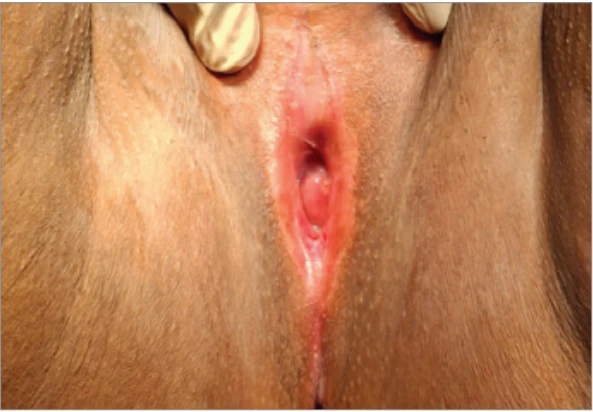
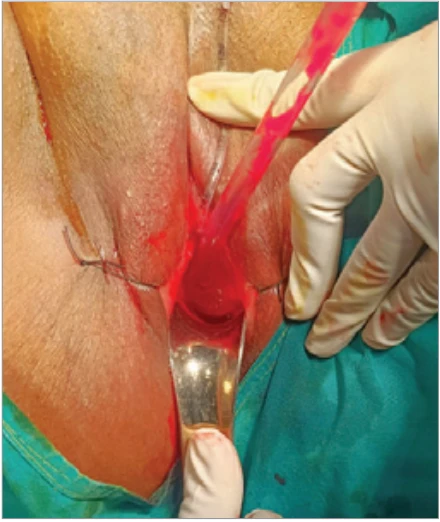
The patient in early thirties was unable to conceive for the past 5 years. Patient had visited various physicians and taken medical treatment. But was not successful. She visited the obstetrician at our hospital with the same complaint. On thorough history taking, the couple said they were unable to have normal sexual intercourse. He was unable to penetrate her vagina completely. On examination the vaginal opening was narrow. There was thick band of labial adhesion both cranially and caudally (Fig. 1). On speculum examination cervical opening was visible (Fig. 2). Urethral opening was not at all visible, but the patient had no complaints.
As a part of the investigations, we did routine blood tests and endocrine work up. Apart from her hypothyroid status nothing was abnormal. Micturating cysto-urethrogram showed normal urinary tract. Magnetic resonance imaging of the abdomen showed normal genital tract organs as well.
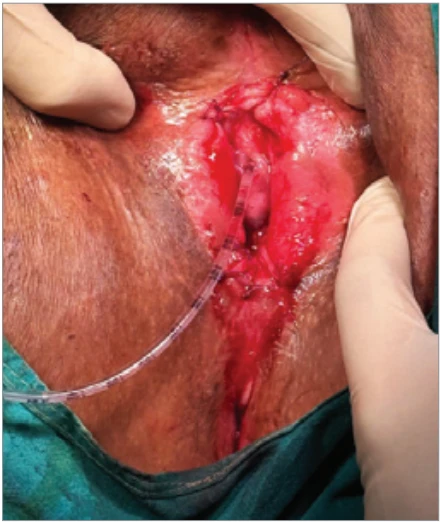
Under spinal anesthesia, cystoscopy and foleys catheterization was the first step. This confirmed that the urinary tract was normal. Only abnormality was labial adhesion with a thick fibrotic band in the midline. The band was surgically released to increase the vaginal opening with advancement of the vaginal mucosa into the defect (Fig. 3). After the wound healing, patient was advised to do serial dilatation so that re-adhesion is prevented. 6 months post-surgery couple was having normal sexual intercourse.
Discussion
Labial agglutinations, labial fusion, labial adhesions are all synonymous medical conditions. These occur mostly at the early age. The exact prevalence is not known. The estimation of prevalence is also difficult as many parents are not aware of the condition. Studies have reported varied prevalence rate from 3.3% to 38.9% [1,2]. Pathophysiology of these labial adhesions is thought to be inflammation. The aetiology of this inflammation of labia minora is multifactorial. Minor causes like poor hygiene and continuous diaper use can lead to labial adhesions. In majority of the cases deficiency of the oestrogen leads to labial inflammation and pre-pubertal adhesion. Other causes include trauma or infection at early age. In little children (2–10 years) the labial adhesions can be due to lichen sclerosis as well. This is a condition where the inflammation of the vulva can give rise to adhesions. The patients who are known to have this condition need to be constantly followed up to detect early labial adhesion and treat the condition [3]. Other infections like candida and bacterial infections can also lead to labial adhesions. Our patient had no history of the above. Even on investigations she was only hypothyroid. Patient probably developed this condition due to oestrogen deficiency.
These labial adhesions are usually asymptomatic [4]. The symptoms, even when present are often not very disturbing. Urinary frequency, urinary tract infection and very rarely vaginitis and post void dripping are the symptoms in few cases [5]. Our patient also had no symptoms. Since the time the patient was married, she was unable to conceive. The only symptom was infertility for which she had visited an obstetrician. The obstetrician examined the patient and referred her to plastic surgery. Thorough evaluation has shown that the patient had very small vaginal opening and thick midline raphe. Labia majora were normal but labia minora was not defined well. Even the urethral opening was not developed but the patient had no symptoms. Hence, the patient was referred to micturating cystourethrogram. After micturating cystourethrogram the urinary tract was found to be normal. So patient was diagnosed with partial labial adhesion (Fig. 1). Conservative management is advised in most patients with labial adhesion, who are asymptomatic. In the early age, topical oestrogen is used [6]. Care should be taken to select oestrogen cream without alcohol so that burning or irritation is avoided. Application is aimed to break the adhesion in midline so that the labia are separated [3,7]. In the literature there has been a debate about the usefulness of topical oestrogen. But it is shown that topical oestrogen is helpful than the wait and watch policy [8–10]. Other alternative is corticosteroids. These measures are effective in pre-pubertal patients. In our patient the adhesions were thick fibrous bands and regular per vaginal examination was very painful. Hence, she needed surgical separation in the midline and advancement of the vaginal mucosa. After the procedure the vaginal opening increased on long term follow up, the patient was able to have sexual intercourse without pain. The couple is now hoping to conceive. The patient and the spouse both were happy as her long-term problem was solved with simple procedure.
Conclusion
Labial adhesion is mostly found in pre-pubertal age, prevalence in adult age is rare.
But when present in adults, it could be the reason for complex problem. Although diagnosis is challenging, treatment is simple.
Roles of the authors
Manjunath Kalapurmatt Nagabhushanaiah – design of the article; Priyadarshini Shivadass – corresponding author; Jyothi G Seshadri – clinical investigator, data collection and analysis; Shwetha B M, Sanmathi Parasuramulu – performing surgeries, clinical investigators.
Disclosure
The authors have no conflicts of interest to disclose. The authors declare that this study has received no financial support. All procedures performed in this study involving human participants were in accordance with ethical standards of the institutional ethics committee and with the Helsinki declaration and its later amend-ments or comparable ethical standards. Since the study had any new intervention, approval from the institutional ethics committee was not necessary.
Sources
1. McCann J., Wells R., Simon M., et al. Genital findings in prepubertal girls selected for nonabuse: a descriptive study. Pediatrics. 1990, 86 (3): 428–439.
2. Berenson AB., Heger AH., Hayes JM., et al. Appearance of the hymen in prepubertal girls. Pediatrics. 1992; 89 (3): 387–394.
3. Van Eyk N., Allen L., Giesbrecht E., et al. Pediatric vulvovaginal disorders: a diagnostic approach and review of the literature. J Obstet Gynaecol Can. 2009, 31 (9): 850–862.
4. Mayoglou L., Dulabon L., Martin-Alguacil N., et al. Success of treatment modalities for labial fusion: a retrospective evaluation of topical and surgical treatments. J Pediatr Adolesc Gynecol. 2009, 22 (4): 247–250.
5. Bacon JL., Romano ME., Quint EH. Clinical recommendation: labial adhesions. J Pediatr Adolesc Gynecol. 2015, 28 (5): 405–409.
6. ACOG Practice Bulletin No. 93: diagnosis and management of vulvar skin disorders. Obstet Gynecol. 2008, 111 (5): 1243–1253.
7. Quint EH. Labial agglutination in a teenager. J Pediatr Adolesc Gynecol. 2003, 16 (1): 61–62.
8. Murina F., Fochesato C., Savasi VM. Treatment of prepubertal labial adhesions with topical estriol + testosterone: a case report. Pediatr Rep. 2024, 16 (3): 558–565.
9. Eroğlu E., Yip M., Oktar T., et al. How should we treat prepubertal labial adhesions? Retrospective comparison of topical treatments: estrogen only, betamethasone only, and combination estrogen and betamethasone. J Pediatr Adolesc Gynecol. 2011, 24 (6): 389–391.
10. Schober J., Dulabon L., Martin-Alguacil N., et al. Significance of topical estrogens to labial fusion and vaginal introital integrity. J Pediatr Adolesc Gynecol. 2006, 19 (5): 337–339.
Labels
Plastic surgery Orthopaedics Burns medicine TraumatologyArticle was published in
Acta chirurgiae plasticae
2026 Issue 1-2
Most read in this issue
- A systematic review of sensory outcomes in nipple reinnervation after implant-based breast reconstruction
- Principles of nasal framework reconstruction for complex nasal defects: review
- Self-esteem and quality of sexual life in women undergoing breast reconstruction due to mastectomy: a cross-sectional study in a non-European setting
- Cutting-edge biotechnological strategies to enhance autologous fat graft survival