
Cylindroma – an “untreatable” condition with a simple surgical solution: a case report
Authors:
N. Krzoková 1,2; G. Badida 1,2; B. Zálešák 1,2; D. Skanderová 2
Authors‘ workplace:
Department of Plastic and Aesthetic Surgery, University Hospital Olomouc, Czech Republic
1; Faculty of Medicine and Dentistry, Palacký University Olomouc, Czech Republic
2
Published in:
ACTA CHIRURGIAE PLASTICAE, 68, 1-2, 2026, pp. 52-55
doi:
https://doi.org/10.48095/ccachp202652
Krzoková N, Badida G, Zálešák B et al. Cylindroma – an “untreatable” condition with a simple surgical solution: a case report. Acta Chir Plast 2026; 68 (1–2): 52–55.
Introduction
Cylindroma is a rare benign tumor. The term “cylindroma” was first introduced by Billroth in 1856 to describe an orbital tumor characterized by a hyaline appearance [1]. Multiple cylindromas are more frequently observed in females and typically present across a broad age range, most often during the second and third decades of life [2]. Clinically, it presents as slowly growing [3], smooth, erythematous nodules. It may occur as a solitary lesion or as multiple tumors, predominantly localized on the scalp (turban tumor), as well as on the face and in the periauricular region. Sporadic cases have been described on the trunk and extremities [4]. Occurrences in the lung and parotid gland have also been documented [5]. Because adnexal structures are compressed by the tumor process, cylindromas are characteristically devoid of hair [6]. Lesion size ranges from a few millimeters to several centimeters [7]. Malignant transformation is exceptional and has been reported primarily in cases with multiple lesions on the scalp. Indicators of malignant transformation include ulceration, bleeding, rapid enlargement, and a change in color from bluish to pink [8]. Multiple cylindromas are inherited in an autosomal dominant manner and may represent part of Brooke-Spiegler syndrome [7]. This rare condition predisposes affected individuals to multiple cutaneous adnexal tumors, most commonly cylindromas, trichoepitheliomas, spiradenomas, trichoblastomas, follicular cysts, organoid nevi and basal-cell carcinomas [9].
Case presentation
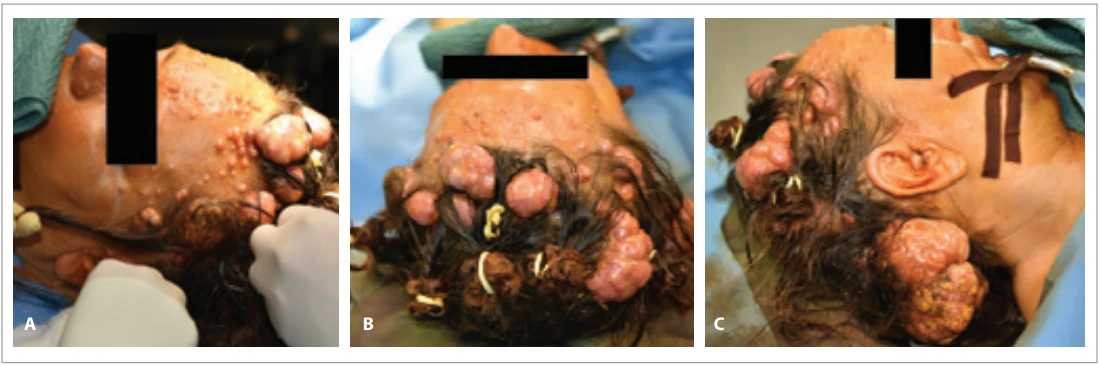
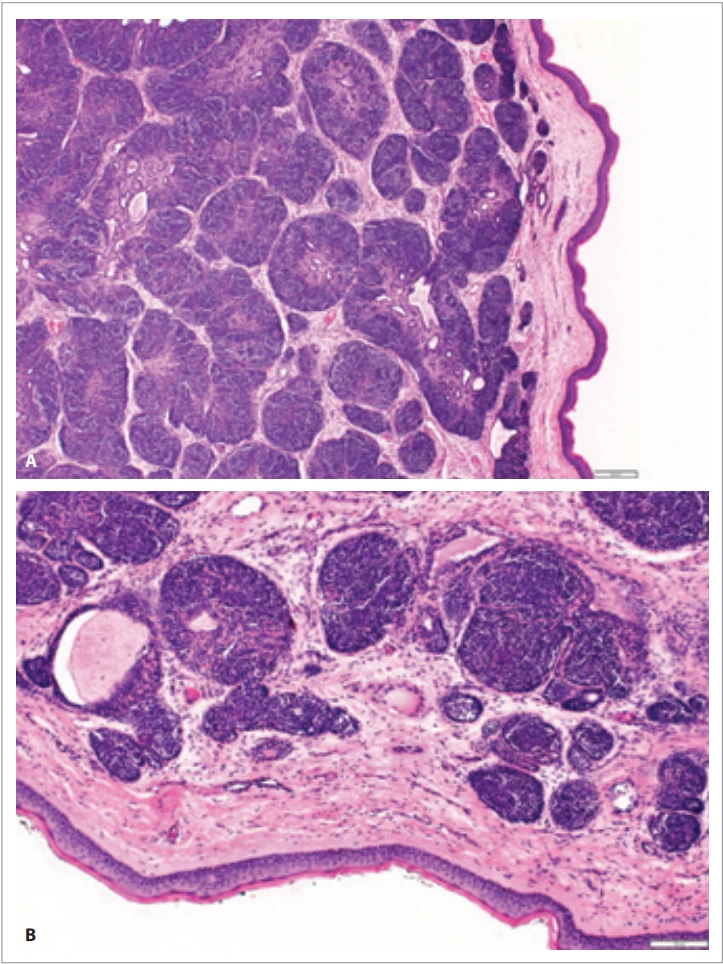
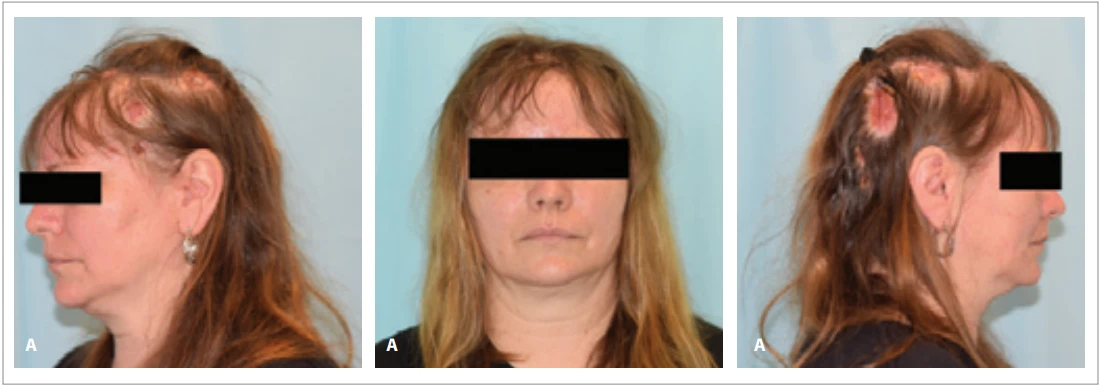
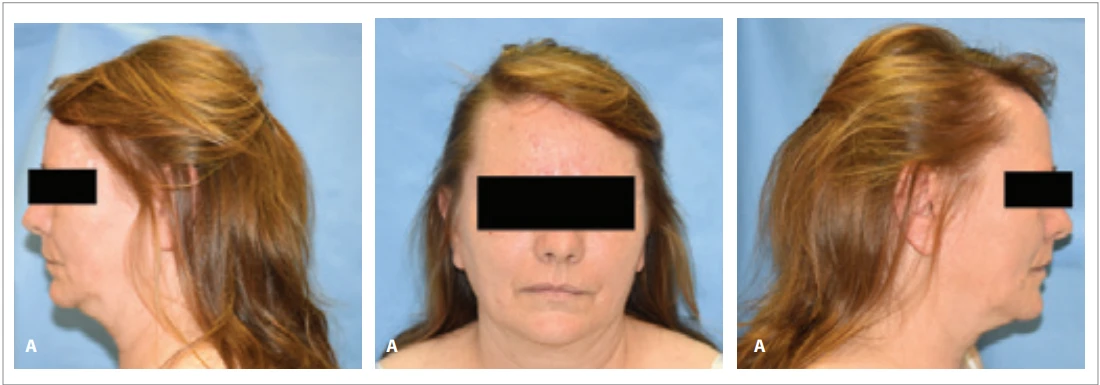
The patient, a 46-year-old woman, had experienced slowly growing cutaneous tumors since the age of 15, initially localized to the face (predominantly the forehead) and later also affecting the scalp. Apart from these lesions, she was otherwise healthy, was taking no regular medication, and was a non-smoker. Family history was negative for dermatological diseases. An initial diagnostic excision performed at a regional facility confirmed the diagnosis of cylindroma on histopathological examination. Repeated laser treatments of the frontal lesions had been attempted, but without success. The patient was first evaluated at our department in April 2021. On clinical examination, multiple isolated, skin--colored nodules up to 1 cm in diameter were present in the frontal region, with similar findings also observed in the external auditory canals. Within the scalp, numerous dispersed nodules and larger pinkish tumors were noted, in some areas forming clusters (up to 10 cm). Following discussion with the patient, surgical management was indicated (Fig. 1). In May 2021, the patient underwent shaving excision and excision with coagulation of the tumor bed. A total of 15 large cylindromas were removed from the scalp. In addition, multiple lesions located on the forehead, nose, cheeks, and periauricular regions were managed by shaving excision, incision, and curettage with a sharp spoon, resulting in the removal of 99 small cylindromas. The surgical defects were initially covered with a temporary synthetic material (COM, VUP Medical, Brno, Czechia), which was removed on postoperative day six. The wounds were subsequently left to heal by secondary intention. Postoperatively, the patient received a 7-day course of systemic prophylactic antibiotics and intravenous corticosteroid therapy (to reduce postoperative edema and inflammation). Wound dressings were changed every 48 h. During routine follow-up, progressive granulation, epithelization and shrinking were observed, leading to complete spontaneous closure of all defects. Histopathological examination confirmed multiple eccrine cylindromas with spiradenocylindromas, a finding that may be associated with Brooke--Spiegler syndrome (Fig. 2). Therefore, molecular genetic testing was completed. However, no pathogenic variants were identified in any of the 22 analyzed genes linked to hereditary tumor syndromes, including the CYLD tumor suppressor gene. In January 2022, due to residual cylindromas, the patient underwent additional incision and curettage, combined with plasma pen treatment of the lesions. Complete healing was achieved within one month. The patient has since remained under regular surveillance at our department. Between January 2022 and the most recent follow-up in June 2025, only three minor procedures under local anesthesia were required. These were performed for early-detected, newly arising cylindromas and were successfully managed by curettage in combination with fractional CO₂ laser therapy, with excellent therapeutic outcomes (Fig. 3, 4).
Discussion
An important consideration in cylindromas is their potential for malignant transformation, although this event remains rare. For this reason, surgical excision serves not only as a therapeutic intervention but also as a valuable diagnostic tool for early detection. Despite these benefits, excision frequently results in large tissue defects, particularly when multiple or extensive lesions are removed. Singh et al. [10] reported successful reconstruction of defects using rotation flaps and skin grafts. However, this approach was not feasible in our case, as the defects were extensive and located in proximity, which made the use of any rotational flap impossible. Moreover, the use of skin grafts alone would have required an extensive amount of autologous donor tissue. Nevertheless, techniques are well established and represent valid reconstructive options. Lo et al. [5] documented a case of cylindroma involving the concha and external auditory canal that was successfully managed with Mohs micrographic surgery. According to Kuklani et al. [2] the treatment of choice for solitary lesions is wide local excision, as these tumors carry an unfavorable recurrence rate and a potential risk of malignant transformation. Alternative therapeutic approaches include Mohs micrographic surgery, laser ablation, electrodessication/curettage, cryotherapy, application of trichloroacetic acid or retinoic acid, carbon dioxide laser treatment, and radiotherapy. In cases of multiple cylindromas, extensive reconstructive surgery is often required; however, this may be avoided by serial excision of groups of nodules in multiple staged procedures [2]. In cases of extensive scalp involvement, especially with ulcerated or confluent lesions, more radical approaches such as partial or total scalp excision have been reported. From a reconstructive standpoint, the choice of technique must balance oncologic safety, cosmetic outcome and scalp preservation. In our case, the clinical presentation was exceptional because of the unusually large size of the cylindromas, requiring a tailored, patient-specific surgical strategy. Our experience demonstrates that surgical excision, shaving reduction or curettage is cheap and when combined with laser treatment, followed by secondary intention healing, appears to be a valuable therapeutic approach in cylindromas. We can achieve exceptional aesthetic results in long-term control with this condition.
Conclusion
The diagnosis of cylindroma requires close collaboration between dermatologists, oncologists, pathologist and plastic surgeons to ensure both oncologic safety and aesthetic restoration. The role of curettage and shaving reduction has been underestimated. In this case, we demonstrate that simple curettage, shave reduction, and secondary healing with appropriate wound care can eliminate the need for extensive surgery and achieve remarkable cosmetic and functional results. Furthermore, our findings suggest that even defects of substantial size can be addressed effectively with straightforward surgical techniques. This can significantly improve patients’ self--confidence, quality of life, and help overcome the psychological stigma associated with this mutilating disease. For this reason, it is important to encourage patients to make their decision to undergo treatment early in their life.
Roles of the authors
Nela Krzoková – performed the literature search, drafted the manuscript and wrote the final version of the manuscript; Gabriel Badida – contributed to the surgical treatment of the patient; Bohumil Zálešák – initiated treatment and performed initial surgery; Daniela Skanderová – assisted with the pathological examination of the patient and provided photographic documentation.
Disclosure
The authors have no conflicts of interest to disclose. The authors declare that this study has received no financial support. All procedures performed in this study involving human participants were in accordance with ethical standards of the institutional and/or national research committee and with the Helsinki declaration and its later amendments or comparable ethical standards.
Sources
1. Jordão C., de Magalhães TC., Cuzzi T., et al. Cylindroma: an update. Int J Dermatol. 2015, 54 (3): 275–278.
2. Kuklani RM., Glavin FL., Bhattacharyya I. Malignant cylindroma of the scalp arising in a setting of multiple cylindromatosis: a case report. Head Neck Pathol. 2009, 3 (4): 315–319.
3. Chaer RA., Lipnick S. Images in clinical medicine. Cylindroma. N Engl J Med. 2004, 351 (24): 2530.
4. Benign tumours with apocrine and eccrine differentiation. In: LeBoit PE., Burg G., Weedon D., et al. (eds.). Pathology and genetics of skin tumours, Vol. 6. Lyon (France): IARC Press 2006 : 145 – 146.
5. Lo JS., Snow SN., Mohs FE. Cylindroma treated by Mohs micrographic surgery. J Dermatol Surg Oncol. 1991, 17 (11): 871–874.
6. Löser C., Rütten A., Dippel E. Zylindrome – selten aber eindrucksvoll [Cylindromas-rare but striking]. Hautarzt. 2019, 70 (9): 677–683.
7. Requena L., Sangüeza O. Cutaneous adnexal neoplasms. Cham (Switzerland): Springer International Publishing, 2017. Cylindroma and Spiradenoma, p. 145–153.
8. Schmaltz R., Müller CS., Vogt T. Plötzliches Grössenwachstum vorher indolenter Knoten am Capillitium [Sudden growth of previously indolent scalp nodule]. Hautarzt. 2010, 61 (6): 518–521.
9. Kim C., Kovich OI., Dosik J. Brooke-Spiegler syndrome. Dermatol Online J. 2007, 13 (1): 10.
10. Singh DD., Naujoks C., Depprich R. et al. Cylindroma of head and neck: review of the literature and report of two rare cases. J Craniomaxillofac Surg. 2013, 41 (6): 516–521.
Labels
Plastic surgery Orthopaedics Burns medicine TraumatologyArticle was published in
Acta chirurgiae plasticae
2026 Issue 1-2
Most read in this issue
- A systematic review of sensory outcomes in nipple reinnervation after implant-based breast reconstruction
- Principles of nasal framework reconstruction for complex nasal defects: review
- Self-esteem and quality of sexual life in women undergoing breast reconstruction due to mastectomy: a cross-sectional study in a non-European setting
- Cutting-edge biotechnological strategies to enhance autologous fat graft survival