
Case report of severe complications after gel injection breast augmentation – treatment and use of hemostatic net for effective management
Authors:
T. Votruba 1,2; K. Procházková 1,3; B. Lipový 4; P. Kurial 1; J. Fau 1; P. Vodička 1; V. Mařík 1
Authors‘ workplace:
Department of Plastic Surgery, Hospital České Budějovice, Czech Republic
1; Third Faculty of Medicine, Charles University, Prague, Czech Republic
2; Faculty of Health and Social Sciences, University of South Bohemia, České Budějovice, Czech Republic
3; Department of Burns Medicine, Third Faculty of Medicine, Charles University and University Hospital Královské Vinohrady, Prague, Czech Republic
4
Published in:
ACTA CHIRURGIAE PLASTICAE, 67, 3, 2025, pp. 210-213
doi:
https://doi.org/10.48095/ccachp2025210
Introduction
Breast augmentation is a popular cosmetic surgery. Historically, various materials have been used for this procedure. Initially, vegetable oil, paraffin, and Vaseline were tried. Later, liquid silicone injections were introduced, followed by polyacrylamide hydrogel (PAAG) in the 1980s, marketed as an ideal soft tissue filler. However, all these materials resulted in similar issues: chronic inflammation, granulomas, and severe tissue reactions. Patients often experienced pain, breast hardening, deformities, lumps, gel migration and leakage, pulmonary embolism, ulcers, fistulas, infections, and necrosis. These complications frequently led to breast amputation. Later, copolyamide fillers were introduced, but they caused the same issues, and it was proved, that the copolyamide has the same composition as PAAG. Ultimately, all these fillers proved unsuitable for breast augmentation [1–8].
Although warnings about complications from this augmentation method surfaced over 20 years ago, gel use in breast augmentation remains common. Many misleading digital ads promise natural-looking results without surgery or general anesthesia. Despite these claims, the Food and Drug Administration (FDA) has not approved this method, and China’s National Medical Products Administration (NMPA) banned PAAG production and use in cosmetic procedures in 2006 [9], it is still used in some European and Asian countries [10]. This method poses local complications and possibly even life-threatening risks. We present a case report of septic complications after gel breast augmentation.
Case report
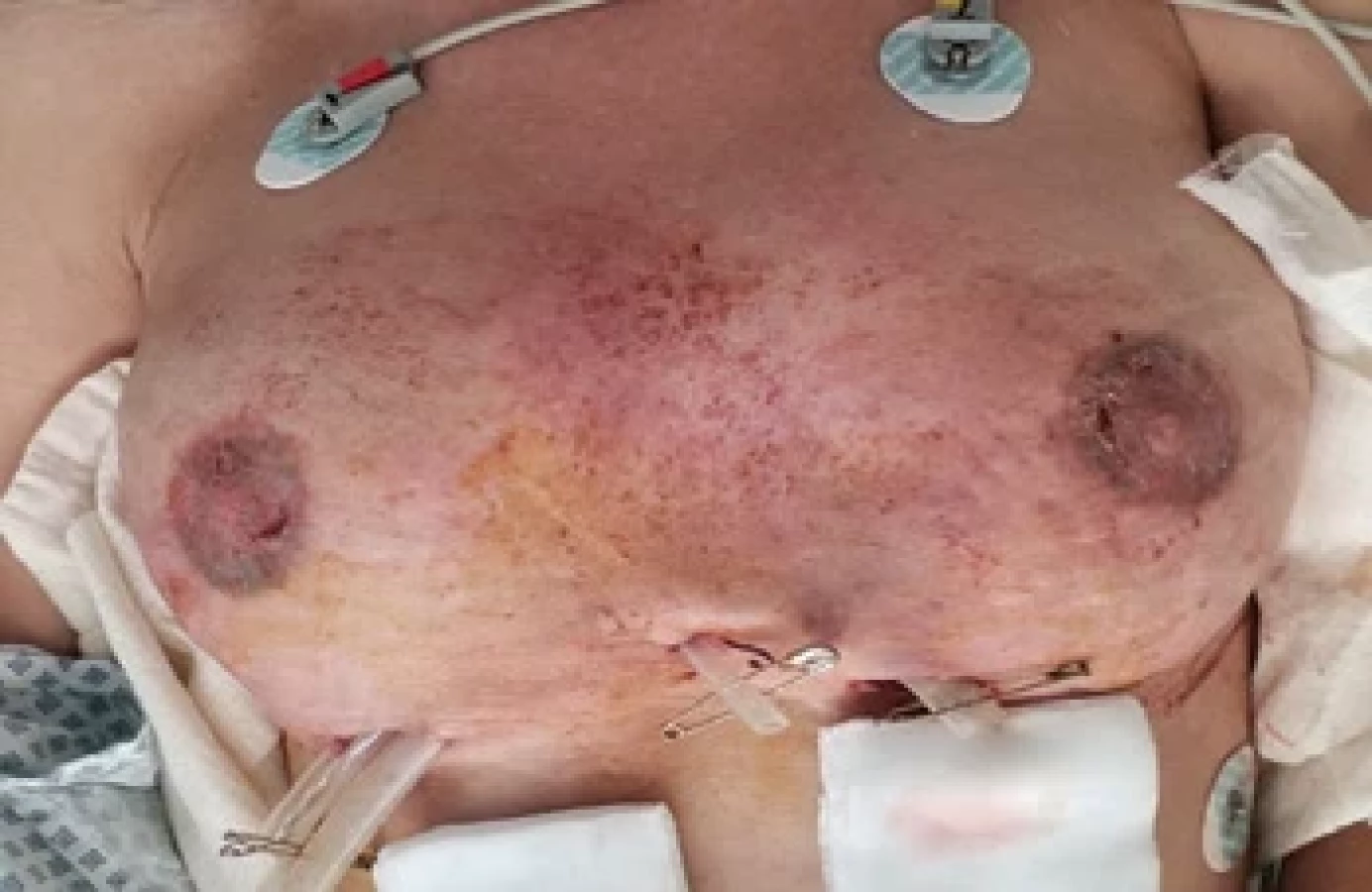
A 46-year-old patient underwent breast augmentation in 2004, with implant replacements in 2019. In April 2022, the patient opted for smaller implants and breast lift. In December 2022, a gel injection boost (Los Deline, Biotrh s. r. o., Prague, Czech Republic) was applied. Partial gel extraction was performed 4 months later, with another aspiration scheduled after the patient’s vacation. Our first contact with the patient occurred in June 2023, when she was brought to the emergency room (Fig. 1) in septic condition (38.6 °C, CRP 369 mg/L, tachycardia 104/min, hypotension 75/55). A CT scan revealed a preimplantation collection, gas bubbles, and reactive pleural effusion (Fig. 2, 3). Initial lavage and drainage were performed (Fig. 4). The patient was further cared for in the intensive care unit. Once the patient’s condition was stabilized, a significant amount of gel was drained through the inframammary incision (total volume of material was 400 mL) (Fig. 5, 6). However, 2 months later, the patient was hospitalized for fever, pain, and elevated CRP again. The revision was performed, removal of the additional loose gel material, antibiotic therapy, and the use of hemostatic net [11] for additional 2 days. We applied hemostatic net for the dead space (Fig. 7) using 3/0 Prolene suture (Ethicon, Bridgewater, NJ, USA). The hemostatic net was removed after 2 days. The patient was then discharged in a generally good condition. No relapses occurred following this treatment (Fig. 8).




Discussion
Various silicone injections were widely used around the world. However, they caused side effects similar to paraffin injections, including silicone migration, inflammation, discoloration, and the development of granulomas, ulcers, and fistulas [1]. Although the term paraffin was coined in the 1920s, its use continues today, with patients still injecting themselves for penis enlargement [12].
PAAG was introduced in Ukraine in the late 1980s for cosmetic purposes. Composed of 2.5% polyacrylamide and 97.5% non-pyrogenic water, PAAG initially received praise. In 2002, Christensen et al. reported that it was stable, non-toxic, non-allergenic, and well-tolerated by the breast, without causing severe fibrosis, pain, or capsular contracture [13].
PAAG has been marketed under various names, such as Interfall (Ukraine Interfall Co., Ltd, Kyiv, Ukraine), Amazigel (Jilin Fuhua Medical High Molecular Matter Co., Ltd, Shenzhen, China), Aquamid (Contura International A/S, Soborg, Denmark) Aqualift (National Medical Technologies Center Co., Ltd., Kyiv, Ukraine), Aquafilling (Biomedica, spol, s. r. o., Prague, Czech Republic), Los Deline (BioTrh s. r. o., Prague, Czech Republic), Bio-Alkamide (Polymekon Research, Brindisi, Italy), Bioformacryl (Polymekon Research, Brindisi, Italy), Argiform (Bioform comp., Moscow, Russia), Activegel (National Medical Technologies Center Co., Ltd., Kyiv, Ukraine). Aquafilling/Los Deline and Aqualift/Activegel are made of copolyamide, but it was proved, that it has the same composition as PAAG [6].
Despite early optimism, most of these products have been linked to severe complications. In pregnant women, complications have led even to bilateral mastectomy due to fibrosis and blockage of the milk ducts, resulting from the inflammation triggered by PAAG injections. [2]. Wang et al. also reported 58 cases of infections in breastfeeding women after PAAG injections, noting that PAAG can serve as a medium for pathogens in the breast tissue. Pregnant women have a high risk of breast infection including a breast abscess during breastfeeding. Once women receive breast augmentation with PAAG, the milk ducts are usually occluded, leading to atherosclerotic degeneration and subsequent stenosis [3].
PAAG can also migrate outside the breast, affecting the back and vulva, causing significant symptoms [5]. The gel often triggers an inflammatory response in surrounding tissues [10]. Acrylamide, a component of PAAG, is associated with neurotoxicity, genotoxicity, and carcinogenicity [14,15]. Complications include breast hardness, pain, disfigurement, asymmetry, infection, gel migration, psychological issues, local and systemic fever, breast swelling, redness, and even the loss of the ability to breastfeed [1–4,7].
The management of these complications belongs exclusively to the care of an experienced plastic surgeon. Beside radical debridement, lavage and drainage, we see great benefits in the use of transcutaneous hemostatic net sutures for dead spaces after gel removal. This method was originally designed for face and neck lift surgery procedures [11]. This method helps prevent hematomas, seromas, and the formation of masses from gel residues. We do not recommend the Barroudi stitches [16] due to the lack of quality subcutaneous tissue and the need to avoid foreign materials in the affected areas.
Conclusion
We strongly warn against the use of copolyamide and PAAG based fillers for breast augmentation. The inclusion of the hemostatic net technique in the surgical treatment of severe complications is beneficial.
Disclosure: This study has received no financial support. All procedures followed the ethical standards and the Helsinki Declaration and its later amendments or comparable ethical standards.
Conflicts of interest: The authors have no conflicts of interest to declare.
Authors’ contribution: Tomáš Votruba, Kristýna Procházková – author, article compositor; Břetislav Lipový, Pavel Kurial, Jakub Fau, Per Vodička, Vladimír Mařík – review and editing.
Sources
1. Peters W., Fornasier V. Complications from injectable materials used for breast augmentation. Can J Plast Surg. 2009, 17 (3): 89–96.
2. Lin WC., Hsu GC., Hsu YC., et al. A late complication of augmentation mammoplasty by polyacrylamide hydrogel injection: ultrasound and magnetic resonance imaging findings of huge galactocele formation in a puerperal woman with pathological correlation. Breast J. 2008, 14 (6): 584–587.
3. Wang ZX., Luo DL., Dai X., et al. Polyacrylamide hydrogel injection for augmentation mammaplasty: loss of ability for breastfeeding. Ann Plast Surg. 2012, 69 (2): 123–128.
4. Ono S., Ogawa R., Hyakusoku H. Complications after polyacrylamide hydrogel injection for soft-tissue augmentation. Plast Reconstr Surg. 2010, 126 (4): 1349–1357.
5. Nomoto S., Hirakawa K., Ogawa R. Safety of copolyamide filler injection for breast augmentation. Plast Reconstr Surg Glob Open. 2021, 9 (2): e3296.
6. Roh TS. Position statement of Korean Academic Society of Aesthetic and Reconstructive Breast Surgery: concerning the use of aquafilling for breast augmentation. Arch Aesthetic Plas Surg. 2016, 22 (1): 45–46.
7. Luo SK., Chen GP., Sun ZS., et al. Our strategy in complication management of augmentation mammaplasty with polyacrylamide hydrogel injection in 235 patients. J Plast Reconstr Aesthet Surg. 2011, 64 (6): 731–737.
8. Arslan G., Celik L., Atasoy MM., et al. Complication of non-US guided procedure of aquafilling breast gel. Med Ultrason. 2017, 19 (2): 236–237.
9. Xiong C., Chen Y., Xu Y., et al. A review of complications of polyacrylamide hydrogel injection. Chin J Plast Reconstr Surg. 2023, 5 (2): 86–95.
10. Chalcarz M., Żurawski J. Injection of Aquafilling® for breast augmentation causes inflammatory responses independent of visible symptoms. Aesthetic Plast Surg. 2021, 45 (2): 481–490.
11. Auersvald A., Auersvald LA. Hemostatic net in rhytidoplasty: an efficient and safe method for preventing hematoma in 405 consecutive patients. Aesthetic Plast Surg. 2014, 38 (1): 1–9.
12. Kalusová K., Trávníček I., Eberlová L., et al. Complications following local application of inorganic material into the subcutaneous tissue of penis. Ces Urol. 2015, 19 (1): 64–68.
13. Christensen LH., Breiting VB., Aasted A., et al. Long-term effects of polyacrylamide hydrogel on human breast tissue. Plast Reconstr Surg. 2003, 111 (6): 1883–1890.
14. Smith EA., Oehme FW. Acrylamide and polyacrylamide: a review of production, use, environmental fate and neurotoxicity. Rev Environ Health. 1991, 9 (4): 215–228.
15. Dearfield KL., Douglas GR., Ehling UH., et al. Acrylamide: a review of its genotoxicity and an assessment of heritable genetic risk. Mutat Res. 1995, 330 (1–2): 71–99.
16. Baroudi R., Ferreira CA. Seroma: how to avoid it and how to treat it. Aesthet Surg J. 1998, 18 (6) : 439 – 441.
Tomáš Votruba, MD
Department of Plastic Surgery
Hospital České Budějovice
B. Němcové 585/54
370 01 České Budějovice
Czech Republic
votruba.tomas@nemcb.cz
Submitted: 6. 1. 2025
Accepted: 6. 9. 2025
Labels
Plastic surgery Orthopaedics Burns medicine TraumatologyArticle was published in
Acta chirurgiae plasticae
2025 Issue 3
Most read in this issue
- Overall and area-specific tactile recovery following different methods of surgical reinnervation in post-mastectomy breast reconstruction – a systematic review and meta-analysis
- Brachymetacarpia – our experience with internal device for distraction osteogenesis in adolescent patients
- The importance of sentinel node biopsy and examination in malignant melanoma of the head and neck
- Case report of severe complications after gel injection breast augmentation – treatment and use of hemostatic net for effective management