
Brachymetacarpia – our experience with internal device for distraction osteogenesis in adolescent patients
Authors:
O. Brychcí 1,2; A. Schmoranzová 1
Authors‘ workplace:
Hand and Plastic Surgery Institute, Vysoké nad Jizerou, Czech Republic
1; Surgical Center, Regional Hospital Liberec, Czech Republic
2
Published in:
ACTA CHIRURGIAE PLASTICAE, 67, 3, 2025, pp. 150-154
doi:
https://doi.org/10.48095/ccachp2025150
Introduction
Brachymetacarpia is characterized by the abnormal shortening of one or more metacarpal bones due to premature closure of the growth plate. This condition disproportionately affects females and commonly involves the fourth metacarpal. Brachymetacarpia may be caused by a congenital defect, or it may be acquired. While traditionally perceived as a cosmetic issue, significant shortening can lead to functional impairments, such as reduced grip strength, difficulty forming a full fist, and hand asymmetry.
The clinical manifestations of brachymetacarpia are variable and depend on the severity of the shortening. Patients typically present in early adolescence when the disproportion between the affected digit and adjacent metacarpals becomes more evident. The anomaly is most noticeable during hand movements, particularly when the patient clenches a fist or extends the fingers. Common clinical findings include: visible shortening of the affected metacarpal leading to loss of the normal knuckle prominence (Fig. 1); functional deficits in more severe cases – patients experience reduced grip strength, difficulty in precision tasks, and altered biomechanics of the hand; pain and discomfort resulting from abnormal mechanical stress distributed across adjacent joints and soft tissues. In addition to these functional concerns, aesthetic dissatisfaction often leads patients to seek surgical intervention, particularly in cases involving significant psychological distress due to hand asymmetry (Fig. 1) [1].

The diagnosis of brachymetacarpia relies on a combination of clinical examination and radiographic assessment. Physical examination identifies the shortened metacarpal, prominence of adjacent joints, and any functional impairments. Standardized anteroposterior and oblique hand X-rays confirm the diagnosis and allow precise measurements of the affected metacarpal. Radiographs demonstrate the affected metacarpal’s relative shortening and positive Archibald’s sign. A radiographic indicator is when the metacarpal heads fail to align in a natural arc when a straight line is drawn across their surfaces (Fig. 2).

Adolescence represents the ideal age for surgical correction of brachymetacarpia [2]. At this stage, skeletal growth is nearly complete, allowing surgeons to accurately assess the final degree of metacarpal shortening and predict the required lengthening. Furthermore, the musculoskeletal system in adolescents exhibits superior regenerative potential, ensuring more efficient bone consolidation during distraction osteogenesis. Adolescent patients typically exhibit superior compliance with postoperative rehabilitation protocols, which is critical for preserving joint mobility and optimizing functional outcomes.
Several surgical techniques have been developed to address brachymetacarpia, each with specific benefits and limitations. Single-stage acute lengthening involves immediate distraction and bone graft placement, but is limited by soft tissue elasticity, often restricting the achievable length to 10 mm. Risks include neurovascular compromise, graft resorption, and joint instability. Gradual distraction osteogenesis using external fixators is a well-established method [3,4], however, it is associated with complications such as pin-tract infections, axial deviation, flexion deformities due to scar formation, and significant patient discomfort.
In our department we use the method of gradual distraction osteogenesis using internal distractor [5]. This device enables precise, gradual lengthening with significantly reduced risk of infection and enhanced stability. By utilizing an internal fixation mechanism with an external activator, the system eliminates many of the challenges seen with traditional external fixators, providing a less cumbersome and more patient-friendly alternative [6].
Materials and methods
This retrospective study included 9 patients (8 females and 1 male), aged 11–21 years, who were treated for brachymetacarpia at the Hand and Plastic Surgery Institute in Vysoké nad Jizerou between 2011 and 2021. All cases were characterized by significant shortening of the fourth metacarpal. All surgical procedures were performed by surgeons with extensive experience in plastic surgery and hand surgery.
Surgical technique
For preoperative planning, we utilize preoperative X-rays. The ideal length of the shortened metacarpal is calculated using Aydinlioglu’s rule: 2nd metacarpal = 1.06 × 3rd metacarpal = 1.16 × 4th metacarpal = 1.26 × 5th metacarpal [7].
Under general anesthesia, the patient is positioned supine with the arm extended on a sterile operating table. A dorsal longitudinal incision is made over the affected metacarpal to expose the bone shaft, ensuring careful retraction of extensor tendons and preservation of neurovascular structures.
A transverse osteotomy is performed at the mid-diaphysis of the metacarpal using a fine oscillating saw, creating a clean and controlled bone cut. Then the internal distractor is applied. The distractor body is secured proximally and distally to the osteotomy with screws, ensuring optimal stability without impeding soft tissue movement. The external activator rod of the distractor is tunneled through a small stab incision in the skin, allowing postoperative adjustments (Fig. 3).
After confirming the distractor’s stability and right position by peroperative X ray, the incision is closed in layers using absorbable sutures for deep tissues and non-absorbable sutures for the skin (Fig. 4). A sterile dressing and splint are applied.
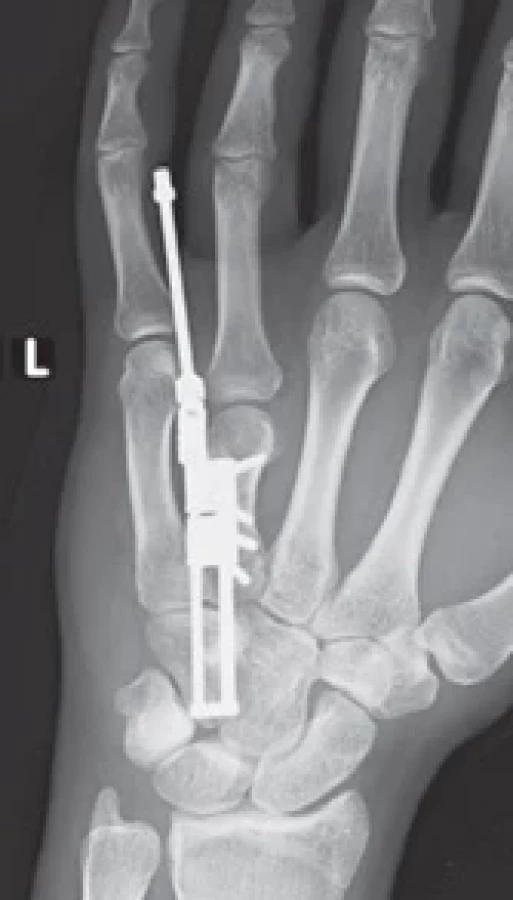
Distraction begins seven days after surgery at a rate of 0.5 mm per day, achieved by the patient turning the activator rod twice daily. Radiographic monitoring is performed every 2 weeks to assess bone regeneration and ensure proper alignment (Fig. 5). The distraction phase proceeds until the preoperatively determined length is attained.
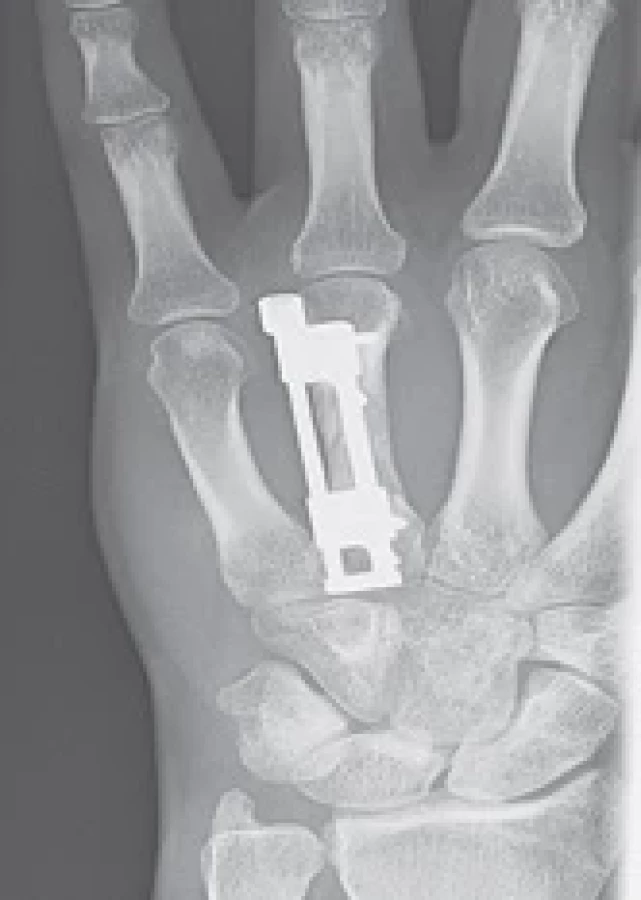
Once adequate lengthening is confirmed radiographically, the external activator rod is removed under local anesthesia, leaving the internal distractor to function as a stabilizing splint (Fig. 6, 7). The consolidation phase spans several weeks, during which patients are advised to incorporate light, functional use of the hand to maintain joint mobility and prevent stiffness. When complete osseointegration is achieved, the internal distractor is surgically extracted under general anesthesia (Fig. 8). At the same time, extensor tendon tenolysis or capsulotomy of the MCP joint can be performed to improve range of motion and optimize joint function. Rehabilitation is initiated promptly to restore full hand function and strength (Fig. 3–8).



Data collection and outcome measures
Data were collected on key parameters to evaluate surgical outcomes. The following variables were analyzed.
Preoperative and postoperative metacarpal lengths
Measurements were taken from preoperative and postoperative radiographs. Ideal metacarpal lengths were calculated using Aydinlioglu’s method.
Deviation from ideal length
The difference between postoperative length and the calculated ideal length was assessed.
Functional outcomes
Postoperative hand function was assessed through fist closure ability.
Complications
Any adverse events, including infection, misalignment, or soft tissue issues, were documented.
Treatment duration
The duration of activator usage and the use of the distractor as a splint were recorded, along with patient-reported satisfaction.
Key patient data are summarized in Tab. 1, 2.


Results
Postoperative measurements demonstrated a mean lengthening of 1.2 cm (range 0.7–1.5 cm) across all patients. The deviation from the calculated ideal metacarpal length was minimal, with a mean difference of +0.3 cm (range −0.2 to +0.6 cm). All patients achieved lengths within acceptable anatomical ranges.
The average duration of activator use was 68 days (range 40–95 days), and the mean splint duration was 6 months (range 4–8 months), excluding one patient in whom the internal distractor was prematurely removed due to synovitis. Restriction of movement into a fist was minimal, with an average limitation of 0.9 cm (range 0–2 cm). Patient satisfaction was universally high, with all patients reporting positive functional and aesthetic results.
Minor complications were observed in three patients, including one case of synovitis requiring device removal and two cases of slow consolidation necessitating spongioplasty. One patient experienced transient pain during distraction, which resolved with conservative measures. No severe infections or hardware failures were reported.
Discussion
The findings from this study demonstrate the efficacy and reliability of the internal distraction system in treating brachymetacarpia. Compared to traditional methods, this technique offers several distinct advantages, including enhanced stability, minimal external hardware, and improved patient comfort. These outcomes align with existing literature, which highlights the benefits of internal distraction systems over external fixators [6,8]. Unlike external fixators, the internal system minimizes the risk of pin-tract infections and flexion deformities caused by soft tissue scarring.
The low complication rate observed in this study underscores the safety of this approach. Although minor complications such as synovitis and slow consolidation occurred in a small number of cases, these were effectively managed without long-term adverse effects. Additionally, the precise control afforded by the internal system resulted in minimal deviations from the calculated ideal metacarpal length, ensuring both functional and aesthetic satisfaction.
Patient satisfaction was uniformly high, with all participants reporting significant improvements in hand function and appearance. This reinforces the importance of individualized surgical planning and meticulous execution. Early mobilization and tailored rehabilitation protocols further contributed to the favorable outcomes.
Despite these advantages, the study is not without limitations. The relatively small sample size (N = 9) limits the generalizability of the findings. Furthermore, the follow-up period focused primarily on short - to medium-term outcomes, leaving long-term results and potential late complications unexplored. Future studies with larger cohorts and extended follow-up periods are necessary to validate these findings and provide comprehensive insights into the durability of the technique.
Conclusion
The internal distraction system represents a significant advancement in the surgical treatment of brachymetacarpia. It provides a safe, effective, and patient--friendly solution, offering superior outcomes compared to traditional methods. With its low complication rate, high patient satisfaction, and reliable functional and aesthetic results, this technique should be considered the gold standard for metacarpal lengthening in appropriately selected cases.
Roles of the authors
Ondřej Brychcí, MD: author, literature review, data collection, translation; Alena Schmoranzová, MD: co-author, lead surgeon, article consultation, critical review.
Disclosure
The authors have no conflicts of interest to disclose. The authors declare that this study has received no financial support. All procedures performed in this study involving human participants were in accordance with ethical standards of the institutional and/or national research committee and with the Helsinki declaration and its later amendments or comparable ethical standards.
Sources
1. Barik S., Farr S. Brachymetacarpia and brachymetatarsia: do we need to operate? EFORT Open Rev. 2021, 6 (1): 55–61.
2. Lam A., Fragomen AT., Rozbruch SR. Metacarpal lengthening in adults with brachymetacarpia. Hand. 2019, 14 (3): 339–345.
3. Kato H., Minami A., Suenaga N., et al. Callotasis lengthening in patients with brachymetacarpia. J Pediatr Orthop. 2002, 22 (4): 497–500.
4. Volpi AD., Fragomen AT. Percutaneous distraction lengthening in brachymetacarpia. Orthopedics. 2011, 34 (8): e424–e427.
5. KLS Martin Group. GENOS mini. 2023 [online]. Available from: https: //www.klsmartin.com/en/products/distraction/genos-mini/.
6. Kitabata R., Sakamoto Y., Nagasao T., et al. Distraction osteogenesis for brachymetatarsia using an internal device. Plast Reconstr Surg Glob Open. 2017, 5 (7): e1381.
7. Aydinlioglu A., Akpinar F., Tosun N. Mathematical relations between the lengths of the metacarpal bones and phalanges: surgical significance. Tohoku J Exp Med. 1998, 185 (3): 209–216.
8. Bashour M., Hill C., Frommer SA., et al. Novel use of an internal distractor for metacarpal lengthening. Hand (N Y). 2023, 18 (4): 598–603.
Ondřej Brychcí, MD
Hand and Plastic Surgery Institute
Dr. Karla Farského 267
512 11 Vysoké nad Jizerou
Czech Republic
ondrej.brychci@seznam.cz
Submitted: 8. 1. 2025
Accepted: 31. 10. 2025
Labels
Plastic surgery Orthopaedics Burns medicine TraumatologyArticle was published in
Acta chirurgiae plasticae

2025 Issue 3
Most read in this issue
- Overall and area-specific tactile recovery following different methods of surgical reinnervation in post-mastectomy breast reconstruction – a systematic review and meta-analysis
- Brachymetacarpia – our experience with internal device for distraction osteogenesis in adolescent patients
- The importance of sentinel node biopsy and examination in malignant melanoma of the head and neck
- Case report of severe complications after gel injection breast augmentation – treatment and use of hemostatic net for effective management