
Diagnostické hodnocení stresem indukovatelného proteinu-1, β-kateninu a cyklinu D1 v prekancerózních lézích tlustého střeva a adenokarcinomu
Authors:
E. S. Atalayy 1; T. Devrim 2
Authors‘ workplace:
Ministry of Health, Fatsa State Hospital, Department of Pathology, Ordu, Turkey
1; Izmir Bakircay University, Faculty of Medicine, Department of Medical Pathology, Izmir, Turkey
2
Published in:
Gastroent Hepatol 2025; 79(6): 494-502
Category:
Gastrointestinal Oncology: Original Article
doi:
https://doi.org/10.48095/ccgh2025494
Overview
Východiska: Kolorektální karcinom (CRC) se vyvíjí prostřednictvím vícestupňového procesu zvaného adenom-karcinomová sekvence. Cílem této studie bylo vyhodnotit hladiny exprese beta-kateninu, cyklinu D1 a stresem indukovaného fosfoproteinu 1 (STIP1) v progresi z adenomu do karcinomu a zkoumat jejich vztahy s klinicko-patologickými znaky u CRC. Soubor pacientů a metody: Studie zahrnovala 88 vzorků tkáně CRC, 20 tubulárních adenomů (TA), 20 vilózních adenomů (VA) a 10 vzorků tkáně normální sliznice tlustého střeva (NCM), náhodně vybraných z běžných archivních materiálů patologického oddělení. Výsledky: Imunohistochemická exprese b-kateninu byla vyšší ve skupině TA než ve skupině CRC (p = 0,007). Exprese cyklinu D1 a STIP1 byla vyšší ve skupině TA (p = 0,008; p < 0,001) a VA (p = 0,002) než v CRC. Exprese STIP1 byla zjištěna vyšší ve skupinách TA a VA ve srovnání se skupinou CRC (p < 0,001; p = 0,002). Cyklin D1 byl exprimován na vyšší úrovni ve skupinách TA a VA ve srovnání se skupinou CRC (p = 0,008; p = 0,002). Kromě toho byly zjištěny pozitivní vztahy mezi expresí b-kateninu a cyklinu D1 (p = 0,025), b-kateninu a STIP1 (p = 0,014), cyklinu D1 a STIP1 (p = 0,001). Závěr: Naše výsledky naznačují, že exprese b-kateninu, cyklinu D1 a STIP1 byly v případech CRC vzájemně propojeny. Zjistili jsme, že všechny tři markery byly vysoce exprimovány, zejména během adenomatózní transformace, ale jejich účinky se v invazivní fázi nádoru snižovaly.

Klíčová slova:
kolorektální karcinom – stresem indukovatelný protein-1 – cyklin D1 – beta-katenin – imunohistochemie
Introduction
Colorectal carcinoma (CRC) ranks as the third most prevalent cancer globally, representing about 10% of all cancer diagnoses, and is the second leading cause of cancer-related mortality around the world [1]. Adenomatous polyps frequently serve as precursor lesions in CRC development. Studies indicate that approximately 60–70% of colon polyps are the adenomatous type. CRC emerges through a multi-stage process known as the adenoma-carcinoma sequence, characterized by the accumulation of genetic alterations [2,3].
Key genes, including adenomatous polyposis coli (APC), play a crucial role in the development and progression of CRC [4]. b-catenin undergoes accumulation within the cell due to mutations in the APC gene. Upon translocation into the nucleus, b-catenin binds to TCF/LEF transcription factors, activating numerous target genes involved in cell proliferation regulation, including cyclin D1 [5]. Cyclin D1, a target gene in this complex, promotes the phosphorylation of retinoblastoma protein (Rb), facilitating progression through the G1 to S phase of the cell cycle and acting as a positive regulator of cell proliferation [6]. Additionally, Stress-induced phosphoprotein 1 (STIP1), also recognized as the HSP70/HSP90 regulatory protein, interacts with heat shock protein family members to form a multiprotein complex involved in various cellular activities such as RNA splicing, transcription, protein folding, translocation, viral replication, signal transduction, and cell cycle regulation [7,8].
In the present study, we aimed to assess the expression of STIP1, cyclin D1, and b-catenin in CRC and precancerous lesions, to elucidate their roles in CRC progression and their interrelationships, as well as comparing these markers with clinicopathological parameters.
Patient set and methodology
This study comprised a total of 88 CRC, 20 tubular adenoma (TA), 20 villous adenoma (VA), and 10 normal colon mucosa (NCM) tissues selected randomly from routine archival materials of the department of pathology. All CRC tissues were obtained from colectomy patients, while TA and VA tissues were obtained from colonoscopic polypectomy patients. Hematoxylin and eosin (H&E) stained slides of CRC cases underwent re-evaluation for histological type, grade, lymphovascular invasion, perineural invasion, tumor deposit, pT, pN, and metastasis. The degree of CRC differentiation was classified according to current guidelines [9]. Tumor localization within the large intestine was categorized as right-sided (cecum, ascending colon, transverse colon) or left-sided (descending colon, sigmoid colon, rectum) [10]. Lymphovascular invasion, perineural invasion, and tumor deposits were assessed and categorized as present or absent. A metastatic lymph node was considered positive, while a reactive lymph node was classified as negative.
Immunohistochemistry
The lesion areas that best represented each case in H&E preparations were identified with a microscope (Nikon Eclipse Ni, Japan) and marked on the corresponding tissue block. A core tissue biopsy, 1 mm in diameter, was then extracted from the marked area using a tissue microarray (TMA) instrument and positioned in the designated recipient pore of the prepared block guide. The coordinates of these core biopsies within the recipient block were meticulously recorded in the tubular form. The prepared blocks underwent heating at 40 °C for 15 minutes to ensure optimal conditions, followed by flattening of the block surface. Sections, 4 microns thick, were obtained from these blocks using a Thermo Fisher Scientific microtome device and were deposited onto positively charged slides coated with Poly-L-Lysine. Subsequently, the sections were deparaffinized at 65 °C in an oven for 1 hour and then subjected to immunohistochemical (IH C) staining with antibodies against STIP1 (Rabbit monoclonal, Cat. No: ab126724, Abcam, MA, USA, diluted 1/500), b-catenin (Rabbit monoclonal, Cat. No: ab32572, Abcam, MA, USA, diluted 1/500), and cyclin D1 (Rabbit monoclonal, Cat. No: ab16663, Abcam, MA, USA, diluted 1/250) using the automatic Ventana Benchmark XT IHC stainer. Testis tissue served as the positive control for STIP1, while breast carcinoma tissue was utilized for b-catenin and cyclin D1. Immunohistochemical staining assessment was conducted independently for all slides in a blinded manner, focusing on both the percentage of positive epithelial cells and staining intensity.
In b-catenin IHC staining, when there was 10% or more expression in the nucleus of the CRC or adenomatous epithelial cells, it was classified as having high expression. Conversely, if the nuclear staining rate of the CRC or adenomatous epithelium was less than 10%, it was categorized as having low expression [11].
For cyclin D1, nuclear staining was assessed using a scoring system ranging from 0 to 3 based on the percentage of positively stained CRC or adenomatous epithelial cells: 0 (no staining), 1 (1–25%), 2 (26–75%), and 3 (76–100%). Additionally, staining intensity was scored as follows: 0 (no staining), 1 (weak), and 2 (medium-strong). A cumulative score ranging from 0 to 6 was then calculated for each case by multiplying the obtained scores. In the statistical analysis, a score of 2 or higher was considered indicative of high expression, while a score of 0 or 1 indicated low expression.
STIP1 IHC staining was based on cytoplasmic immunoreactivity in tumor or adenomatous epithelial cells. The percentage of positively stained cells was classified into three groups: 0% was assigned a score of 0, 1–50% received a score of 1, and 51–100% was given a score of 2. STIP1 staining intensity was none (0), weak (1), and medium-strong (2). For the immune staining score, a value between 0 and 4 was obtained by multiplying the staining percentage and intensity scores. If the overall score for each case was 2 or less, it was considered having a low expression; a score of 4 was categorized as having a high expression.
Statistical analysis
Analysis was carried out using a software package for Windows (SPSS, version 23.0, Chicago, III, USA). Descriptive statistics of the groups were reported as frequencies and percentages within the group (N, %). The Kruskal-Wallis test was used for comparisons of groups, and the Mann-Whitney U Test was used for paired group comparisons. Distribution of categorical data among the groups was evaluated using the Chi-square test. Considering the number of patients in the categories, Pearson‘s Chi-Square or Fisher‘s Exact Test p-values were used for significance. P < 0.05 was accepted as the limit of significance.
Results
Upon evaluation of precancerous lesions of the TA and VA groups together in comparison to NCM, significant increases in the expression levels of b-catenin, cyclin D1, and STIP1 were observed (P < 0.001; p < 0.001; p = 0.007, respectively). However, when comparing the VA and TA groups separately, no statistically significant difference was found in the expressions of b-catenin, cyclin D1, and STIP1 (P = 0.127; P = 1.000; P = 0.182, respectively). Clinicopathological characteristics of CRC cases are detailed in Tab. 1.

It was observed that b-catenin was significantly more prevalent in the CRC located in the left colon (P = 0.008). A negative relation between cyclin D1 expression and lymph node metastasis was observed, although it did not reach statistical significance (P = 0.067). However, when cases with less than 4 lymph node metastases (N1 + N0) were grouped together, a statistically higher cyclin D1 expression was found compared to cases with 4 or more lymph node metastases (N2) (P = 0.043). The relationship between the expression of b-catenin, STIP1, and cyclin D1 in the CRC, TA, and VA groups is summarized in Tab. 2.

In the CRC group, significant and high STIP1 expression was found in cases with serosal invasion (pT4) compared to those with lower invasion depth (P = 0.019). Although no statistically significant difference was observed between STIP1 expression and tumor differentiation or the presence of distant metastasis in the CRC (P > 0.05), it was noted that the STIP1 expression level increased with higher tumor grade and the presence of distant metastasis. The relationship between the expression of b-catenin, STIP1, and cyclin D1 in the CRC group with clinicopathological parameters is summarized in Tab. 3 and Fig. 1. As shown in Fig. 2, a schematic illustration depicts the pathophysiological roles of b-catenin, cyclin D1, and STIP1 in colorectal tumorigenesis, summarizing their expression patterns in normal mucosa, adenomas, and colorectal carcinoma, and highlighting their interactions and contributions to cell proliferation, tumor progression, and invasion.
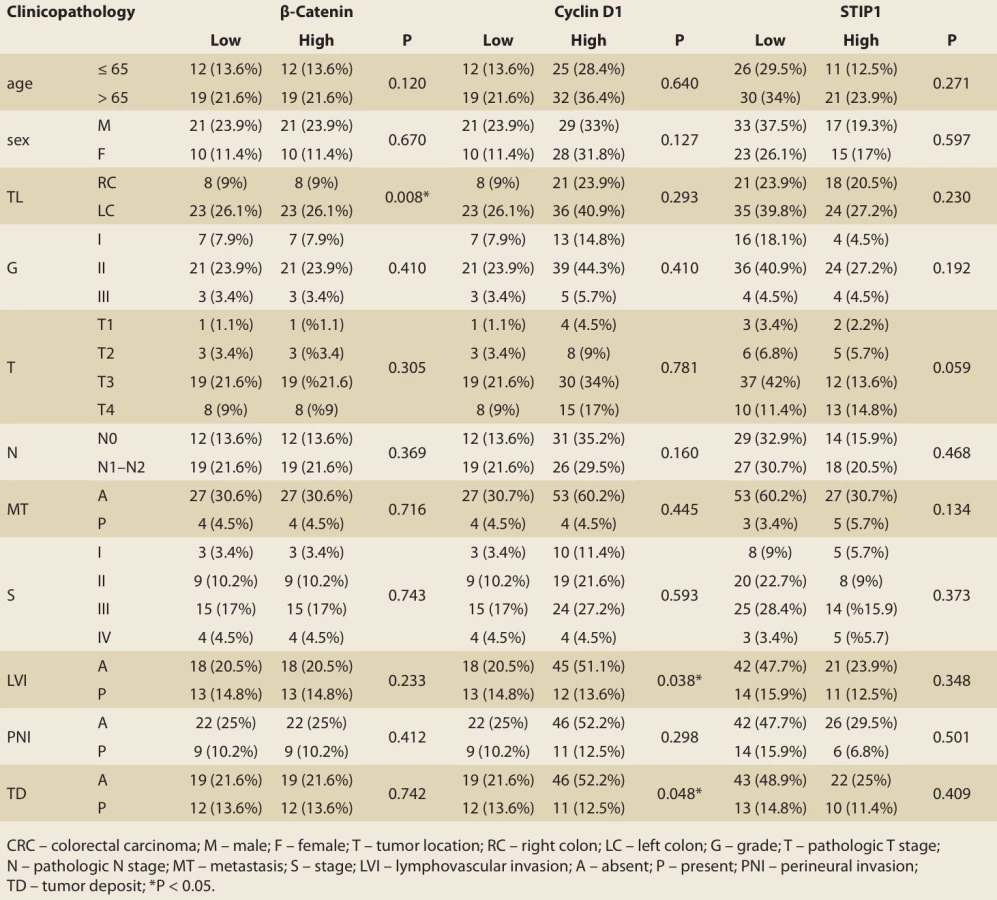


When evaluating the IHC expressions of the CRC group according to age, gender, and location, cyclin D1 expression was found to be higher in the CRC group located in the left colon compared to the right (P = 0.012). However, in the VA group, no significant relationship was observed between b-catenin and STIP1 expression and age, gender, and location parameters (P > 0.05). Similarly, in the TA group, there was no significant relationship between the expression of b-catenin, cyclin D1, and STIP1 and the clinicopathological parameters (P > 0.05).
When the IHC markers included in the study were evaluated together, statistically significant positive relations were found between b-catenin and cyclin D1 (P = 0.025), b-catenin and STIP1 (P = 0.014), as well as cyclin D1 and STIP1 (P = 0.001) in the CRC group (Tab. 4, 5).


In the present study, when we evaluated the relationship between the co-expression of IHC markers and the clinicopathological parameters of the CRC group, we found that lymphovascular invasion was significantly lower in cases where b-catenin and cyclin D1 were expressed together (P = 0.006). However, no statistically significant difference was observed between the other clinicopathological parameters (P > 0.05). Nevertheless, it was noted that CRC cases in which cyclin D1 and b-catenin were co-expressed tended to show a lower pT (P = 0.085).
Discussion
Mutated APC activates nuclear b-catenin and cyclin D1, driving colorectal carcinogenesis [12–14]. In our study, nuclear b-catenin expression was significantly higher in CRC and adenomas compared to normal mucosa, with adenomas (TA and VA) showing higher levels than CRC, suggesting a decrease during tumor invasion, which was consistent with previous reports [15–17]. Cyclin D1 and STIP1 were also elevated in precancerous lesions, while in CRC, b-catenin was more prevalent in left-sided tumors, higher cyclin D1 was associated with lower lymph node involvement, and STIP1 was elevated in cases with serosal invasion. Positive relations among all three markers and co-expression of b-catenin and cyclin D1 were linked to reduced lymphovascular invasion, highlighting their potential role in colorectal tumorigenesis and adenoma progression.
Studies have indicated that the cyclin D1 gene is amplified in a considerable proportion (22–58%) of malignant tumors. This amplification disrupts the cell cycle, leading to increased cell growth and ultimately contributing to carcinogenesis [18]. Albasri et al. [19] observed a significant increase in cyclin D1 expression across the normal-adenoma-carcinoma sequence. Similarly, Toru and Bilezikçi [20] found higher cyclin D1 expression in adenomas compared to normal mucosa, with no significant difference between VA and TA cases. Our study observed high cyclin D1 expression in all VA cases, the majority of TA cases, and a significant proportion of normal mucosa samples. Furthermore, we found a lower rate of increased cyclin D1 expression in CRC compared to adenomas. This suggests a potential loss of cyclin D1 expression during the transition from adenoma to carcinoma. Overall, our findings support the notion that cyclin D1 protein expression is important in adenoma formation, but there may be a loss of expression upon progression to carcinoma. This highlights the dynamic role of cyclin D1 in colorectal tumorigenesis and underscores its potential as a biomarker for disease progression.
It has been suggested that cyclin D1, which is reported to be overexpressed in colorectal cancers, may serve as a positive prognostic indicator for patients with this disease [21]. However, there are many articles that did not find a significant relationship between cyclin D1 expression and tumor differentiation in CRC, including our study [22–25].
The findings of our study support the studies of Kamposioras et al. [26] who showed a negative relationship between cyclin D1 expression at the tumor invasion margin and lymphatic, venous, and perineural invasion in CRC. Conversely, Al-Maghrabi et al. [22] and Albasri et al. [19] reported higher cyclin D1 expression in tumors with lymphovascular invasion compared to tumors without lymphovascular invasion. Our observation of significantly lower cyclin D1 expression in cases with lymphovascular invasion supports the notion that tumors with reduced cyclin D1 expression may exhibit a more aggressive phenotype characterized by increased invasion through lymphovascular channels. These findings highlight the potential role of cyclin D1 as a prognostic indicator for tumor aggressiveness and invasion in CRC.
Kubota et al. [27] and Zhang et al. [28] reported that STIP1 expression was higher in CRC cells than in normal mucosa. Our study did not detect a difference in STIP1 expression between tumor tissue and normal mucosa. In the studies performed by Zhang et al. [28] in CRC and Zhai et al. [29] in gastric carcinoma, it was stated that they found a significant relationship between advanced pT stage and increased STIP1 expression. In our study, we found significantly higher STIP1 expression in cases with serosal invasion than cases with lower invasion depth. This may suggest that STIP1 expression may be a poor prognostic indicator in CRC.
It is reported that overexpression of cyclin D1 protein is generally associated with the amplification of the CCND1 gene. However, it has been suggested that there is often no amplification in the CCDN1 gene in CRC, and cyclin D1 is overexpressed at the transcriptional level [30,31]. There are studies suggesting that b-catenin induces protein synthesis of cyclin D1 by binding to TCF/LEF transcription factors in the nucleus [32]. Therefore, it is thought that b-catenin and cyclin D1 nuclear expressions may show similar behavior. Jang et al. [33] reported that there was a significant positive relation between cyclin D1 and b-catenin in CRC cases. They found that positive b-catenin expression was higher in well-moderately differentiated tumors and lymph node-negative patients, and in patients with no metastases, cyclin D1 expression was significantly higher. Utsunomiya et al. [34] reported that in CRC cases where cyclin D1 and b-catenin expressions were both negative, they found a significantly lower degree of tumor invasion compared to other expression combinations. In our study, we found a significant positive relation between cyclin D1 and b-catenin. We found that subjects showing co-expression of cyclin D1 and b-catenin showed significantly lower lymphovascular invasion than tumors showing other combinations of expression. We also found that tumors in which cyclin D1 and b-catenin were co-expressed tended to show a lower pT stage. Our data suggested that b-catenin and cyclin D1 co-expression in CRCs may be indicators of good prognosis in CRC.
Huang et al. [35] reported that reduced b-catenin was detected with low STIP1 expression in gastric carcinomas and increased b-catenin was found with excessive STIP1 expression. In studies conducted in hepatocellular carcinoma and gastric carcinoma cases, STIP1 has been suggested to increase tumor cell proliferation and migration by increasing the expression of c-myc and cyclin D1, the target genes of the Wnt/b-catenin signalling pathway [35,36]. In addition, in the study conducted by Wang et al. [37], it was reported that the cyclin D1 protein in tumor cells decreased significantly by lowering the STIP1 level in pancreatic ductal adenocarcinoma. In addition, Li et al. [38] also suggested that the reduction of STIP1 expression in cervical carcinoma is reversed by b-catenin overexpression and STIP1 regulates the Wnt/b-catenin pathway by indirectly affecting p-GSK3-beta activity. In our study, we found high b-catenin expression in 75% of CRCs with high STIP1 expression and high cyclin D1 expression in 87.5%. Thus, in accordance with the literature, we have shown that there is a significant positive relation between STIP1 expression and b-catenin and cyclin D1 expression in CRC [35–37].
Conclusion
In conclusion, our results indicate that b-catenin, cyclin D1, and STIP1 expressions are interrelated in CRC, exhibiting high levels during adenomatous transformation that diminish in the invasive tumor phase, and suggest that the combined assessment of cyclin D1 and b-catenin may serve as a prognostic marker for CRC patients.
Sources
1. Siegel RL, Giaquinto AN, Jemal A. Cancer statistics, 2024. CA Cancer J Clin 2024; 74 (1): 12–49. doi: 10.3322/caac.21820.
2. Pelikán A, Tulinský L, Peteja, M et al. Are there any changes in the surgical management of stenosing rectal cancer? Gastroent Hepatol 2017; 71 (1): 62–68. Doi: 10.14735/amgh2016csgh.info16.
3. Myers DJ, Arora K. Villous adenoma. 2024 [online]. Available from: https: //www.ncbi.nlm.nih.gov/books/NBK470272/.
4. Grady WM, Markowitz SD. The molecular pathogenesis of colorectal cancer and its potential application to colorectal cancer screening. Dig Dis Sci 2015; 60 (3): 762–772. doi: 10.1007/s10620-014-3444-4.
5. Brabletz T, Jung A, Reu S et al. Variable beta-catenin expression in colorectal cancers indicates tumor progression driven by the tumor environment. Proc Natl Acad Sci 2001; 98 (18): 10356–10361. doi: 10.1073/pnas.171610498.
6. Chen W, Luo Y, Liu L et al. Cryptotanshinone inhibits cancer cell proliferation by suppressing mammalian target of rapamycin-mediated cyclin D1 expression and Rb phosphorylation. Cancer Prev Res 2010; 3 (8): 1015–1025. doi: 10.1158/1940-6207.
7. Odunuga OO, Longshaw VM, Blatch GL. Hop: more than an Hsp70/Hsp90 adaptor protein. Bioessays 2004; 26 (10): 1058–1068. doi: 10.1002/bies.20107.
8. Tsai CL, Chao A, Jung SM et al. Stress-induced phosphoprotein-1 maintains the stability of JAK2 in cancer cells. Oncotarget 2016; 7 (31): 50548–50563. doi: 10.18632/oncotarget.10500.
9. Jain D, Chopp WV, Graham RP et al. Protocol for the examination of resection specimens from patients with primary carcinoma of the colon and rectum. 2024 [online]. Available from: https: //www.cap.org/protocols-and-guidelines/cancer-reporting-tools/cancer-protocol-templates.
10. Nosho K, Yamamoto H, Mikami M et al. Overexpression of poly (ADP-ribose) polymerase-1 (PARP-1) in the early stage of colorectal carcinogenesis. Eur J Cancer 2006; 42 (14): 2374–2381. doi: 10.1016/j.ejca.2006.01.061.
11. Lee KS, Kwak Y, Nam KH et al. Favorable prognosis in colorectal cancer patients with co-expression of c-MYC and ß-catenin. BMC Cancer 2016; 16 (1): 730. doi: 10.1186/s12885-016-2770-7.
12. Disoma C, Zhou Y, Li S et al. Wnt/b-catenin signaling in colorectal cancer: is therapeutic targeting even possible? Biochimie 2022; 195 : 39–53. doi: 10.1016/j.biochi.2022.01.009.
13. Guinney J, Dienstmann R, Wang X et al. The consensus molecular subtypes of colorectal cancer. Nat Med 2015; 21 (11): 1350–1356. doi: 10.1038/nm.3967.
14. Macdonald BT, Tamai K, He X. Wnt/beta-catenin signaling: components, mechanisms, and diseases. Dev Cell 2009; 17 (1): 9–26. doi: 10.1016/j.devcel.2009.06.016.
15. Wang L, Li D, Liu Y et al. Expression of RUNX3 and b-catenin in the carcinogenesis of sporadic colorectal tubular adenoma. Tumour Biol 2014; 35 (6): 6039–6046. doi: 10.1007/s13277-014-1800-9.
16. Yang B, Mao L, Li Y et al. b-catenin, leucine-rich repeat-containing G protein-coupled receptor 5 and GATA-binding factor 6 are associated with the normal mucosa-adenoma-adenocarcinoma sequence of colorectal tumorigenesis. Oncol Lett 2018; 15 (2): 2287–2295. doi: 10.3892/ol.2017.7566.
17. Uzun S, Isik A, Katipoğlu K et al. Characterization of the subcellular distribution of phospho-b-catenin in colorectal cancer. In Vivo 2023; 37 (4): 1576–1583. doi: 10.21873/invivo.13242.
18. Moradi Binabaj M, Bahrami A, Khazaei M et al. The prognostic value of cyclin D1 expression in the survival of cancer patients: a meta-analysis. Gene 2020; 728 : 144283. doi: 10.1016/j.gene.2019.144283.
19. Albasri AM, Elkablawy MA, Ansari IA et al. Prognostic significance of cyclin D1 over-expression in colorectal cancer: an experience from Madinah, Saudi Arabia. Asian Pac J Cancer Prev 2019; 20 (8): 2471–2476. doi: 10.31557/APJCP.2019.20.8.2471.
20. Toru S, Bilezikçi B. Early changes in carcinogenesis of colorectal adenomas. West Indian Med J 2012; 61 (1): 10–16. doi: 10.7727/wimj.2011.136.
21. Jun SY, Kim J, Yoon N et al. Prognostic potential of cyclin D1 expression in colorectal cancer. J Clin Med 2023; 12 (2): 572. doi: 10.3390/jcm12020572.
22. Al-Maghrabi J, Mufti S, Gomaa W et al. Immunoexpression of cyclin D1 in colorectal carcinomas is not correlated with survival outcome. J Microsc Ultrastruct 2015; 3 (2): 62–67. doi: 10.1016/j.jmau.2015.01.001.
23. Ogino S, Nosho K, Irahara N et al. A cohort study of cyclin D1 expression and prognosis in 602 colon cancer cases. Clin Cancer Res 2001; 15 (13): 4431–4438. doi: 10.1158/1078-0432.CCR-08-3330.
24. Nosho K, Kawasaki T, Chan AT et al. Cyclin D1 is frequently overexpressed in microsatellite unstable colorectal cancer, independent of CpG island methylator phenotype. Histopathology 2008; 53 (5): 588–598. doi: 10.1111/j.1365.
25. Palaiologos P, Chrysikos D, Theocharis S et al. The prognostic value of G1 cyclins, p21 and Rb protein in patients with colon cancer. Anticancer Res 2019; 39 (11): 6291–6297. doi: 10.21873/anticanres.13839.
26. Kamposioras K, Konstantara A, Kotoula V et al. The prognostic significance of WNT pathway in surgically-treated colorectal cancer: b-catenin expression predicts for disease-free survival. Anticancer Res 2013; 33 (10): 4573–4584.
27. Kubota H, Yamamoto S, Itoh E et al. Increased expression of co-chaperone HOP with HSP90 and HSC70 and complex formation in human colonic carcinoma. Cell Stress Chaperones 2010; 15 (6): 1003–1011. doi: 10.1007/s12192-010-0211-0.
28. Zhang Z, Ren H, Yang L et al. Aberrant expression of stress-induced phosphoprotein 1 in colorectal cancer and its clinicopathologic significance. Hum Pathol 2018; 79 : 135–143. doi: 10.1016/j.humpath.2018.05.016.
29. Zhai E, Liang W, Lin Y et al. HSP70/HSP90-organizing protein contributes to gastric cancer progression in an autocrine fashion and predicts poor survival in gastric cancer. Cell Physiol Biochem 2018; 47 (2): 879–892. doi: 10.1159/000490080.
30. Aamodt R, Jonsdottir K, Andersen SN et al. Differences in protein expression and gene amplification of cyclins between colon and rectal adenocarcinomas. Gastroenterol Res Pract 2009; 2009 : 285830. doi: 10.1155/2009/285830.
31. Toncheva D, Petrova D, Tzenova V et al. Tissue microarray analysis of cyclin D1 gene amplification and gain in colorectal carcinomas. Tumour Biol 2004; 25 (4): 157–160. doi: 10.1159/000081097.
32. Herbst A, Jurinovic V, Krebs S et al. Comprehensive analysis of b-catenin target genes in colorectal carcinoma cell lines with deregulated Wnt/b-catenin signaling. BMC Genomics 2014; 15 : 74. doi: 10.1186/1471-2164-15-74.
33. Jang KY, Kim YN, Bae JS et al. Expression of cyclin D1 is associated with b-catenin expression and correlates with good prognosis in colorectal adenocarcinoma. Transl Oncol 2012; 5 (5): 370–378. doi: 10.1593/tlo.12220.
34. Utsunomiya T, Doki Y, Takemoto H et al. Correlation of beta-catenin and cyclin D1 expression in colon cancers. Oncology 2001; 61 (3): 226–233. doi: 10.1159/000055379.
35. Huang L, Zhai E, Cai S et al. Stress-inducible protein-1 promotes metastasis of gastric cancer via Wnt/b-catenin signaling pathway. J Exp Clin Cancer Res 2018; 37 (1): 6. doi: 10.1186/s13046-018-0676-8.
36. Luo X, Liu Y, Ma S et al. STIP1 is over-expressed in hepatocellular carcinoma and promotes the growth and migration of cancer cells. Gene 2018; 662 : 110–117. doi: 10.1016/j.gene.2018.03.076.
37. Wang K, Jiang S, Huang A et al. GOLPH3 promotes cancer growth by interacting with STIP1 and regulating telomerase activity in pancreatic ductal adenocarcinoma. Front Oncol 2020; 10 : 575358. doi: 10.3389/fonc.2020.575358.
38. Li R, Li P, Wang J et al. STIP1 down-regulation inhibits glycolysis by suppressing PKM2 and LDHA and inactivating the Wnt/b-catenin pathway in cervical carcinoma cells. Life Sci 2020; 258 : 118190. doi: 10.1016/j.lfs.2020.118190.
Labels
Paediatric gastroenterology Gastroenterology and hepatology SurgeryArticle was published in
Gastroenterology and Hepatology

2025 Issue 6
Most read in this issue
- Porucha polykání jako první projev desminopatie
- Multimodální opioid-šetřicí totální intravenózní anestezie v bariatrii – první zkušenosti
- Eozinofilní ezofagitida u dětských pacientů – aktuální poznatky a zkušenosti z klinické praxe
- EUS-navigovaná transgastrická drenáž opuzdreného paramalígneho ascitu