
Mediating the role of sleep quality in the relationship between stress and depressive symptomatology
Authors:
Petra Zbínová; Marta Górna
Authors‘ workplace:
Department of Psychology, Faculty of Arts, University of Ss. Cyril and Methodius in Trnava, Slovakia
Published in:
Čes. a slov. Psychiat., 122, 2026, No. 4, pp. 147-154.
Category:
Original Article
doi:
https://doi.org/10.48095/cccsp202608
Overview
Objective: This research explores the associations between perceived stress, sleep quality, and depressive symptoms, focusing on the mediating effect of sleep quality in the relationship between stress and depressive symptoms in a sample of Slovak adults. Methods: The research sample consisted of 248 individuals aged 18 to 79 years, with an average age of 39.1 years. Data collection was conducted using a questionnaire method, specifically the Perceived Stress Scale-10 (PSS-10) to assess perceived stress, the Pittsburgh Sleep Quality Index (PSQI) to evaluate sleep quality, and the Beck Depression Inventory II (BDI-II) to measure the presence and severity of depressive symptoms. Results: Linear regression analysis indicated that both perceived stress (b = 0.528; P < 0.001) and sleep quality (b = 0.262; P < 0.001) are significant predictors of depressive symptoms with perceived stress being a more significant predictor. Additionally, mediation analysis revealed a significant indirect effect of perceived stress on depressive symptoms via sleep quality (b = 0.0942). Dimensions of the PSQI, specifically subjective sleep quality (ρ = 0.404 and ρ = 0.311, respectively) and sleep-related disruptions of daily routines (ρ = 0.485 and ρ = 0.343, respectively), showed the strongest correlations with both depressive symptoms and perceived stress. Conclusion: Perceived stress and sleep quality are important factors associated with depressive symptomatology, as evidenced by their significant associations with depressive symptoms within the present sample. Higher levels of perceived stress and poorer sleep quality were associated with more severe depressive symptoms. Furthermore, sleep quality statistically mediated the relationship between perceived stress and depressive symptoms, accounting for part of that association both directly and indirectly. Future longitudinal studies are needed to verify the directionality of these associations and further evaluate the proposed mediation model. These findings underscore the importance of addressing both stress and sleep difficulties in the management of depressive disorders.
Keywords:
sleep – stress – depression – adult population – mediation analysis
Introduction
Depression is a heterogeneous disorder that encompasses a range of biological, social, somatic, and psychological components. It is a mood disorder with a pathological nature that significantly impacts mental functioning and shapes its expression [1]. While many assumptions have been proposed regarding its origins, contemporary perspectives on depression emphasize its multifactorial nature, acknowledging the complex and bidirectional interactions among various factors [2]. Multifactorial models of depression consider various factors that influence the risk of its onset and progression, including vulnerability and resilience factors. These factors can either exacerbate or mitigate the development and intensification of depressive symptomatology. Their influence may be direct or indirect, with some factors accelerating or intensifying the disorder, while others contribute to preventing its onset, recurrence, or worsening of depression [3].
Stress, in a biological context, is the body‘s response to demands or threats, known as stressors. Stressful situations are characterized by a significant discrepancy between exposure and dispositional factors. In this context, dispositional factors, particularly personality traits, adaptive capacities, and individual performance capabilities, play a crucial role in managing imposed demands. Individuals can effectively cope with, manage, and adapt to these dispositional stimuli without experiencing pathological changes, or they may falter, potentially leading to a spectrum of mental health challenges [4]. While acute stress can serve as an adaptive function, it is the prolonged or chronic activation of the stress response that poses a significant risk factor for detrimental physical and mental health outcomes [5].
A substantial body of research indicates a strong link between stress and the development of depressive symptoms [6,7]. From a different standpoint, the link between stress and depression is often conceptualized as bidirectional, acknowledging that each can influence and intensify the other [8].
Among the risk factors for depression, sleep quality is undeniably significant, as it is essential for both physical and psychological restoration, including mood regulation and stability [9]. Sleep disturbances can lead to an increased risk of health issues in both physical and mental domains and contribute to a diminished quality of life. Poor sleep is frequently associated with a higher prevalence of mental disorders and can exacerbate the progression of various conditions, such as memory disorders, hypertension, and diabetes [10]. Moreover, sleep disturbances often occur along with medical conditions, including depression, and are considered as significant predictors of its development [11]. Common symptoms of impaired sleep quality include difficulties falling asleep, unintended early awakening, problems maintaining sleep continuity, and hypersomnia [12]. According to Hamilton [13], 60–90% of individuals with depression experience poor sleep. These findings are supported by recent research, indicating 50–90% of individuals with depression suffer from sleep disturbances, which affect the course of the illness [14]. It is well-documented that individuals with poor sleep quality, as indicated by the Pittsburgh Sleep Quality Index, manifested significantly higher levels of depressive symptoms compared to those with good sleep quality [15]. Depression and sleep disorders often co-occur, leading to considerations of factors that may contribute to their mutual onset and connection, such as stress and hyperarousal [16]. This insomnia, in turn, causes distress due to the inability to fall asleep, ultimately intensifying and perpetuating the problems [18].
Certain theories propose that stress deteriorates sleep quality by elevating cognitive and somatic arousal in the pre-sleep period [19,20]. Sleep disorders may also be perceived as consequences of the fast-paced lifestyle, stress, and rising psychological strain in contemporary society [21]. Stressors, surrounding an individual, are additional risk factors for mental health. In particular, prolonged stress or the occurrence of multiple, albeit minor stressors followed by a lack of recovery, increases an individual’s vulnerability [9]. Perceived stress is often associated with depressive symptoms [22], higher levels of anxiety [23], and an increased incidence of insomnia, sleep disturbances, and reduced sleep efficiency [24,25]. A study conducted by Liu et al. [26] verified the intricate connection between stress, sleep quality, and depression, identifying sleep quality as a mediator among older adults. Zhuang et al. [27] observed a similar trend, finding that insomnia partially mediated the effect of perceived stress on depression among university students, with the indirect effect of insomnia explaining approximately 45% of the total variance in depression.
While research studies are increasingly exploring the complex interplay and dynamics between perceived stress, sleep quality, and depressive symptoms, with a focus on the mediating role of sleep quality [26,27], this area remains under-researched within the Slovak population. Therefore, drawing upon prior theoretical and empirical research, this study aims to elucidate the associations among perceived stress, sleep quality, and depressive symptoms within the present sample, with a particular focus on the potential mediating role of sleep quality. Specifically, we investigate how perceived stress and sleep quality contribute to depressive symptoms and assess whether sleep quality mediates the stress-depression association.
We hypothesize that: sleep quality and perceived stress are significant predictors of depressive symptomatology; there is a positive relationship between sleep quality and perceived stress; and there is a positive relationship between sleep quality and depressive symptoms. Finally, we explore the research question: Does sleep quality mediate the relationship between perceived stress and depressive symptoms?
Methods
Research sample
Participants were selected through convenience sampling, and in-person data collection occurred from October 2022 to January 2023. Individuals younger than 18 or older than 80 years were excluded from the study. The research sample consisted of 248 individuals aged 18 to 79 years (M = 39.1; SD = 13.38), including 52.4% women, 43.5% men, and 4% who did not specify their gender. Regarding occupational status, 75% were employed, 14% were students, 6.5% were retirees, 3% were on parental leave, and 1% were unemployed. Respondents were informed about the study‘s purpose and procedures and provided their consent via an informed consent form.
Measures
The study employs a quantitative approach, and data were collected using a questionnaire-based method.
The Perceived Stress Scale (PSS-10) evaluates how unpredictable, uncontrollable, and overwhelming life a person perceives. It is composed of 10 items rated on a 5-point Likert scale. Items reflecting self-efficacy and the individual’s ability to cope with problems are reverse scored, and the total score is calculated to indicate the level of perceived stress.
Higher scores indicate greater perceived stress [28]. The scale demonstrates a satisfactory internal consistency value [29,30].
Beck Depression Inventory (BDI-II) assesses the severity of depression symptomatology. The questionnaire consists of 21 items, each representing a specific depressive symptom. Items are rated on a 4-point Likert scale, where a rating of 3 indicates the most severe form of the symptom. Adding up the item scores reflects the overall severity of depressive symptomatology [31]. The BDI-II is a widely used screening tool with satisfactory psychometric properties [32–34].
Sleep quality and sleep patterns are rated by the Pittsburgh Sleep Quality Index (PSQI). The Index comprises of 24 questions, 19 of which are self-rated by the respondent. The remaining questions solely serve clinical purposes and do not contribute to the scores. The 19 items are grouped into seven dimensions of sleep quality (dimensions are rated 0–3 points each). A higher score reflects worse sleep quality in both the overall assessment and individual dimensions. A global PSQI score ranging from 0 to 5 signifies good sleep quality, whereas a score of 6 or above indicates disrupted sleep quality [35]. This instrument demonstrates high internal consistency [35,36].
Statistical procedures
Obtained data were processed and analyzed using Microsoft Excel and IBM SPSS Statistics 25.0 (IBM Corporation, Armonk, NY, USA). Mediation analysis was performed using the PROCESS version 4.2 for SPSS (specifically Model 4) developed by Andrew F. Hayes [37]. A P-value of less than 0.05 was considered the threshold for statistical significance.
Missing data were handled using listwise deletion. Participants with missing responses on variables required for a given analysis were excluded from that specific analysis. As a result, sample sizes varied slightly across analyses (PSS-10: N = 248; PSQI: N = 245; BDI-II: N = 243; mediation analysis: N = 241). Given the low proportion of missing data, no imputation procedures were applied.
Results
Descriptive characteristics of the perceived stress, sleep quality, and depressive symptomatology
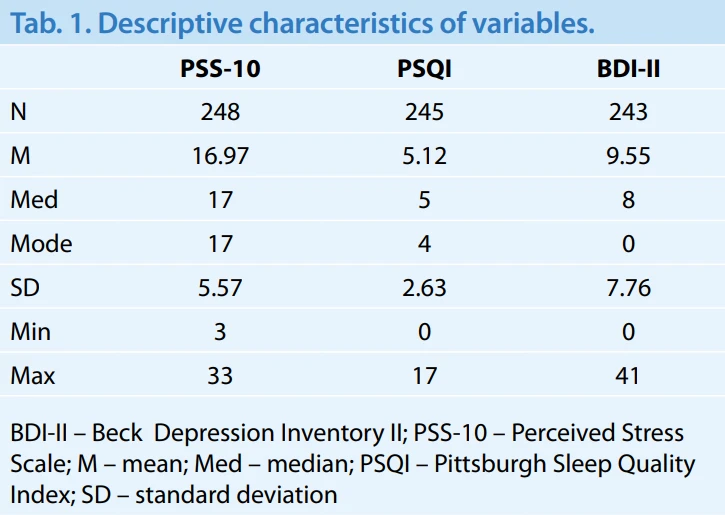
We examined the basic descriptive parameters of the variables such as perceived stress, sleep quality, and depression using a descriptive analysis, which are presented in Tab. 1. Perceived stress in the research sample showed a mean of 16.97 (SD = 5.57), with a median and mode of 17 points. Sleep quality showed the mean for the entire sample 5.12 (SD = 2.63), with a median of 5 points and a mode of 4 points. Depression showed a mean of 9.55 (SD = 7.76), with a median of 8 points and a mode of 0 points.
Correlation analyses (sleep quality, stress, depressive symptomatology)
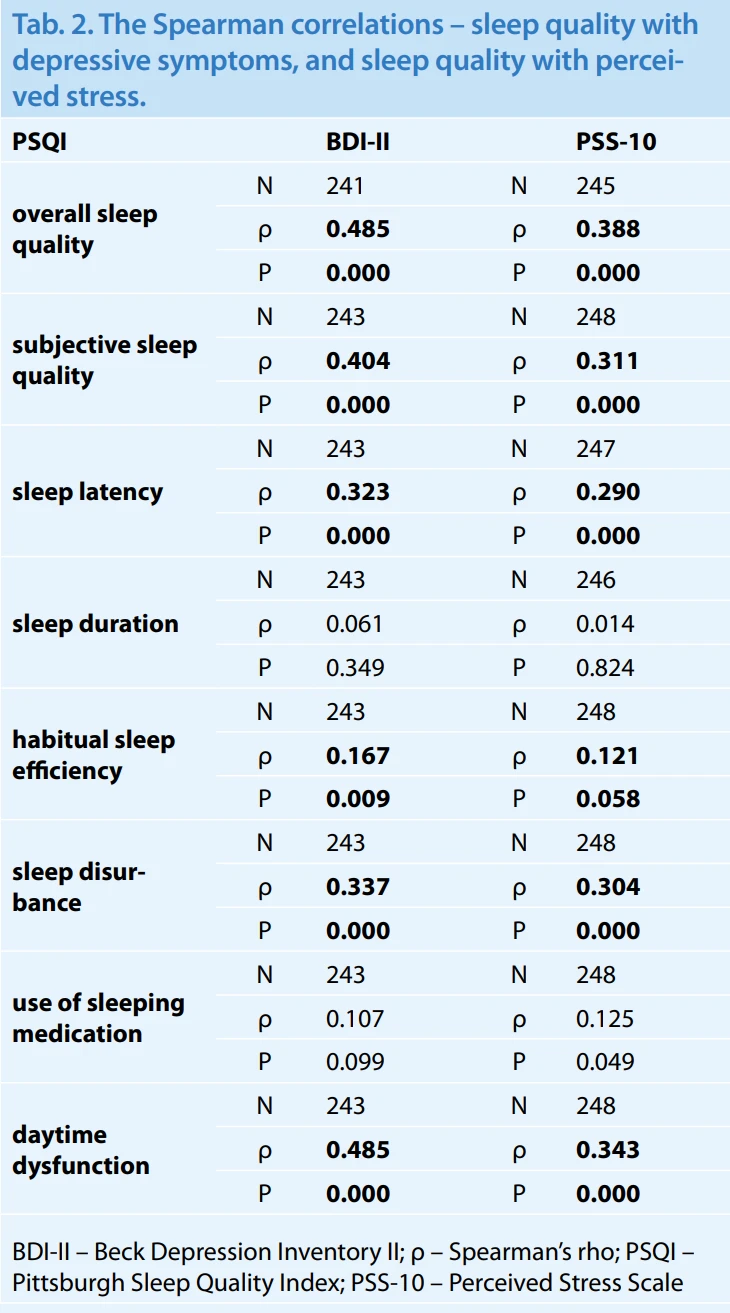
The strongest positive correlations were observed between depressive symptoms and overall sleep quality (ρ = 0.485), as well as its specific components, including the disruption of daily routine due to poor sleep (ρ = 0.485) and subjective sleep quality (ρ = 0.404). Among the seven dimensions of the Pittsburgh Sleep Quality Index (PSQI), no statistically significant relationships were found between depressive symptoms, as measured by the BDI-II, and sleep duration (P > 0.05) or the use of sleep medication (P > 0.05).
In terms of perceived stress, the strongest positive correlation was observed with overall sleep quality (ρ = 0.388). Among the specific components of sleep quality, the most significant relationships were observed between perceived stress and the disruption of daily routines due to poor sleep (ρ = 0.343), subjective sleep quality (ρ = 0.311), and sleep disturbances (ρ = 0.304). No significant relationships were identified between perceived stress and sleep duration or sleep efficiency (P > 0.05). Results are pictured in Tab. 2.
Perceived stress and sleep quality as risk factors for depressive symptoms
To investigate the role of perceived stress and sleep quality as predictors of depressive symptoms, a linear regression analysis was conducted. In this analysis, perceived stress and sleep quality served as independent variables, while depressive symptoms were the dependent variable.
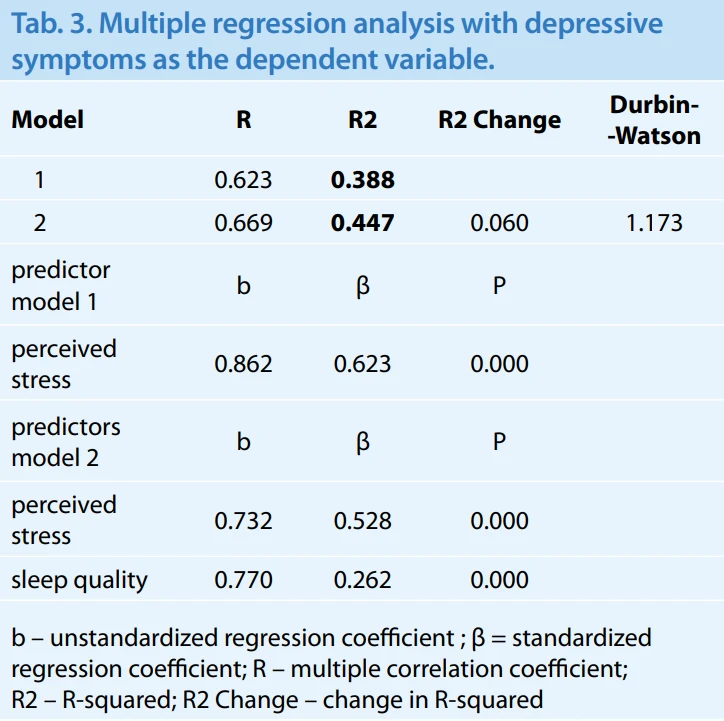
The analysis employed the ENTER method for both predictors: the first block included perceived stress as a predictor, and the second block added sleep quality. According to the results from Model 1, perceived stress alone accounts for 38.8% of the variance in depressive symptoms. When sleep quality was added as a second predictor, the explained variance increased by 6%, with a P < 0.001. This indicates that addition of sleep quality to the model is statistically significant. Model 2, which incorporates both predictors (perceived stress and sleep quality), explains 44.7% of the variance in depressive symptoms. The analysis demonstrated that both predictors are statistically significant in relation to depression, with a P < 0.001. Furthermore, perceived stress, with a coefficient of b = 0.528, predicts depression more strongly than sleep quality, which has a coefficient of b = 0.262. Positive values of the standardized beta coefficients indicate that as the levels of perceived stress and sleep difficulties increase, the severity of depressive symptoms also rises (Tab. 3). The Durbin–Watson statistic for Model 2 was 1.173, which is below the reference value of 2. Although values close to 2 are generally interpreted as indicating no autocorrelation among residuals, the Durbin–Watson test is primarily intended for ordered or time-series data and is of limited relevance in cross-sectional survey research. The statistic is therefore reported for transparency. The Durbin–Watson statistic was calculated and reported only for the final regression model (Model 2) and was therefore not reported for Model 1.
Mediation analysis – Does sleep quality mediate the relationship between perceived stress and depressive symptoms?
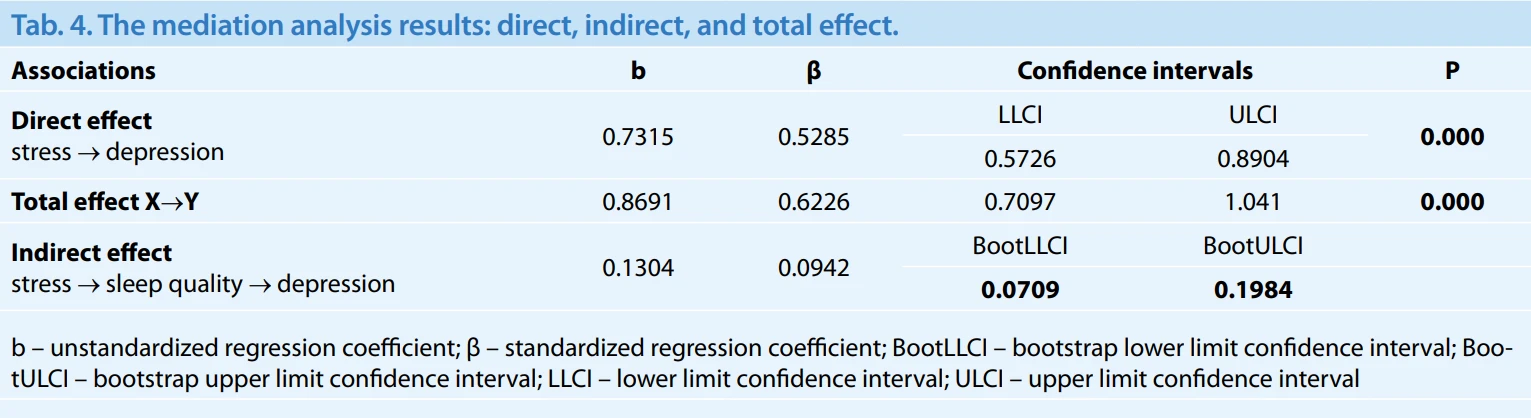
To elucidate the underlying mechanisms linking perceived stress, sleep quality, and depression, a mediation analysis was performed. In this analysis, perceived stress served as the predictor variable, depression was the dependent variable, and sleep quality acted as the mediator. This model allowed for the assessment of both the direct effects of perceived stress on depression and the indirect effects mediated by sleep quality (Tab. 4, Fig. 1). The bootstrapping method was employed to calculate the indirect effect.

The initial step consisted of confirming the hypothesized position of the mediator within the proposed statistical model and was situated between the independent and dependent variables. Analysis revealed a significant effect of perceived stress on sleep quality (b = 0.1692; P < 0.001). Similarly, sleep quality was identified as a significant predictor of depressive symptoms (b = 0.7705; P < 0.001).
Results confirmed that perceived stress has a significant direct effect on depressive symptoms (b = 0.7135; P < 0.001), indicating that as perceived stress increases, the level of depressive symptoms experienced also rises. The indirect effect of perceived stress on depressive symptomatology through sleep quality was found to be b = 0.1304, with a confidence interval ranging from 0.0709 to 0.1984 (BootLLCI-ULCI), confirming its significance. These findings indicate that sleep quality plays a partial mediating role in the relationship between perceived stress and depressive symptoms.
Discussion
Depression is defined as a multifactorial mood disorder influenced by various factors. Previous studies suggest that risk factors include stress [38], problems [38], or disruptions in social rhythms [40]. The current study seeks to investigate how stress and sleep quality affect depressive symptoms, particularly focusing on the mediating role of sleep quality. What is the relationships’ structure and interconnectedness between perceived stress, sleep quality, and depressive symptoms in the present sample of Slovak adults?
The findings align with the hypothesis that both perceived stress and sleep quality are significant predictors of depressive symptoms. This indicates that as perceived stress increases, depressive symptoms also rise; similarly, as sleep difficulties escalate, depressive symptoms tend to increase as well. Furthermore, the findings showed that when both predictors operate simultaneously, they explain a greater percentage of the variance in depressive symptoms compared to a regression model in which perceived stress acts alone. This supports the conclusions drawn by Weiss et al. [41], which indicated that disrupted sleep significantly predicts depressive symptomatology, explaining 20% of the variance in BDI-II scores within their sample. According to Peach et al. [42], poor sleep quality contributes to an increase in depressive symptoms and a decline in subjective well-being. Disturbed sleep has even been identified as a prodromal symptom of recurrent depressive disorder, where a progressive worsening of sleep occurs before the onset of a depressive episode [43].
In the mediation analysis, we examined whether an additional variable statistically accounted for part of the association between the independent and dependent variables, thereby indirectly explaining the relationship between the predictor and outcome. Specifically, we investigated whether sleep quality statistically mediated the association between perceived stress and depressive symptoms.
Our research confirmed a direct positive relationship between perceived stress and depressive symptoms, indicating that as stress levels increase, severity of depressive symptoms also rises. Additionally, perceived stress had a significant indirect effect on depression through sleep quality. Higher levels of perceived stress were associated with poorer sleep quality, and poorer sleep quality was in turn associated with higher levels of depressive symptoms. Based on these findings, we concluded that sleep quality serves as a mediator in the relationship between stress and depressive symptoms within the present sample of Slovak adults. However, given the cross-sectional nature of the study, the mediation model should be interpreted as reflecting statistical associations rather than causal or temporal processes. Therefore, no conclusions can be drawn regarding the directionality of the observed relationships. It is important to note that stress had a significant direct effect; thus, only a part of the association between stress and depressive symptoms was mediated by sleep quality. Research conducted by Zhuang et al. [27] illustrated insomnia‘s mediating role between perceived stress and depression among medical students. Similarly, Liu et al. [26] confirmed that the effect of stress on depression is partially mediated by sleep quality in seniors from urban communities. Additionally, Park et al. [44] also found that disrupted sleep mediates the effects of negative life events on both depression and impulsivity.
Concerning our current research model and the variables studied, we can reflect on various factors that may have an influence on these relationships, including a wide range of risk and protective factors. Among these are the ways individuals cognitively assess and process stressful events, which can significantly modify the relationship between stress and depressive symptoms. Faleel et al. [45] found that individuals with higher coping capacities tend to report lower levels of both depression and stress. Li et al. [46] further illustrated that rumination partially mediates the adverse effects of stress on sleeping patterns. Roohafza et al. [47] identified social support perceptions as another protective factor against anxiety and depression concerns. For future research, it would be beneficial to incorporate additional potential factors that could provide greater insight into the structure of the relationships addressed in this study. The present findings suggest that perceived stress, sleep quality, and depressive symptoms are closely interrelated, as indicated by the mediation model, which identified a significant indirect association among these variables. Participants reporting higher levels of perceived stress also tended to report poorer sleep quality and more severe depressive symptoms. These findings suggest that sleep quality may statistically account for part of the association between perceived stress and depressive symptomatology. Incorporating the findings of the current study within the context of broader theoretical and empirical knowledge, it may be beneficial for prevention and intervention efforts targeting depressive symptoms to consider both stress and sleep quality as relevant factors. In relation to the issues studied, it is essential to promote strategies that help individuals cope with stress, adaptively maintain good sleep hygiene, and utilize the potential of other protective factors effectively.
Limitations
Several limitations exist within this study, one of which is the use of a questionnaire-based method. The instruments used were self-report measures, carrying the risk of response bias and intentional distortion. Another limitation is the use of a non-probability convenience sampling method. Consequently, the findings cannot be considered representative of the Slovak adult population and should be interpreted as applying only to the present convenience sample. Lastly, there is the potential for distortion of the results due to the influence of other variables that were not considered in the presented research.
An additional limitation is the cross-sectional design of the study. Although a mediation analysis was employed, the data do not permit conclusions regarding causal relationships or temporal precedence among perceived stress, sleep quality, and depressive symptoms. Future longitudinal and experimental studies are needed to verify the directionality of these associations and to further evaluate the proposed mediation model.
A further limitation concerns statistical power. No a priori power analysis was conducted prior to data collection. A post-hoc sensitivity power analysis was therefore conducted using G*Power [48] for the multiple regression model (Model 2, two predictors). With a total sample size of N = 241, a = 0.05, and power (1−b) = 0.80, the analysis indicated that the study had sufficient sensitivity to detect effects as small as f² = 0.041, which is classified as a small effect according to Cohen‘s [28] conventions. This suggests that the sample size was adequate to detect the effects of the magnitude typically reported in comparable mediation studies; however, smaller indirect effects than those captured by this threshold may have gone undetected. Future studies should determine sample size requirements a priori, particularly given that mediation analysis generally requires larger samples than standard regression to detect indirect effects with adequate precision.
Despite these limitations, the findings provide valuable insights into the intricate relationship among stress, sleep, and depression, suggesting potential avenues for future research and intervention development.
Ethical statement
As authors, we honestly declare that the research was conducted in compliance with the ethical standards set by the Declaration of Helsinki (1964) and all participants provided informed consent. Participants of the study were informed about the purpose of the research, data protection, and were given an informed consent form to sign before their participation, emphasizing the ethical principles and the ability to withdraw from the study if they did not want to continue. No one used the option to withdraw from research – neither at the beginning nor during the research study. The research study was approved and supervised by The Research Center at the Department of Psychology, UCM. Ethical standards set by the Declaration of Helsinki (1964) were secured throughout the research.
Availability of data and materials
The datasets used and/or analyzed during the current study are available from the corresponding author upon reasonable request.
Competing interests
The authors declare that they have no competing interests.
Funding
This work received no external funding provided by a third party.
Author contribution
PZ – conceptualization, methodology, formal analysis, data curation, writing (original draft), visualization.
MG – conceptualization, methodology, formal analysis, data analysis consultation, supervision, writing – review & editing.
Mgr. Petra Zbínová
Department of Psychology
Faculty of Arts
University of Ss. Cyril and Methodius in Trnava
Námestí J. Herdu 2
917 01 Trnava
Slovakia
e-mail: zbinova1@ucm.sk
Sources
1. Kořínková V. Možnosti diagnostiky a liečby depresie v ambulancii praktického lekára. Via practica 2005; 2 (10): 412–416.
2. Patarák M. Úvod do psychiatrie. Bratislava: Slovenská zdravotnícka univerzita v Bratislave 2021.
3. Dobson KS, Dozois DJ. Introduction: assessing risk and resilience factors in models of depression. In: Dobson KS, Dozois DJ (Eds.). Risk factors in depression. Amsterdam: Elsevier Inc. 2008 : 1–12.
4. Paulík K. Psychologie lidské odolnosti: 2. přepracované a doplnené vydáni. Praha: Grada Publishing, a. s. 2017.
5. Sic A, Cvetkovic K, Manchanda E et al. Neurobiological implications of chronic stress and metabolic dysregulation in inflammatory bowel diseases. Diseases 2024; 12 (9): 220. doi: 10.3390/diseases12090220.
6. Gress-Smith JL, Roubinov DS, Andreotti C et al. Prevalence, severity and risk factors for depressive symptoms and insomnia in college undergraduates. Stress Health 2015; 31 (1): 63–70. doi: 10.1002/smi.2509.
7. Su YY, D’Arcy C, Li M et al. Specific and cumulative lifetime stressors in the aetiology of major depression: a longitudinal community-based population study. Epidemiology and Psychiatric Sciences 2022; 31 (3): e3. doi: 10.1017/S2045796021000779.
8. Alba J, Calvete E. Bidirectional relationships between stress, depressive symptoms, and cognitive vulnerabilities in adolescents. J Soc Clin Psychology 2017; 38 (2): 87–112. doi: 10.1521/jscp.2019.38.2.87.
9. Hautzinger M. Depresia. Trenčín: Vydavateľstvo F 2000.
10. Borzová C, Jirák R, Holíková M et al. Nespavost a jiné poruchy spánku: Pro nelekářské zdravotnícke obory. Praha: Grada Publishing, a. s. 2009.
11. Germain A, Thase ME. Sleep dysregulation and related regulatory models. In: Dobson KS, Dozois DJ (Eds.). Risk factors in depression. Amsterdam: Elsevier Inc. 2008 : 91–109.
12. Praško J, Espa-Červená K, Závěšická L. Nespavost. Praha: Portál, s. r. o. 2004.
13. Hamilton M. Frequency of symptoms in melancholia (depressive illness). Br J Psychiatry 1989; 154 : 201–206. doi: 10.1192/bjp.154.2.201.
14. Zhang Q, Tong M, Ji Y et al. The impact of sleep disturbances on treatment efficacy and prognosis in patients with depressive and anxiety disorders. Front Psychol 2024; 15 (2024): 1432538. doi: 10.3389/fpsyt.2024.1432538.
15. Celik N, Çağan Ö, Ünsal A. Depression in health college students: relationship factors and sleep quality. Psychol Health Med 2018; 24 (5): 625–630. doi: 10.1080/13548506.2018.1546881.
16. Gupta R, Lahan V. Insomnia associated with depressive disorder: primary, secondary or mixed? Indian J Psychol Med 2011; 33 (2): 123–128. doi: 10.4103/0253-7176.92056.
17. Plante DT. The evolving nexus of sleep and depression. Am J Psychiatry 2021; 178 (10): 896–902. doi: 10.1176/appi.ajp.2021.21080821.
18. Lavie P, Pillar G, Malhotra A. Poruchy spánku: Diagnostika, manažment a liečba. Trenčín: Vydavateľstvo F 2004.
19. Harvey (2002) – sekundárna citácia, primárny zdroj je [20].
20. Liu X, Liu C, Tian X et al. Associations of perceived stress, resilience and social support with sleep disturbance among community-dwelling adults. Stress Health 2016; 32 (5): 578–586. doi: 10.1002/smi.2664.
21. Nevšímalová S, Šonka K, Illnerová H et al. Poruchy spánku a bdění: Druhé, doplněné a přepracované vydání. Praha: Galén 2007.
22. Grant KE, Compas BE, Thurm AE et al. Stressors and child and adolescent psychopathology: Measurement issues and prospective effects. J Clin Child Adolesc Psychol 2004; 33 : 412–425. doi: 10.1207/s15374424jccp3302_23.
23. Zhao X, Lan M, Li H et al. Perceived stress and sleep quality among the non-diseased general public in China during the 2019 coronavirus disease: a moderated mediation model. Sleep Med 2021; 77 : 339–345. doi: 10.1016/j.sleep.2020.05.021.
24. Bernert RA, Merrill KA, Braithwaite SR et al. Family life stress and insomnia symptoms in a prospective evaluation of young adults. J Fam Psychol 2007; 21 (1): 58–66. doi: 10.1037/0893-3200.21.1.58.
25. Hall M, Buysse DJ, Nowell PD et al. Symptoms of stress and depression as correlates of sleep in primary insomnia. Psychosom Med 2000; 62 (2): 227–230. doi: 10.1097/00006842-200003000-00014.
26. Liu Y, Li T, Guo L et al. The mediating role of sleep quality on the relationship between perceived stress and depression among the elderly in urban communities: a cross-sectional study. Public Health 2017; 149 : 21–27. doi: 10.1016/j.puhe.2017.04.006.
27. Zhuang L, Rongxun L, Yue Z et al. Association between perceived stress and depression among medical. J Affect Disord 2021; 292 : 89–94. doi: 10.1016/j.jad.2021.05.028.
28. Cohen J. Statistical power analysis for the behavioral sciences (2nd ed.). Lawrence Erlbaum Associates 1988.
29. Cohen S, Kamarck T, Mermelstein R. A global measure of perceived stress. J Health Soc Behav 1983; 24 (4): 385–396. doi: 10.2307/2136404.
30. Raczova B, Hricová M, Lovášová S. Verification of psychometric properties of the slovak version of the pss-10 questionnaire (Perceived stress scale) on the sample of helping professionals. Cesk Psychol 2018; 62 (6): 552–564.
31. Džuka J. Faktorová štruktúra BDI u všeobecnej populácie: Zjednodušená verzia Beckovho inventára depresie a teória homeostaticky chránenej nálady. Cesk Psychol 2021; 65 (4): 336–352. doi: 10.51561/cspsych.65.4.336.
32. Beck AT, Steer RA, Brown GK. Manual for the Beck Depression Inventory-II. San Antonio, TX: Psychological Corporation 1996.
33. Ptáček R, Raboch J, Vňuková M et al. Beckova škála deprese BDI-II – standardizace a využití v praxi. Čes a slov Psychiatr 2016; 112 (6): 270–274.
34. Rutkowska A, Liska D, Cieślik B et al. Stress levels and mental well-being among Slovak students during e-learning in the Covid-19 pandemic. Healthcare 2021; 9 (10): 1356. doi: 10.3390/healthcare9101356.
35. Buysse DJ, Reynolds CF, Monk TH et al. The Pittsburgh Sleep Quality Index: a new instrument for psychiatric practice and research. Psychiatry Res 1989; 28 (2): 193–213. doi: 10.1016/0165-1781 (89) 90047-4.
36. Vitkova M, Gdovinova Z, Rosenberger J et al. Factors associated with poor sleep quality in patients with multiple sclerosis differ by disease duration. Disabil Health J 2014; 7 (4): 466–471. doi: 10.1016/j.dhjo.2014.05.004.
37. Hayes AF. Partial, conditional, and moderated moderated mediation: Quantification, inference, and interpretation. Communication Monographs 2018; 85 : 4–40.
38. Karim MR, Ahmed HU, Akhter S. Behavioral and psychosocial predictors of depression in bangladeshi medical students: a cross-sectional study. F1000Res 2022; 11 : 745. doi: 10.12688/f1000research.122927.1.
39. Skouteris H, Wertheim EH, Germano C et al. Assessing sleep during pregnancy: a study across two time points examining the Pittsburgh Sleep Quality Index and associations with depressive symptoms. Womens Health Issues 2009; 19 (1): 45–51. doi: 10.1016/j.whi.2008.10.004.
40. Haynes P, Gengler D, Kelly M. Social rhythm therapies for mood disorders: an update. Curr Psychiatry Rep 2016; 18 (8): 75. doi: 10.1007/s11920-016-0712-3.
41. Weiss C, Woods K, Filipowicz A et al. Sleep quality, sleep structure, and PER3 genotype mediate chronotype effects on depressive symptoms in young adults. Front Psychol 2020; 11 : 2028. doi: 10.3389/fpsyg.2020.02028.
42. Peach H, Gaultney JF, Gray DD. Sleep hygiene and sleep quality as predictors of positive and negative dimensions of mental health in colegge students. Cogent Psychology 2016; 3 (1): 1168768. doi: 10.1080/23311908.2016.1168768.
43. Perlis ML, Giles DG, Buysse DJ et al. Self-reported sleep disturbance as a prodromal symptom in recurrent depression. J Affect Disord 1997; 42 (2–3): 209–212. doi: 10.1016/S0165-0327 (96) 01411-5.
44. Park I, Oh SM, Lee KH et al. The moderating effect of sleep disturbance on the association of stress with impulsivity and depressive mood. Psychiatry Investig 2020; 17 (3): 243–248. doi: 10.30773/pi.2019.0181.
45. Faleel SF, Tam CL, Lee TH et al. Stress, perceived social support, coping capability and depression: a study of local and foreign students in the Malaysian context. Int J Soc Human Sci 2012; 6:, 8–14. doi: 10.5281/zenodo.1071358.
46. Li Y, Gu S, Wang Z et al. Relationship between stressful life events and sleep quality: rumination as a mediator and resilience as a moderator. Front Psychiatry 2019; 10 : 348. doi: 10.3389/fpsyt.2019.00348.
47. Roohafza HR, Afshar H, Keshteli AH et al. What’s the role of perceived social support and coping styles in depression and anxiety? J Res Med Sci 2014; 19 (10): 944–949.
48. Faul F, Erdfelder E, Buchner A et al. Statistical power analyses using G*Power 3.1: Tests for correlation and regression analyses. Behav Res Methods 2009; 41 (4): 1149–1160. doi: 10.3758/BRM.41.4.1149.
Labels
Addictology Paediatric psychiatry PsychiatryArticle was published in
Czech and Slovak Psychiatry

2026 Issue 4
Most read in this issue
- Tobacco dependence in psychiatry
- Zemřel prof. MUDr. Ivan Rektor, CSc.
- Mediating the role of sleep quality in the relationship between stress and depressive symptomatology
- Mezinárodní konference o poruchách příjmu potravy 2026 (ICED, Haag 2026)