
Pregnancy-associated EGFR-mutant lung adenocarcinoma in a TB-endemic region – diagnostic bias and therapeutic barriers
Authors:
Dr. Muhammad Hafiz, SpP 1,2; Prof. Dr. Aziza G. Icksan 3; Dr. Ph. Sita Laksmi Andarini D, Ph.D, SpP 1,4,5; Dr. Nur M Karim, SpR 6; Dr. Annisa Dian Hari Hasari, SpP 2; Farhana Ibrahim Syuaib, MD 4,5; Dr. Retno Widyawati, SpPA 7; Dr. Tati Herdawati, SpPA 7
Authors‘ workplace:
Lung Cancer Center, MRCCC Siloam Hospitals Semanggi, Jakarta, Indonesia
1; Department of Pulmonology and Respiratory Medicine, Budhi Asih General Hospital, Jakarta, Indonesia
2; Department of Radiology, Universitas PRIMA, Medan, Indonesia
3; Division of Thoracic Oncology, Department of Pulmonology and Respiratory Medicine, Persahabatan Hospital, Jakarta, Indonesia
4; Faculty of Medicine, Universitas Indonesia, Jakarta, Indonesia
5; Department of Radiology, Budhi Asih General Hospital, Jakarta, Indonesia
6; Department of Anatomical Pathology, Budhi Asih General Hospital, Jakarta, Indonesia
7
Published in:
Klin Onkol 2026; 39(5): 372-377
Category:
doi:
https://doi.org/10.48095/ccko2026372
Introduction
Non-small cell lung cancer (NSCLC) in young, non-smoking women is frequently associated with activating epidermal growth factor receptor (EGFR) mutations. Globally, the therapeutic landscape for EGFR-mutated NSCLC has shifted decisively toward frontline next--generation targeted therapies. Based on landmark data from the FLAURA and FLAURA2 trials reflected in contemporary European Society for Medical Oncology (ESMO) clinical practice guidelines, frontline osimertinib, administered as a monotherapy or in combination with platinum-pemetrexed chemotherapy, is now established as the preferred first-line therapy due to its superior efficacy and central nervous system penetration. More recently, the MARIPOSA trial demonstrated improved progression-free survival (PFS) with amivantamab plus lazertinib compared with osimertinib, further expanding frontline treatment options for EGFR-mutated NSCLC [1–3]. Historically, treatment relied on first-generation EGFR tyrosine kinase inhibitors (TKIs), such as erlotinib or gefitinib. While these agents offered significant clinical benefits over conventional chemotherapy, they inevitably led to acquired resistance, most commonly mediated by secondary T790M mutation [4,5]. However, access to third-generation EGFR-targeted therapies remains uneven across many low-and middle-income countries (LMICs). In Indonesia, financial constraints, reimbursement limitations, and drug availability continue to influence treatment selection. Consequently, sequencing first-generation EGFR-TKIs followed by subsequent therapy at disease progression remains a pragmatic reality in routine clinical practice [6,7].
Pregnancy-associated lung cancer (PALC) is rare and frequently diagnosed at an advanced stage. Respiratory symptoms are often dismissed as physiological changes of pregnancy, and concerns regarding fetal radiation exposure frequently delay mandatory diagnostic investigations. In tuberculosis (TB) --endemic regions such as Indonesia, these challenges may be further compounded. Persistent respiratory symptoms in young patients are often initially attributed to pulmonary TB, creating a diagnostic anchoring bias that delays oncologic evaluation, staging, and molecular profiling [8,9]. We report a case of pregnancy-associated EGFR-mutant lung adenocarcinoma that illustrates both diagnostic delays related to TB-associated anchoring bias and a resource-constrained treatment pathway necessitated by limited local access to contemporary targeted therapies.
Case presentation
A 28-year-old non-smoking woman, with no prior medical history, presented in November 2023 with worsening dyspnea and a persistent cough 2 months in duration. She had initially been treated empirically for clinical pulmonary TB for over a month at a primary care facility without clinical improvement. At presentation, she was at term gestation, tachypneic with bilateral lung crackles, and had an oxygen saturation of 94% on room air. Computed tomography (CT) of the chest revealed a spiculated solid peri-bronchial mass involving segments IV and VI of the right lung, mea-suring 7.54 × 3.9 × 3.4 cm, alongside numerous pulmonary nodules in both lungs (Fig. 1A and 1B). A prior chest radiograph demonstrated consolidation in the right perihilar region and multiple bilateral nodules (Fig. 1C). Bronchoscopy was safely performed during the peripartum period, followed by successful delivery of a healthy infant, who was subsequently formula-fed and remains healthy to date. Histopathology and cytology (Fig. 1D and 1E) revealed non-small cell carcinoma consistent with adenocarcinoma. Molecular analysis confirmed an EGFR exon 19 deletion. Contrast-enhanced brain CT demonstrated two enhancing metastatic nodules with perifocal edema measuring 2.3 × 2.2 cm and 2.4 × 2.9 cm (Fig. 2A and 2B), consistent with stage IV disease.


The patient initiated erlotinib (150 mg daily) 1 week after delivery to allow adequate post-surgical wound healing. Treatment was initiated promptly after delivery because of the advanced stage of disease. She received concurrent whole-brain radiotherapy (WBRT) administered over 10 fractions (total dose 30 Gy) using three-dimensional conformal radiotherapy. A follow-up chest radiograph obtained after 3 months demonstrated marked regression of the primary lung mass and complete disappearance of the bilateral pulmonary nodules (Fig. 3A). According to RECIST version 1.1, measurable residual disease demonstrated an approximately 70.8% reduction in the sum of the diameters compared with baseline, which was consistent with a deep partial response (Fig. 3B). Follow-up brain CT demonstrated a stable hypodense area without surrounding cerebral edema (Fig. 3C and 3D).

with a deep partial response according to RECIST 1.1 criteria; C, D) follow-up brain CT demonstrating stable treated lesions and complete resolution of surrounding edema.
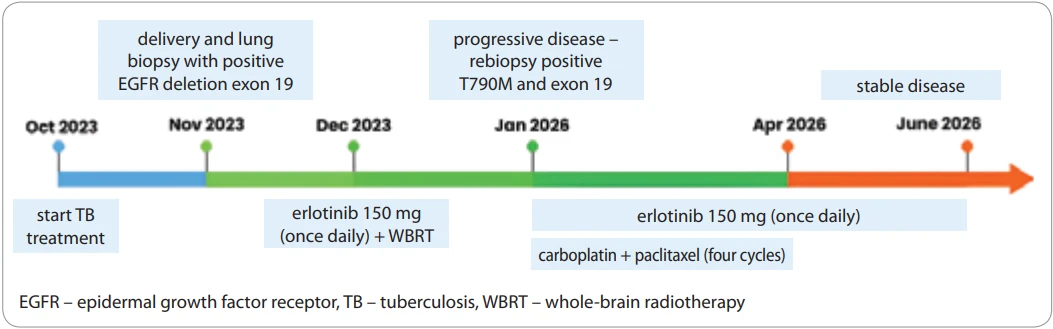
The patient experienced a favorable clinical course, achieving a PFS of 24 months on first-line erlotinib. In January 2026, routine follow-up imaging revealed enlargement of the primary lung mass to 7.1 × 5.5 × 3.3 cm (Fig. 4A and 4B) representing an approximate 68% increase from the nadir, confirming progressive disease. Tissue re-biopsy demonstrated persistence of the original EGFR exon 19 deletion together with acquisition of the EGFR T790M mutation. Because third-generation TKI therapy was financially inaccessible and not covered by local public insurance frameworks, a resource-constrained treatment strategy was adopted. This consisted of continuing erlotinib combined with carboplatin (AUC 5) and paclitaxel (175 mg/m2), administered every 3 weeks for four cycles. Treatment was well tolerated, with only grade 1 diarrhea reported. A follow-up chest CT in June 2026 demonstrated radiologically stable disease (Fig. 4C and 4D). Written informed consent for publication was obtained from the patient. A treatment timeline is provided (Scheme 1).

June 2026 demonstrated stable disease.
Discussion
A key clinical message from this case is the diagnostic delay resulting from anchoring bias in a TB-endemic setting. Anchoring bias occurs when clinicians rely excessively on an initial diagnostic impression and fail to sufficiently adjust their assessment in response to subsequent findings [10]. In TB-endemic regions, young, non-smoking adults presenting with constitutional symptoms, cough, and pulmonary infiltrates are often initially suspected of having pulmonary TB, creating a profound diagnostic preoccupation that delays the recognition of malignancy [11]. Because advanced lung adenocarcinoma and pulmonary TB share overlapping clinical and radiological features, including pleural involvement, consolidation, and pulmonary nodules, malignancy may not be immediately considered. In the present case, the initial diagnostic anchoring resulted in empirical anti-TB treatment and delayed definitive oncologic evaluation. These findings highlight the importance of maintaining a broad differential diagnosis and pursuing tissue confirmation when patients fail to demonstrate early clinical or radiological improvement after initiating anti-TB therapy.
Beyond the diagnostic challenges, this case illustrates the impact of limited access to contemporary targeted therapies in resource-constrained healthcare systems. Current ESMO clinical practice guidelines recommend frontline third-generation EGFR-TKIs such as osimertinib as the preferred treatment for patients with advanced EGFR-mutated NSCLC. However, implementing these recommendations remains challenging in many LMICs, where financial constraints, reimbursement limitations, and restricted access to molecular diagnostics influence treatment decisions. Consequently, treatment pathways involving first-generation EGFR-TKIs followed by subsequent therapy at progression continue to be encountered in routine clinical practice. The management strategy described in this report therefore reflects the realities of resource-constrained settings rather than a preferred contemporary treatment standard.
PALC, defined as lung cancer diagnosed during pregnancy or within 1 year postpartum, is an exceptionally rare clinical entity and is frequently diagnosed at an advanced stage [12]. Consistent with previously reported cohorts, our patient was a young, non-smoking woman with adenocarcinoma harboring an actionable EGFR mutation. Prior studies demonstrated a high prevalence of targetable driver alterations among patients with PALC, with EGFR mutations and anaplastic lymphoma kinase rearrangements accounting for the vast majority of cases [13]. This distinct molecular profile underscores the importance of rapid, comprehensive molecular profiling in this population, as identifying actionable genomic alterations dramatically influences both maternal survival and therapeutic decisions [14]. Molecular reassessment at progression remains essential even when access to recommended second-line therapies is restricted. In our patient, a repeat biopsy confirmed the persistence of the original EGFR exon 19 deletion together with the acquisition of the T790M mutation, illustrating clonal evolution during EGFR-targeted therapy. Following disease progression, erlotinib was continued concurrently with carboplatin and paclitaxel. While the clinical rationale was to maintain pressure on potentially sensitive systemic clones in the absence of osimertinib, the clinical significance of this approach must be interpreted cautiously. The phase III IMPRESS trial demonstrated no PFS benefit from continuing a first-generation EGFR-TKI alongside chemotherapy. Therefore, efficacy conclusions cannot be drawn from this single patient observation, and this treatment course should be regarded as a descriptive account of management under resource constraints rather than a therapeutic recommendation [15]. Similarly, while the patient achieved a prolonged 24-month PFS on erlotinib, the potential contribution of upfront WBRT to systemic disease kinetics remains speculative. Although WBRT provides vital intracranial control, its role in extending systemic PFS cannot be definitively established.
Conclusion
This case underscores the significant diagnostic and therapeutic challenges of managing pregnancy-associated lung adenocarcinoma in a resource-constrained, TB-endemic setting. In these environments, diagnostic anchoring bias toward infectious etiologies can critically delay oncologic evaluation in young, non-smoking adults presenting with persistent respiratory symptoms. Early tissue diagnosis and comprehensive molecular profiling are essential to identify actionable driver mutations, because optimal clinical outcomes depend on reliable access to contemporary targeted therapies. The clinical course described in this report reflects the pragmatic realities of cancer care in many LMICs, where financial barriers, reimbursement limitations, and restricted drug availability may influence treatment selection. Sequential use of a first--generation EGFR-TKI followed by concurrent TKI-chemotherapy upon disease progression was necessitated by limited access to recommended third-generation therapies rather than contemporary best practice. In alignment with the negative findings of the landmark IMPRESS trial, no efficacy conclusion can be drawn regarding this combination. Ultimately, this case highlights the critical need to maintain clinical vigilance for malignancy in patients with non-resolving respiratory symptoms, perform molecular reassessment at progression to identify resistance mechanisms such as EGFR T790M, and actively address disparities in access to effective targeted therapies.
Acknowledgments
The authors sincerely thank the patient and her family for their cooperation, trust, and permission to share this clinical history for medical education. We also acknowledge the multidisciplinary clinical and nursing teams at MRCCC Siloam Hospitals Semanggi and Budhi Asih General Hospital for their dedicated care and support throughout the patient’s diagnostic and therapeutic journey.
Informed consent
Written informed consent was obtained directly from the patient for the publication of this case report and any accompanying clinical images.
Author contributions
All authors contributed to the conception, preparation, revision, and final approval of the manuscript.
Sources
1. Jänne PA, Planchard D, Kobayashi K et al. Survival with osimertinib plus chemotherapy in EGFR-mutated advanced NSCLC. N Engl J Med 2026; 394 (1): 27–38. doi: 10.1056/nejmoa2510308.
2. Hendriks LE, Kerr KM, Menis J et al. Oncogene-addicted metastatic non-small-cell lung cancer: ESMO Clinical Practice Guideline for diagnosis, treatment and follow-up. Ann Oncol 2023; 34 (4): 339–357. doi: 10.1016/j.annonc.2022.12.009.
3. Cho BC, Lu S, Felip E et al. Amivantamab plus lazertinib in previously untreated EGFR-mutated advanced NSCLC. N Engl J Med 2024; 391 (16): 1486–1498. doi: 10.1056/nejmoa2403614.
4. Maemondo M, Inoue A, Kobayashi K et al. Gefitinib or chemotherapy for non-small-cell lung cancer with mutated EGFR. N Engl J Med 2010; 362 (25): 2380–2388. doi: 10.1056/NEJMoa0909530.
5. Rosell R, Carcereny E, Gervais R et al. Erlotinib versus standard chemotherapy as first-line treatment for European patients with advanced EGFR mutation-positive non-small-cell lung cancer (EURTAC): a multicentre, open-label, randomised phase 3 trial. Lancet Oncol 2012; 13 (3): 239–246. doi: 10.1016/S1470-2045 (11) 70393-X.
6. Ocran Mattila P, Ahmad R, Hasan SS et al. Availability, affordability, access, and pricing of anti-cancer medicines in low - and middle-income countries: a systematic review of literature. Front Public Health 2021; 9 : 628744. doi: 10.3389/fpubh.2021.628744.
7. Bamodu OA, Chung CC. Cancer care disparities: overcoming barriers to cancer control in low - and middle--income countries. JCO Glob Oncol 2024; 10: e2300439. doi: 10.1200/GO.23.00439.
8. Amanda G, Susanto AD, Soehardiman D et al. Adenocarcinoma of the lung with positive epidermal growth factor receptor mutation in pregnancy. Lung India 2017; 34 (6): 548–551. doi: 10.4103/0970-2113.217574.
9. Zhou JP, Wang Y, Lin YN et al. Clinical features and management of lung cancer during pregnancy: a narrative review based on reported cases. Womens Health Rep (New Rochelle) 2023; 4 (1): 544–550. doi: 10.1089/whr.2023.0085.
10. Tversky A, Kahneman D. Judgment under uncertainty: heuristics and biases. Science 1974; 185 (4157): 1124–1131. doi: 10.1126/science.185.4157.1124.
11. Revannasiddaiah S, Madabhavi I, Thakur P et al. Undue delay in the diagnosis of lung cancer due to the clinician’s preoccupation with pre-existing tuberculosis. BMJ Case Rep 2011; 2011: bcr1020114932. doi: 10.1136/bcr.10.2011.4932.
12. Boussios S, Han SN, Fruscio R et al. Lung cancer in pregnancy: report of nine cases from an international collaborative study. Lung Cancer 2013; 82 (3): 499–505. doi: 10.1016/j.lungcan.2013.09.002.
13. Yang L, He YT, Kang J et al. Clinical features and intervention timing in patients with pregnancy-associated non-small-cell lung cancer. J Thorac Dis 2021; 13 (7): 4125–4136. doi: 10.21037/jtd-21-234.
14. Simons E, Camidge DR. Lung cancer oncogene-directed therapy, fertility, and pregnancy. J Thorac Oncol 2024; 19 (6): 866–876. doi: 10.1016/j.jtho.2024.01.003.
15. Mok TS, Kim SW, Wu YL et al. Gefitinib plus chemotherapy versus chemotherapy in epidermal growth factor receptor mutation–positive non–small-cell lung cancer resistant to first-line gefitinib (IMPRESS): overall survival and biomarker analyses. J Clin Oncol 2017; 35 (36): 4027–4034. doi: 10.1200/JCO.2017.73.9250.
Labels
Paediatric clinical oncology Surgery Clinical oncologyArticle was published in
Clinical Oncology

2026 Issue 5
Most read in this issue
- FLAURA2 – a step forward in first-line treatment of advanced EGFR-mutated non-small cell lung cancer
- Pregnancy-associated EGFR-mutant lung adenocarcinoma in a TB-endemic region – diagnostic bias and therapeutic barriers
- Kontinuita
- Can a negative PSMA PET/CT limit the indication for lymphadenectomy in patients with localized moderate- and high-risk prostate cancer?