
The National Colorectal Cancer Screening Programme in the Czech Republic in 2025
Authors:
Š. Suchánek 1,2; M. Ambrožová 3,4; T. Piskovský 4; T. Grega 1,2; R. Chloupková 3,4; O. Májek 3,4; B. Seifert 5; P. Kocna 6; J. Bureš 1,2; L. Dušek 3,4; M. Zavoral 1,2
Authors‘ workplace:
Interní klinika 1. LF UK a ÚVN – VFN Praha
1; Ústav gastrointestinální onkologie, ÚVN – VFN Praha
2; Institut biostatistiky a analýz, Lékařská fakulta MU, Brno
3; Národní screeningové centrum, Ústav zdravotnických informací a statistiky České republiky, Praha
4; Ústav všeobecného lékařství, 1. lékařská fakulta UK, Praha
5; Ústav lékařské biochemie a laboratorní diagnostiky 1. LF UK a VFN v Praze
6
Published in:
Gastroent Hepatol 2026; 80(5): 362-369
Category:
Gastrointestinal Oncology: Original Article
doi:
https://doi.org/10.48095/ccgh2026362
Overview
Introduction: The National Colorectal Cancer (CRC) Screening Programme has been running in the Czech Republic since 2000. This paper reports the results of the programme for 2025 and places them against the development of the preceding years.
Methods: A retrospective descriptive analysis of aggregated nationwide data from the Registry of Preventive Colonoscopies, the National Register of Reimbursed Health Services, the Czech National Cancer Registry, and the Czech Statistical Office for the calendar year 2025. For waiting and appointment times, the most recent available 2026 figures are reported as well.
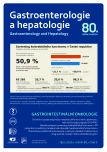
Results: In 2025, 63,265 preventive colonoscopies were performed, of which 32,214 were screening colonoscopies (50.9%) and 31,051 followed a positive faecal occult blood test (FOBT). Adenoma was found in 48.3% of colonoscopies after a positive FOBT and in 32.6% of screening colonoscopies, cancer was found in 2.8% and 0.5% respectively. Screening FOBT positivity was 8.6% (7.8–9.6% across regions), the caecal intubation rate was 98.3%, and bowel preparation was adequate in 96% of examinations. Out of 203 evaluated centres, 161 (79%) met all six national thresholds. A total of 58.0% of individuals with a positive FOBT in the first half of 2025 underwent colonoscopy within six months, and the mean test-to-colonoscopy interval was 80 days in the fourth quarter of 2025. Within the applicable intervals, 33.7% of the population aged 50 years and over had undergone a screening examination and 41.0% had any relevant examination.
Discussion: Colonoscopy quality indicators are monitored continuously and remain at relatively high levels; the main challenge remains the organisation of the screening pathway between a positive test and colonoscopy.
Conclusion: In 2025, the highest number of preventive colonoscopies in the programme’s history was performed, and screening colonoscopy exceeded the number of colonoscopies after a positive FOBT for the first time.
Keywords:
screening – colonoscopy – colorectal cancer – quality indicators – faecal occult blood test
Sources
1. Bray F, Laversanne M, Sung H et al. Global cancer statistics 2022: GLOBOCAN estimates of incidence and mortality worldwide for 36 cancers in 185 countries. CA Cancer J Clin 2024; 74 (3): 229–263. doi: 10.3322/caac.21834.
2. Suchánek Š, Ambrožová M, Grega T et al. Screening kolorektálního karcinomu v České republice – minulost, současnost a budoucnost. Gastroent Hepatol 2024; 78 (5): 378–387. doi: 10.48095/ccgh2024378.
3. Ambrožová M, Dvořák P, Chloupková R et al. Hodnocení programu screeningu kolorektálního karcinomu v České republice. Gastroent Hepatol 2025; 79 (5): 361–370. doi: 10.48095/ccgh2025361.
4. Národní screeningové centrum, Ústav zdravotnických informací a statistiky ČR. Program screeningu kolorektálního karcinomu. 2026 [online]. Available from: https: //nsc-data.uzis.cz/; https: //www.kolorektum.cz.
5. Věstník Ministerstva zdravotnictví ČR 2021; částka 14 : 196–201.
6. Věstník Ministerstva zdravotnictví ČR 2025; částka 22 : 283–289. Program screeningu kolorektálního karcinomu v České republice.
7. Věstník Ministerstva zdravotnictví ČR 2009; částka 1 : 20–23.
8. Věstník Ministerstva zdravotnictví ČR 2023; částka 11 : 134.
9. Věstník Ministerstva zdravotnictví ČR 2020; částka 9 : 161.
10. Lv XH, Lu Q, Wang ZJ et al. Colonoscopy-related adverse events in the 21st century: an updated systematic review and meta-analysis. Am J Gastroenterol 2026; 121 (1): 212–221. doi: 10.14309/ajg.0000000000003429.
11. Kindt IS, Martiny FH, Gram EG et al. The risk of bleeding and perforation from sigmoidoscopy or colonoscopy in colorectal cancer screening: a systematic review and meta-analyses. PLoS One 2023; 18 (10): e0292797. doi: 10.1371/journal.pone.0292797.
12. Ngo O, Hejcmanová K, Suchánek Š et al. Coverage by examinations associated with early detection of colorectal neoplasia in the Czech Republic. Eur J Public Health 2023; 33 (3): 515–521. doi: 10.1093/eurpub/ckad071.
13. Kaminski MF, Thomas-Gibson S, Bugajski M et al. Performance measures for lower gastrointestinal endoscopy: a European Society of Gastrointestinal Endoscopy (ESGE) Quality Improvement Initiative. Endoscopy 2017; 49 (4): 378–397. doi: 10.1055/s-0043-103411.
14. Segnan N, Patnick J, von Karsa L (eds). European guidelines for quality assurance in colorectal cancer screening and diagnosis. 1st ed. Luxembourg: Publications Office of the European Union 2010.
15. Rex DK, Anderson JC, Butterly LF et al. Quality indicators for colonoscopy. Am J Gastroenterol 2024; 119 (9): 1754–1780. doi: 10.14309/ajg.0000000000002972.
16. Senore C, Basu P, Anttila A et al. Performance of colorectal cancer screening in the European Union Member States: data from the second European screening report. Gut 2019; 68 (7): 1232–1244. doi: 10.1136/gutjnl-2018-317293.
17. Toes-Zoutendijk E, Portillo I, Hoeck S et al. Participation in faecal immunochemical testing-based colorectal cancer screening programmes in the northwest of Europe. J Med Screen 2020; 27 (2): 68–76. doi: 10.1177/0969141319879712.
18. Olesen TB, Jensen H, Møller H et al. Nationwide participation in FIT-based colorectal cancer screening in Denmark during the COVID-19 pandemic: an observational study. Elife 2023; 12: e81808. doi: 10.7554/eLife.81808.
19. Gies A, Cuk K, Schrotz-King P et al. Direct comparison of diagnostic performance of 9 quantitative fecal immunochemical tests for colorectal cancer screening. Gastroenterology 2018; 154 (1): 93–104. doi: 10.1053/j.gastro.2017.09.018.
20. Rutter MD, Beintaris I, Valori R et al. World Endoscopy Organization consensus statements on post-colonoscopy and post-imaging colorectal cancer. Gastroenterology 2018; 155 (3): 909.e3–925.e3. doi: 10.1053/j.gastro.2018.05.038.
Labels
Paediatric gastroenterology Gastroenterology and hepatology SurgeryArticle was published in
Gastroenterology and Hepatology
2026 Issue 5
Most read in this issue
- The National Colorectal Cancer Screening Programme in the Czech Republic: changes in 2026–2027
- Inherited metabolic disorders as an indication for liver transplantation in adults
- Prevention of cancer in the gastrointestinal tract
- Diagnostic methods for Helicobacter pylori infection