
Staphylococcal Scalded-Skin Syndrome in Newborns. Two Cases Report
Authors:
Z. Plzáková 1; J. Augustinová 2; K. Hodanová 2; K. Růžičková 2; F. Baldík 2
Authors‘ workplace:
Dermatovenerologická klinika 1. LF UK a VFN, Praha
1; Klinika pediatrie a dědičných poruch metabolismu 1. LF UK a VFN, Praha
2
Published in:
Čes-slov Derm, 101, 2026, No. 4, p. 170-174
Category:
Case Reports
Overview
Staphylococcal scalded skin syndrome (SSSS) – formerly known as Ritter’s disease or pemphigus neonatorum – is a condition caused by exfoliatin, a toxin produced by the bacterium Staphylococcus aureus (S. aureus). The syndrome primarily affects individuals unable to adequately neutralize the toxin or excrete it via the kidneys. The source of infection is typically the surrounding environment, including hospital staff. The clinical course varies in severity. Clinical presentation is crucial for diagnosing SSSS; however, detection of the toxin in serum can confirm the diagnosis in cases of uncertainty. While S. aureus cultures from eroded skin areas are often negative, the bacterium can usually be detected at the primary site of infection. Treatment involves systemic antibiotic administration and, above all, comprehensive local care. Severe cases require hospitalization in intensive care units or burn centers. In less severe cases, appropriate treatment leads to rapid, complete healing (restitutio ad integrum), whereas mortality in severe cases is most often caused by secondary bacterial infection. The authors describe two cases of the syndrome in newborns, in whom the clinical diagnosis was confirmed by the detection of exfoliative toxin-producing Staphylococcus aureus from the source infection (omphalitis and conjunctivitis). Both infants were successfully treated with oxacillin – initially empirically and subsequently based on confirmed susceptibility. Thanks to early diagnosis and treatment.
Keywords:
intensive care – resistance – antibiotics – staphylococcal scalded-skin syndrome – pemphigus neonatorum – epidermolytic toxin – desmoglein 1
Sources
1. ARNOL, J. D., HOEK, S. N., KIRKORIAN, A. J. Epidemiology of staphylococcal scalded skin syndrome in the United States: A cross-sectional study, 2010 – 2014. JAAD, 78 (2), 2018, p. 404–406, ISSN 0190-9622, doi: https://doi.org/10.1016/j. jaad.2017.09.023.
2. DANCER, S. J., POSTON, S. M., EAST, J. et al. An outbreak of pemphigus neonatorum. J Infect., 1990, 20(1), p. 73 – 82. doi: 10.1016/s0163-4453(90) 92434-m.
3. LIPOVÝ, B., BRYCHTA P., CHALOUPKOVÁ, Z. et al. Staphylococcal scalded skin syndrome in the Czech Republic: an epidemiological study. Burns, 2012, 38(2), p. 296 – 300. doi: 10.1016/j.burns.2011.08.005.
4. LIY-WONG, C., POPE, E., WEINSTEIN, M. et al. Staphylococcal scalded skin syndrome: An epidemiological and clinical review of 84 cases. Pediatr Dermatol., 2021, 38(1), p. 149 – 153. doi: 10.1111/ pde.14470.
5. LYELL, A. Review of toxic epidermal necrolysis in Britain. Br J Dermatol., 1967, 79(12), p. 662–671. doi: 10.1111/j.1365-2133.1967.tb11434.x.
6. MELISH, M. E., GLASGOW, L. A., TURNER, M. D. The staphylococcal scalded-skin syndrome: isolation and partial characterization of the exfoliative toxin. J Infect Dis., 1972,125(2), p. 129–140. doi: 10.1093/ infdis/125.2.129.
7. WANG, Z., FEIG, J. L., MANSCHRECK, D. B. et al. Antibiotic sensitivity and clinical outcomes in staphylococcal scalded skin syndrome. Pediatr Dermatol., 2020, 37(1), p. 222 – 223. doi: 10.1111/pde.14014.
Labels
Dermatology & STDs Paediatric dermatology & STDsArticle was published in
Czech-Slovak Dermatology
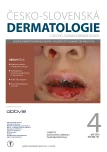
2026 Issue 4
Most read in this issue
- Reactive Infectious Mucocutaneous Eruption. Review
- Staphylococcal Scalded-Skin Syndrome in Newborns. Two Cases Report
- Zápis ze schůze výboru ČDS konané dne 30. 4. 2026 v Praze
- Laudatio na letošním kongresu v Olomouci